This is a story about May Day in Britain (and other places). This is a series of moments that brought us here. It is specific to the British context and the historical route we have taken to get here. It occasionally flicks around the world and strays away from the focus, but these are the moments that stand out to me as chalk markings through history bringing us here.
The purpose of the text is to remind and inspire. To remember what this day means and why action on it (and ever other day) is so vital. Resistance is an action.
I speak too briefly about each and every instance. I stole half the words and I don’t include a single damn citation as this is no academic text. I’m not trying to prove my case. Accept these stories or don’t. It’s up to you. If you don’t, research them. If I’m wrong, write a better bit. Tell your mates about the cool new thing you discovered. Give me a nudge and correct me.
I missed plenty, contact me with additions and I’ll add them.
This is a living document and is subject to changes, additionas, corrections.
– P
So lets start somewhere.
It is 1353, Walsham le Willows, workers tired of the conditions and taxes go on strike. They down tools, stop paying rent and tell the local Lord to fuck off. The Walsham Manor Strike is one of the earliest on record in Britain and acts as an precursor to a wave of self empowerment amongst the working class that would bring about open rebellion.
It is 30 May 1381, John Bampton MP comes to Brentwood to collect unpaid poll tax. Locals, organised and armed, tell him to jog on, when Bampton tried to arrest their representative, violence breaks out. It’s a 14th century de-arrest and it doesn’t stop there. Bampton bounced but several lackeys are killed. By the next day, the local villages are in uproar. The people rise up, prisons are opened, rebels gather and march upon London. Wat Tyler’s Rebellion has begun,
It is 14 June 1381, the workers are opening up Westminster prison and burning down government offices. Upon and down the land there are a plethora of rebellions and risings in solidarity. Every worker knows the toil they face and the realities of the system they face. The king is forced to treat with the rebels at Mile End, while he’s there the rebels take the Tower of London. They hunt down a number of hated authorities, some of the most powerful people in the land, taken them outside and execute the. Their heads were paraded around the city, before being affixed to London Bridge.
The next day Wat was murdered while treating with the King at Smithfield, the court records insisting it was Wat’s fault stating that he attacked the valet first. Court records have a tendency to have a certain way about them. They beheaded Wat and before the rebels could attack, they were pacified by either threat or promise we’ll never know, either way, shortly after the King had hundred strung up. A wave of suppression would follow, but the government didn’t try to impose the poll tax and alongside the French revolts the Harelle and Maillotin in 1382, the working class would of Western Europe set the timer on peace which would last a couple of dozen years. (albeit punctuated by the Welsh uprising of Owain ap Gruffydd)
It is 1619, Polish Workers in Jamestown Virginia strike. They want equality and suffrage. It is granted.
It is 1638, The first strike proper in the Americas when six fisherman on Richmond Island off the Maine coast walk out after not being paid for a year. They walked out of the settlement and started fishing for themselves. When the local authority tried to blacklist them, fellow workers rolled out in their defence. The company would start maintaining contracts and fines in response, of the workers little is known, Researcher James Phinney Baxter notes A few did well, two eventually went back to work for Winter, one was fined for profaning on the sabbath. At least one of them sued for his back wages and was awarded him one pound in return, some ten years later.
It is 1646, There is a lull in the Wars of the Three Kingdoms, The Levellers begin to organise across England. They call for popular sovereignty and equality. They begin to issue a manifesto, “An Agreement of the People”. This manifesto appealed to the rank and file of the New Model Army and became one of the two documents representive debated over during the Putney Debates, The other being the “Head of Proposals” a more moderate document.(Guess which the army choice to make the basis of their appeal to a constitutional settlement with the bastard?)
It is 1649, Gerrard Winstanley and 14 others published The True Levellers Standard Advanced, a radical break off they call for the reformation of society to localised agrarianism and common ownership. They take to cultivating on common land and are subsequently labelled the Diggers.
It is 1791, Carpenters in Philadelphia struck for a shorter work day of 10 hours. It is the first (documented) such strike in the building trades. The same year the cities shoemakers establish the first permanent union local.
It is 1794, the Federal Society of Journeyman Cordwainers formed. In 1806 A Philadelphia court declares the organisation of labour illegal after they stuck for higher wages.
“Eight leaders of the Federal Society of Journeymen Cordwainers were brought to trial and accused of conspiring to increase their pay rates after leading an unsuccessful strike for higher wages. The employers, not the government, paid the prosecution’s expenses. The arguments in Pullis promoted the idea ‘”that workers were transitory, irresponsible, and dangerous”, and were, thus, properly the subject of judicial control.” – Notes from Thomas Lloyd who attended proceedings.
Union organising would remain illegal in the America until 1842 .
It is 1811, English textile workers in the North begin to talk of Ned Ludd. They are pissed at the new machinery being forced upon them. They are concerned about labour being replaced, a drop in pay and a lower quality output. They are not anti-technology, but opposed to it’s weaponisation against the workers. They are conscious of how profits are being displaced, the bosses are taking home more, the workers less. They take to organised raids to smash machinery.
The government, serving it’s purpose of protecting capital, sends 12,000 troops to suppress the rebellion. Arrested Luddites are either executed or transported to the colonies.
It is 1816, Welshman Robert Owen has worked his way through management and after securing a stake in a Scottish mill has decided to show his benevolence. He reduces the working day from 11.75 hours to 10.75 at his New Lanark Mill.
Owen, is a capitalist and exploiter of working men, women, and children. He has discovered his bleeding heart and with all of compassion of any other liberal, began to write and and consider how with the benefaction of the wealthy, the working classes, might be less hideous.
Much like Friedrich Engels, who – According to Mike Dash of the Smithsonian, as part-owner of the Ermen & Engels mill, would receive a payouts from his 7.5 percent share, earning £263 in 1855 and as much as £1,080 in 1859 (around £175,000 today) – would live an affluent life while philosophising on the suffering of the less fortunate, Owen found himself the command of a enterprise and despite being quite happy to profit from the labour and suffering of the workforce, sought to improve them, not out of a sense of class consciousness of course but in pursuit of a happier more loyal subject and through the lens of paternalist moralism.
These men are not fellow workers. They are philosophers who seek to improve the lesser throng of slum dwellers. While Engels along with Marx would take a radical, revolutionary position on the elevation of the working class, the vast majority of would be socialists and Unionists, sort accommodation, compliance, and appeasement. They would not struggle to end the mechanisms of capital, with it’s hegemonic authority and individualist greed, but collaborate with the grinder for a softer, more palatable economic prison, one more reflective of good Christian morals.
These morals didn’t stop him working hundreds of children as young as five for up to 13-hour days, of course. Don’t you see, they were well fed, clothed, and homed. Nor did his morality stop him using a truck shop system to ensure what little he paid the thousands in his employ came back to him. No, in fact, because he only profited “a little” from this, it was actually a fantastic example of socialism and his ideas here would lay much of the foundation of the co-operative society, which would never develop into yet another crass manifestation of capitalism, but foster a genuinely socialist economy for the benefit of all, well especially him.
The following year working with Robert Peel (Then Chief Secretary for Ireland and generally quite distracted developing his colonial army of “Peelers”. Special Constables who set about letting the Irish know whose boss.) who also a cotton magnate to get a bill approved which would prohibit employment before the age of ten, to reduce hours of labour to 10.5 per day, and to require a minimal education before beginning work.
Owen would over time develop extensive theories around utopian socialist communities, Which would ultimately lead to several colonies and and communities being founded in the USA, Canada, UK and Ireland. Each of them failed. New Harmony, Indiana was the flag ship, founded and steered by himself. An open welcome which lead to people disconnected from the social ethos and lacking the socialist discipline to drive them, and antagonistic credit system that divided “workers” and “non-Workers” alongside an inability to exist in the insular autonomy desired set a ruinous path.
It is 16 August 1819, cavalrymen of the Manchester and Salford Yeomanry,ride over starving workers in St. Peter’s field, hacking away with their sabres are they do. They call it the Peterloo Massacre. Hundreds are injured. At least 18 die, the youngest of which wasn’t even born. The government command the police and courts to suppress the presses. Journalists are charged with sedition for reporting the infamy. Organisers are tried and sentenced. Seven are sentenced to hard labour. Two to be hung, Samuel Hayward managed to secure a reprieve on 2 April, his sentence reduced. Five days later Thomas Palin is executed. There is a general crack down on labour organising.
It is 2 February 1821, cavalrymen of the South Shropshire Yeomanry, open fire at striking workers of the Coalbrookdale Coalfield when they refuse to disperse. They call it the Cinderloo Uprising. How many are injured isn’t recorded. Two miners are slain. Organisers are tried and sentenced. Seven are sentenced to hard labour. Two to be hung, Samuel Hayward managed to secure a reprieve on 2 April, his sentence reduced. Five days later Thomas Palin is executed. There is a general crack down on reformist organising.
It is 1822, James Straighter, a convict shepard in Australia is was sentenced to 500 lashes, one months solitary confinement and five years penal servitude for ‘inciting his Master’s servants to combine for the purposes of obliging him to raise the wages and increase the rations’.
It is 1825, 600 House Carpenters in Boston appeal for shorter working hours with no reduction in pay. Their masters are incredulous, didn’t they know that when they become Masters, they’ll be wanting the Journeymen to work all day for them too?
It is 1 May 1828, William King founds a monthly periodical “The Co-operator”, in which he develops upon the failed ideas of Owen. King’s ideas were less about establishing new communities and decidedly in favour of building mutual societies in our communities. Since everyone in a town went to the shop, shouldn’t it be owned by the townspeople. He was ardently opposed the the radical position against capitalism, but sought a social order which allowed for community self organising with it. He would close the paper two years later and distance himself from the movement as it came to harm his processional reputation, none the less, his ideas would be deeply influential to the subsequently ideas of the co-operative movement and later The settlement movement (a similarly reformist notion from our betters in which the middle class and working class would live together and through the power of friendship, magic, and social servitude, the workers lot would be improved.
These movements would by the mid-1900’s almost entirely end up as small bastions of a solidarity economy, a place where middle class people could feel rebellious, speak of the working class, liberalise their movements and get to sniff their own farts as they kept hold of the social resources, physical space, and logistical might. Like the adjacent Charity and NGO sectors, they operate for the benefit of an educated moral elite and present absolutely zero threat to the existence of state and capital. They drip feed funding and material to those who fill out forms with the correct platitudes or who knew the right neoplastic “third sector” influencer. They are the acceptable face of social conscience and the channel in which countless corporations and affluent parasites launder their conscience tho.
It is 1830, In the proceeding 60 years, about 6 million acres (24,000km2) of common land were enclosed. The common land is stolen from the common people, leaving them landless as large land owners (who they are now dependant on) treat them as entirely disposable. Across the South and East of England this is absolutely devastating to the agricultural workers. The moment they could, landowners started replacing workers with threshing machines. The workers in turn started smashing them to pieces. Well, first they would generally write a nice letter informing the local lord that if he didn’t get rid of the machines right quick, they’d be wrecked. Often signing of with Captain Swing or just Swing.
The result was hundreds of small scale, focused, “riots”. Barns were burnt, Wheelhouses trashed, Threshing machines smashed up.
Only one person is killed in all of the “Swing Riots”, and that was a worker who was shot. However the state, ever protective of capital decided to send a message. Nearly 2,000 are put on trial, 252 were sentenced to death, 644 were imprisoned and 481 were transported to penal colonies in Australia.
It is 21 August 1831, after a decade of organising, Nat Turner leads a rebellion in Southampton County, Virginia. Over four days they scoured the region, liberating slaves and murdering white slave masters and their families as they went, killing between 50-70. In response militia and mobs commit atrocities. Blacks suspected of participating in the rebellion were beheaded by militia, and their severed heads were mounted on poles at crossroads. The violence spreads wide beyond the are of the rebellion with numerous militias and mobs massacring black communities either out of fear or reprisal. Nat is later caught, tried and executed in November. His body is dissected and flayed. It is said that his skin was used to make souvenir purses, and bits of his body kept as mementos.
Slave-holding states enacted legal restrictions on their black populations. Abolitionist materials are criminalised as are gatherings, Black communities can no longer hold religious services without a white minister present.
It is 21 November 1831, It has been a year since the July Revolution. King Louis-Philippe sits on the throne. Very little has changed for the working class. Hundreds of silk workers (Canuts) march through the commune of Croix-Rousse Lyon. The price of silk has dropped and they are not being paid for their labours. They force others to down tools, and fight National Guard who attempt to stop them, erect a barricade and fly the black flag.
It is the first time it is flown.
It marks the nullification of the nation.
It is a symbol of the people.
The following day they take the police barracks at Bon-Pasteur, the National and Military guard try to put an end to it but are forced into retreat by a barrage stones, tiles and musket fire. Many in the National Guard decide to join them, fellow workers silk workers or have family who are, together they fight off the military, ultimately taking the town.
100 dead, 263 injured on the military side.
69 dead, 140 injured on the civilian side.
They did not fight for any political purpose, but for the fair price for their labour.
On the 25th 20,000 soldiers are sent retake Lyon which they do so on the 3rd of December, constructing a permanent fort to cut the commune of Croix-Rousse and Lyon asunder.
90 workers were arrested, 11 of whom were prosecuted and acquitted in June 1832.
It is 1833, Some 60,000 slaves in Jamaica revolt, they are lead by Samuel Sharpe, they demand more freedom and better pay. They damage property, the British Army enlist Jamaica Maroons to do their fighting for them, they are eventually successful are suppressing the revolt. During the revolt 207 rebels and 14 whites are killed.
In reprisal the British execute over 300 ring leaders and white mobs terrorise black communities and vandalise churches. The act is seen as horrific by the British back home who are undergoing a period of mild empathy for other humans which they call “The enlightenment” in which they displace they horrific brutality visited upon the British poor and Empire’s subjects a like, with acts of philanthropy. The political winds shift towards abolition and liberty for the enslaved, well provided the capitalists are paid for their loss, and the former slaves are now essentially indentured servants trapped in economic snares.
It is February 1834, Owen returns from the states, his utopian dreams a failure, He declares the need for a guild-based system of co-operative production, cause thats just the type of shit you can do when you’re an industrialist. This is first general union of all trades, the Grand National Consolidated Trades Union, he has the aim of achieving an 8-hour working day.
In Tolpuddle, a group of labourers form the Friendly Society of Agricultural Labourers to combat a wage cut that left them brassic. George Loveless is their defact leader and he becomes the focus of the states ire. Six are tried for having made an “unlawful Oath” and are transported to Australia.
Torn over how to respond, whether to act as a liberal political body advocating kinship between worker and boss, or as an organised force of labour, something actually meaningful. They steer towards the former, Owen is made Grand Master. The confederation falls apart and is defunct by the end of the year.
It is 4 November 1839, thousands of Chartists march in Newport. They want democracy and the right to vote. It is three years since a meeting of the Carmarthen Working Men’s Association, gave birth to the movement. They are in good cheer despite the rain and delays, their demands reasonable, their manner civil. Their aim is to release the detained at imprisoned at the Westgate Hotel. A column was headed by John Frost, a prominent leader in the movement, from the West, Zephaniah Williams led a column from Blackwood to the north west and William Jones led a column from Pontypool to the north.
They are met by the 45th Regiment of Foot along with an army of specials who open fire into the crowd. a fire fight and melee breaks out before the Chartists flee. They murder two dozen and injury scores more. The Mayor, two of the specials and two soldiers are inured, including one lucky bastard who took six slugs to the head.
200 or more Chartists were arrested for being involved and twenty-one were charged with high treason, sentenced to death, they are eventually given clemency and deported as convict labour.
Queen Vic knights the Mayor.
A 35 Meter mosaic mural, an artwork of some 200,000 tile and glass pieces, is erected in 1978 in a underpass connecting to John Frost Square. It is the work of Kenneth Budd , it is beautiful and tells the story of that day across it’s span. It becomes a pilgrimage spot for Labour historians. In the Early 2000’s the Labour council wants to redevelop the city centre. They stop maintaining the assets they are keen to remove. In 2007 they remove the panel with introduces the pieces and remembers the fallen. They begin to talk destruction. In 2013, campaigns to save the mural are ignored or rebuffed. It wont be preserved as the structure it is attached to is in poor keeping, it’ll cost too much to remove or even remake. A demonstration is planned to try and save it, two days before the gathering the order is given and it is destroyed by construction workers.
It is 1842, Economic depression and a wave of hungry fill Britain and Ireland with suffering. There is a wave of strikes and riots. Chartism as a movement is torn by working class militancy and the gentrified appeal to social wellbeing from a variety of merchant elite and politicians. The workers of Sheffield and Bradford suffer the brunt of it as their attempts to rise are squashed. The movement is subsequently hollowed out by co-operative schemes and liberal petitions for the states benevolence. In May 1842, a second petition, of over three million signatures, was submitted, and was yet again rejected by Parliament, the subsequent decade sees a varity of projects and schemes gifted from our betters to appease the masses and improve them. None of which amounts to much.
John Frost is pardoned in 1856, returning to Britain with great cheer from the people. He moves to Stapleton in Bristol. Two years later the final National Convention of Chartists is held. It’s attended by only a handful of delegates.
It is 21 April 1856, stonemasons in Melbourne downed tools and walked off the job in protest over their employers’ refusal to accept their demands for reduced working hours. Around the world Labour have a shared call. An 8-hour work day.
It is 1863, Stalybridge, a small town on the outskirts of Manchester is put to the sword. It is a satellite town, where the waves of Irish immigrants have been dumped to toil away in endless mills tramped in company towns and micosms of filth and suffering. It is the third year of the Lancashire Cotton Famine caused by over saturation of the textile market and an interruption in imports due to the American Civil War. Just 5 of the 64 local mills are operating. 7000 locals are unemployed. Starving. The executive committee of the Poor Law in Manchester has just cut their relief funding, of the pittance left, much of it was in vouchers which could only be exchanged at certain shops and clothing handed out thusly was marked, a brand of your poverty. A poverty overwhelmingly inflicted on the Irish immigrant labour force. Disorder breaks out, local police go for their Cutlasses and a troppof Hussars from Manchester are sent to suppress the mob.
It is December 1865, the Thirteenth Amendment to the U.S. Constitution is ratified, finishing the work of The Emancipation Proclamation by abolishing chattel slavery across the USA. 3.5 Million former slaves enter the free market. Black labour is immediately exploited. As W.E.B. Du Bois wrote, the “slave went free; stood a brief moment in the sun; then moved back again toward slavery.”
It is September 1866, the1st General Congress of the International Workingmen’s Association, is held in Geneva. They take up the demand for an eight-hour day, declaring “The legal limitation of the working day is a preliminary condition without which all further attempts at improvements and emancipation of the working class must prove abortive” and and “The Congress proposes eight hours as the legal limit of the working day”.
It is 1867, The Labour movement in Chicago fought for and won the 8-hour day, a simple reform that meant thousands would gain a marginally improved life, a life with a little breathing room, space to exist. The lingering pain of the Civil War, and the Long depression hung over the relatively young city as it burst into industrialisation fuels as much by political corruption as it was is vast workforce of multiethnic (tho predominately German) émigré labour. Fourteen hour days were the norm and men, women, and children alike spent entire lives trapped horrific work conditions for a pittance. Now they might have a few moments to exist.
It was, however a hollow victory, one in name only.
The Illinois legislature wrote in a loophole which allowed for employers to contract out further work hours. Ultimately all that changed was workers paid by the day, were now paid by the hour. Nothing changed, only added insecurity.
The 8-hour day has been a common front for labour disputes in the USA for a hundred years, there have been victories and failures in it’s pursuit, but now this is the first time such an appeal has been made. Through the 1820’s the work day had been reduced from 12 to 10 hours, by the 1860’s the labour movement had consolidated itself so that across the board they argued for an 8 hour day, seeing some partial concessions in various cities and industries.
It is 1 May 1867, workers in Chicago went on strike for an 8-hour day proper. For a week they were out and closed most of the city down. The response by the state was violence and oppression, in the media, demonisation. Liberal politicians and reformists attacked their revolutionary peers for their radicalism and socialist ethos. How could the situation of the workers be improved when you in actually want to destroy capitalism and American vision? No wonder the crack down was so violent.
It is December 1869, 214 delegates attended the “Colored” National Labor Union convention in Washington, D.C. This union was a counterpart to the white National Labor Union. It is organised by a Caulker from Baltimore, Isaac Myers. He is elected it’s first president.
Racial divisions remain deeply entrenched. The bosses weaponise black communities as cheap labour against the émigré and American labour pools. The National Labor Union (NLU), despite making gestures towards the black worker and expectant of class solidarity in disputes, remains segregated. As much out of the memberships racism as it is their political aims. White organisers focused on establishing political power for the class and bringing about economic reform, and black workers were more concerned with the ability to own property and be treated a equals in economic, social, and political terms.
The assembly send a petition to Congress requesting direct intervention in alleviating the “condition of the colored workers of the Southern States” by subdividing the public lands of the South into farmland and providing low-interest loans to black farmers.
Frederick Douglass became the president in 1971 and by the following year they had dissolved in a schism over the transition into being a mear political body and disengaging with trade union activity.
It is 1884, the convention of Federation of Organized Trades and Labor Unions (soon to become the American Federation of Labor) and the three year old organisation has a plan to bolster their numbers and reputation. One of the 18 delegates gathered,Peter J. McGuire, Vice-President of the Federation and leader of the United Brotherhood of Carpenters and Joiners of America, lays out plan, and the resolution if decreed.
“Eight hours shall constitute a legal day’s labor from and after May 1, 1886.”
By the 1870 and into 1880’s it was a core demand of every union, liberal and radical. Even Anarchists appeal to this meaningful reform and the call is punctuated in Union pamphlets and Anarchist papers. They are under no illusion that reformism will liberate the working class from beneath the heel of the their lazy parasitic masters, they simply identify it as a cause célèbre that will bring real change to societies most down trodden and stab at the heart of the industrial leviathan. Even the rival outfit The Knights of Labor, whose leadership where opposed to socialism and radical politics, could not refuse to part take it. The rank and file of the much larger organisation were in absolute agreement here, the cry is clear “Eight-hour day with no cut in pay”.
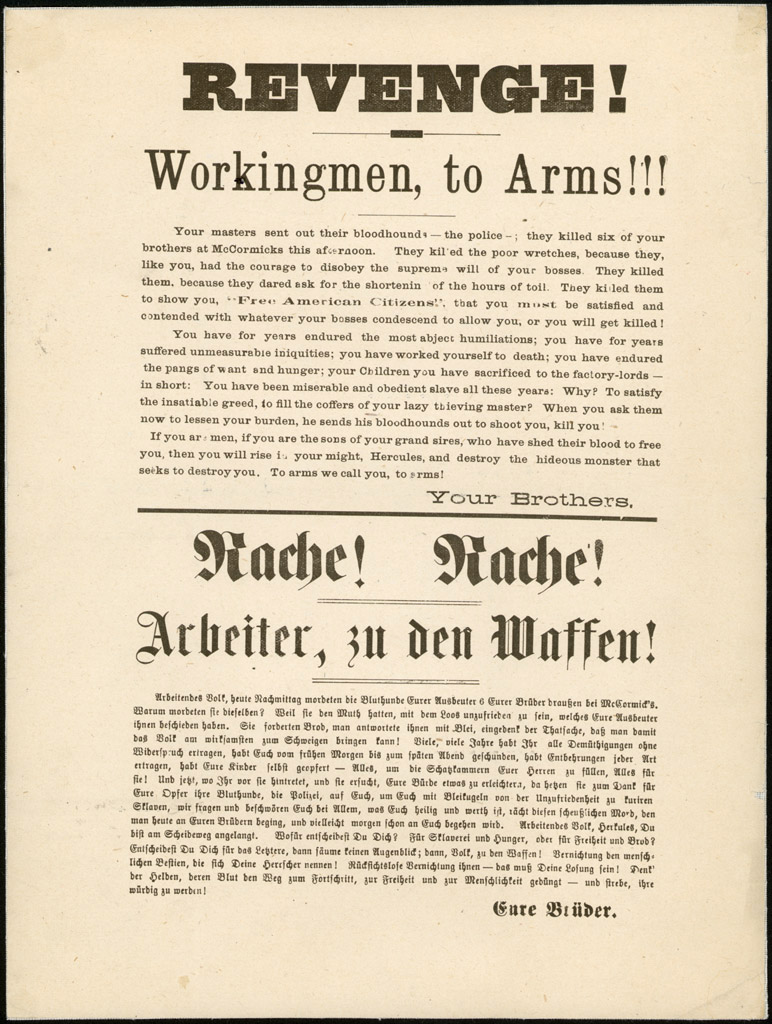
It is 1 May 1886, Albert Parsons, founder of the International Working People’s Association, Marches 80,000 people down Michigan Avenue in Chicago. It is a day struggle and solidarity. Tens of thousands more march in cities across America. Hundreds of factories shut down as countless workers down tools. It is a political broad labour movement, Anarchist and Socialist orators and organisers feature prominently and have worked for months and months to help organise their fellow workers into action.
Two days later August Spies, Editor of Arbeiter-Zeitung (“Workers’ Newspaper”) is speaking outside the gates of the McCormick Harvesting Machine Company plant on the West Side of Chicago, it’s whistle blows and scabs attempt to leave the gates. They are rush, police defned them with horrific brutality leading to death and injury that outrages the anarchists. The next day fliers went out across the city. It spoke of six deaths and laid the blame on the doorstep of the bosses.
Despite the hostile tone of the flyer, the gathering was not that of the mob but of fellow workers. The speakers spoke for up to an hour telling the few hundred gathered what had happened and how they believe together they can organise against the corporate and government might. They came to the Haymarket to hear the anarchists talk. There were no pick handles, no torches, no pitch forks, or guns in hand. Around 10:30pm, the weather turning, people are starting to leave as the last speaker was wrapping up, when the riot line of police rocked up and demanded that the gathered disperse.
Suddenly a bomb is tossed, is goes of with a terrific thunder and the police started shooting. According the historian Paul Avrich, most sources suggest it was the police who opened the volley and even took time to reload and fire again. Atleast 70 were injured, four people die as did seven cops (and one would die a year later due to his injuries) after five minutes of chaos, only the injured were left in the square.
According to one police officer “A very large number of the police were wounded by each other’s revolvers. … It was every man for himself, and while some got two or three squares away, the rest emptied their revolvers, mainly into each other.” The stitch up started immediately.
The paper spewed nonsense “Rioting and Bloodshed in the Streets of Chicago” and blamed anarchists who were not even present. Police rounded up every organiser they could. Trade unions and liberal organisers quickly distance themselves from the Anarchists and the narrative was set in stone, the first “red scare” a massive success.
It is 21 June 1886, The trials are a farce, their so called legal processes ignored in favour of hysteria and political suppression. The arrested men claimed to know nothing about the bomb throwing. Some even openly condemned the act.
The defendants are:
August Spies
August Spies was born in Germany and emigrated to Chicago in 1872. A leading member of the International Working People’s Association, he edited the German-language anarchist paper Arbeiter-Zeitung. Spies was a brilliant writer, in both German and English. On May 1, 1886, several days before the rally at Haymarket, Spies led a parade of 80,000 workers up Michigan Avenue as part of the national strike for an eight-hour work day.
Spies was the first speaker at the Haymarket rally and left before its fiery conclusion. He was convicted with the other seven accused, and hanged in 1887. His final words inspired unionists and anarchists alike: “The day will come when our silence will be more powerful than the voices you are throttling today.”
Albert Parsons
Albert Parsons, a former Confederate soldier who moved to Chicago in 1873, worked as a typesetter for the Chicago Tribune before being fired for speaking against capitalism. After that, he worked as a printer, primarily for radical and labor causes. He was a member of the moderate Knights of Labor organization and a founding member of the syndicalist Central Labor Union. Parsons counted August Spies as a close ally, and edited the English language counterpart to Arbeiter-Zeitung, The Alarm.
Spies recruited him at the last minute to speak at the Haymarket rally. Parsons addressed the crowd for nearly an hour and left before the bomb exploded. He fled Chicago after arrests were made for the bombing, but returned voluntarily for trial. He was hanged in 1887, declaring in his final words, “Let the voice of the people be heard!”
George Engel
George Engel was born in Germany and relocated to Chicago in 1874. An unwavering critic of authority and capitalism, Engel lost faith in the political process and joined the International Working People’s Association. “Can anyone feel any respect for a government that accords rights only to the privileged classes, and none to the workers?” he once wrote.
Engel was at home playing cards at the time of the explosion. He was convicted and hanged in 1887.
Adolph Fischer
Adolph Fischer was born in Germany and moved to Chicago in 1883. An extreme anarchist, Fischer worked as typesetter for the Arbeiter-Zeitung and co-edited the journal, Der Anarchist. He supervised the printing of the broadside announcing the Haymarket rally and inserted the line, “Workingmen Arm Yourselves and Appear in Full Force.” August Spies convinced Fischer to remove the line.
Fischer attended the Haymarket rally but departed before the ending events. He was arrested, convicted and sentenced to death by hanging. His last words before execution were, “Hurray for Anarchy! This is the happiest moment of my life!”
Louis Lingg
Louis Lingg was born in Germany and emigrated to Chicago in 1885, drawn to its strong anarchy movement. Lingg was an organizer for Chicago’s Carpenters’ Union and a representing delegate for the Central Labor Union.
Lingg bristled at the violence used by police during labor conflicts and stated, “if they use cannons against us, we shall use dynamite against them.” He regularly practiced with a rifle and learned how to create dynamite and assemble bombs. Lingg used this skill to commit suicide in jail by detonating a bomb in his mouth, the day before his scheduled execution. He died some days later.
Michael Schwab
Michael Schwab was born in Germany and came to Chicago in 1881 or 1882. He once wrote, “Violence is one thing and Anarchy is another… we advocated the use of violence against violence, but against violence only, as a necessary means of defense.”
Schwab attended the Haymarket rally briefly, but left to speak at another rally. Still, he was arrested and sentenced to life in prison. He served seven years before Governor John Peter Altgeld commuted his sentence in 1893.
Oscar Neebe
Born in New York and raised in Germany, Oscar Neebe came to Chicago in 1875. A declared communist, Neebe organized labor demonstrations and anarchist social events in the Chicago area.
An avid reader, Neebe once wrote, “We socialists are great believers that the laboring men should educate themselves.” Neebe did not attend the Haymarket rally. He was convicted and sentenced to 15 years in prison. In his autobiography, Neebe wrote of his suspicion that a brewing company whose workers he had organized paid officials to secure his conviction. Governor Altgeld pardoned and released Neebe in 1893, after he had served seven years of his sentence.
Samuel Fielden
Samuel Fielden was born in England and settled in Chicago in 1871. He joined the International Working People’s Association in 1884 and became a popular speaker, using orating skills he had developed in the Methodist church.
Fielden was the final speaker at the Haymarket Rally. When Police Captain Bonfield advanced with his troops to bring an end to the rally, Fielden briefly protested before he stepped down from the makeshift stage. At the same time, the bomb was thrown. Fielden was wounded in the knee during the chaos that followed. He was arrested and sentenced to death. Following an appeal for clemency, Governor Oglesby reduced the sentence to life in prison. In 1893 Governor Altgeld absolved Fielden and he was released.
It is 10 November, In his cell Lingg, decides to save the executioner the bother and blows half his face off with a blasting cap. He lived for some six hours before finally passing.
He wrote “Hoch die anarchie!” (Hurrah for anarchy!) on the cell stones in his own blood.
It is 11 November 1877, Engel, Fischer, Spies, and Parsons are marched out before the gathered spectators and hung.
Spies could be heard saying, “The time will come when our silence will be more powerful than the voices you strangle today.” Fisher announced, “This is the happiest day of my life!” Engel shouted “Long live anarchy!” Parsons was still speaking –“Harken to the voice of the people”– when the axe swung cutting the rope and the trapdoors opened, the four men fell.
In Rochester, New York, a 17-year-old immigrant named Emma Goldman read the news from Chicago. She said what she called the “martyr’s ordeal” implanted “something new and wonderful in my soul.” She called the execution date the date of her “spiritual birth.”
In Chicago, Illonois, Mary Harris Jones, a widowed dressmaker, declared that the executed defendants were soldiers who sacrificed their lives for workers. Mother Jones, as she came to be called, later referred to the Haymarket trial as the the “days of martyrs and saints.”
In Rebel Creek, Nevada, a young Bill Haywood called the Chicago trial the turning point of his life. Haywood would go on to found the IWW, the Industrial Workers of the World.
Neebe, Schwab and Fielden served six years of their sentences before being pardoned in 1893 by Governor John P. Altgeld, elected with labour backing, who sacrificed a promising political career to right what he viewed as a judicial wrong.
It is 1888, 1,400 matchgirls, (predominately Irish between the ages of 13 and 20) walk out after management dismiss a fellow worker. It is the last straw. 14 hour days, horrific conditions, the severe health complications of working with dangerous chemicals (particularly White Phosphorus), the sweating system used for the box makers, and ultimately the deeply disinterested bosses. The Bryant & May match factory is shut down. Sarah Chapman leads the strike and is assisted in negations and medias by Annie Besant
Bryant &May, were terrified of bad press harming their reputation and capital. The strike evolves into a labour dispute proper and two weeks later it is concluded, an overwhelming successful and results in the foundation of the Union of Women Matchmakers, it’s the largest union of women and girls in the country.
The women and girls go back to work with marginally better conditions, still using White Phosphorus for another two years. A hundred and thirty years later they start naming stuff after Sarah Chapman.
It is 1 May 1895, Max Nettlau shares an anarchist manifesto. In it he calls for a fraternity across nation and race, he denounces the British police and their abuse of “friendless foreign refugees” and warns British peoples that their liberties are are next.
This weeks issue of The Clarian features a relief print by Walter Crane, It is called “A Garland for May Day 1895”. While not an anarchist himself, Crane, a friend of William Morris and member of the SDF, often leads his artistic talents to Anarchist publications, he is particularly taken with solidarity with the Haymarket Martyrs. This image would come to define May Day for generations, weaving naturalistic imagery and environmentalism with Anarchism and the labour movement.
It is 1897, Errico Malatesta writes over the April – May span. He laments how the day how gone from one of resistance, of striking workers squaring of with their bosses, to a holiday, a petty decadence, a day off to get drunk and to thank the boss for. He snipes at the democratic socialists who appeal to the electoral with such anodyne reforms.
“Right from the outset they strove to turn the workers’ strike into a labor holiday, mounted, if possible, with the assent of the masters, and they so far as to want governments to declare it an official and mandatory holiday—and they are now carrying on in the same vein.”
Ever his way, he remains hopeful for the workers of tomorrow.
“Anyway, people won’t accept our ideas in one fell swoop, and society won’t switch abruptly and without transition from today’s hell to the paradise which we yearn.
Every step taken is a real advantage, provided it is a step in the right direction, which is to say, as long as it is a step in the direction of the abolition of authority and private property and as long it nurtures the spirit and practice of free and voluntary cooperation in the workers.”
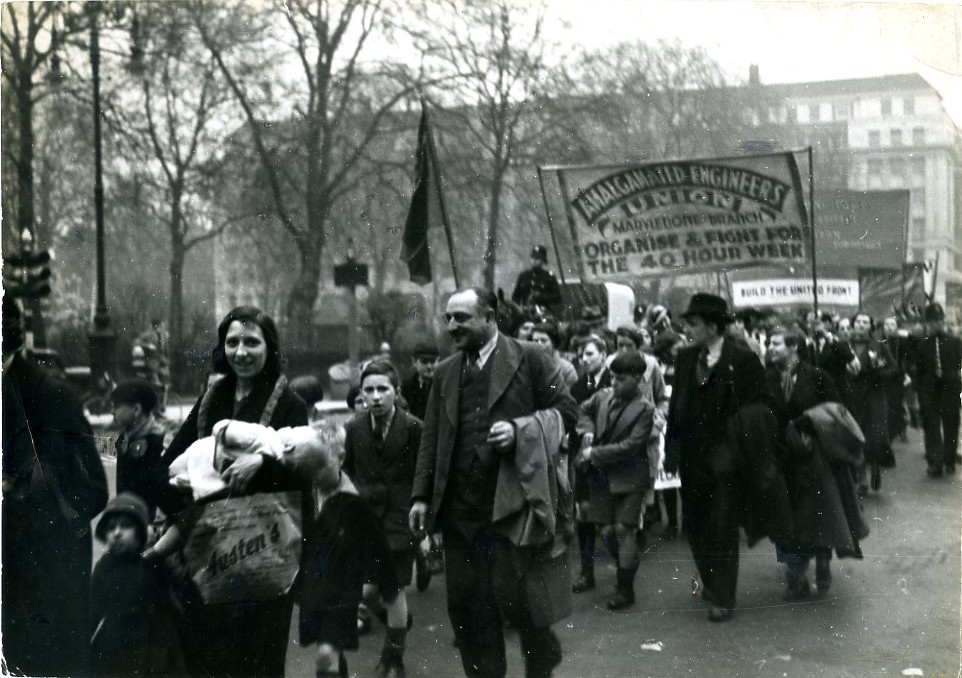
It is 4 May 1890, the first Sunday of May sees the first May Day protests in Britain in Hyde Park. 300,000 “New Unionists”, Anarchists, Socialists and just average folk gather. The band of the North Camberwell Radical Club leads proceedings, a key demand: ‘8 Hours’ work, 8 Hours Pay, 8 Hours rest for 8 bob a day’. Dockers marched in their rough working clothes next to the aristocracy of labour, the “gentlemen comps” in kid gloves and top hats. British workers proclaimed their organisation as a class, skilled and unskilled united.
It is 1 May 1918, led by the Clyde Workers’ Committee and William Gallacher, 100,000 marched to Duke Street Prison, shouting “Release John Maclean” the advocate of Irish independence and revolutionary fighter against the imperialist war. He has been detained on11 charges of attempting to cause mutiny, sedition and disaffection. Later in the month in an Edinburgh courthouse he’d declare:
“I am not here as the accused, I am here as the accuser of capitalism, dripping with blood from head to foot”.
He was sentenced to five years penal servitude tho the government is barraged with popular resentment and in December 1918, shortly after the signing of the armistice.
Maclean refused the ‘free pardon’ by the King, telling the Under-Secretary of State for Scotland that the workers who had campaigned on his behalf had earned him his freedom and not the King.
It is 3 May 1926 one minute to midnight, after failed talks, the General Strike 1926 begins.the General Council of the Trades Union Congress (TUC) have called for the action in opposition to wage reductions and poor conditions. Some 1.5/7 million workers strike, especially in transport and heavy industry. By the 12May, The workers are undermined and betrayed by TUC leadership and the labour party. Once again capitulation takes precedence over the workers struggle or that of class. A few unions stay out, standing alone, until they too are forced back to work. The Miners in particular are torn a part by these two tides.
It is 1938, the Fair Labor Standards Act is signed into law, it establishes amongst other things a base line of for the eight hour day alongside a minimum wage. Like many aspects of liberal reform, the “right” is a granted by the state and it was won with the representative democratic voice. This is a lie, it was forced upon them with innumerable strike actions large and small, acts of resistance and rebellion, campaigns peaceful and violence and the bodies of all to many that they killed to suppress even this tacit concession to conscience.
It is 2 May 1949, Political processions are banned by the home secretary.
Thousands of workers, mostly trade unionists gather in Trafalgar square gathered for an assembly of the London Trade’s Council, they seek to consume the history of May Day, establish it a benign and toothless appeal for a softer whip. As the Communist march down The Strand towards the assembly, mounted police attack. An hour long scuffle ensues.. 21 are arrested. Few from the official gathering stand up for their fellow workers cum agitators and radicals.
Pathe report “What a waste of a lovely spring day”
Later in the evening Oswald Mosley gives a speech in Dalston. Several thousand fascists are accosted by anti-fascists, A large force of mounted and foot police protect them.
Communists, the new enemy are attacked in Yorkshire as they hold a meeting.
It is 1884, Tom Mann of the Social Democratic Federation (SDF) and publishes a pamphlet calling for the working day to be limited to eight hours. He founds the Eight Hour League, which successfully pressured the Trades Union Congress (TUC) to adopt the eight-hour day as a key goal.
The British Fabian socialist economist Sidney Webb and the scholar Harold Cox co-wrote a book supporting the “Eight Hours Movement” in Britain
It is 1912, “The IWW is urging the workers to set aside the first of May, 1912 to demand of the master class an eight-hour working day. A few days later they help to organise the New York City Waiters’ Strike alongside the Hotel Workers’ International Union. 54 hotels and 30 restaurants and other establishments without their staff. This amounted to 2,500 waiters, 1,000 cooks, and 3,000 other striking hotel workers. The bosses employed students and black labour to undermine the strikers and through June the police would often attack strikers, encouraging those who had returned to work to stay in their place. The strike would ultimately fail but the campaigns would continue on with regular strikes through-out the next decade and into the 30’s.
In Britain, the first May Day protests following the international call coincided with the heights of New Unionism, when huge numbers of workers demanded better working conditions. In Gallery One of the museum we tell the story of New Unionism, a movement that began with the Match Girls’ Strike in 1888 and sparked waves of strikes and mass unionisation among workers who had previously been ignored by the more respectable, almost exclusively male, craft unions. In the museum’s archive you can see drawings of the first May Day protests in Britain in Hyde Park where these new unionist workers flocked, 300,000 in 1890 demanding the eight hour day. Along with Engels, the socialist Eleanor Marx is on the platform, and in her speech to the crowd she proclaimed: ‘We have not come to do the work of political parties, but we have come here in the cause of labour, in its own defence, to demand its own rights’. Quoting Shelley, Eleanor Marx ended her speech with the famous ‘Ye are many they are few’.
It is 1918, The Bolsheviks have secured the Russian Revolution. They how it’s first legal parade. The people still believe it is a struggle of the workers, that the revolution will bring liberty from economic and political masters. The day is now a public holiday in Russia.
The name and purposes have changed over the decades on the whims of the state. For a decade or two it was Labor Day then the Soviet leaders decided to make May 1 a celebration “for internal use” — highlighting the achievements of the CPSU and glorifying its leaders came to the fore.
It is 1976, Michael Foot as Employment Minister and leader of the house had introduced the anodyne reform. The 1st of May will now become a Bank Holiday. You can thank Cheers are given for John Lubbock, the first Baron of Avebury for inventing them with the Bank Holidays Act of 1871 – a day for the Banks, not the people albeit gradually bit by bit taken up by various industries.
It is 1 May 1978, the first official (and mandatory) May Day Bank Holiday to take place in the UK. Labour have turn the workers’ strike into a labour holiday, mounted with the assent of the masters, and they so far as to want governments to declare it an official and mandatory holiday. A few Tories work the weekend in protest, St George flags are flew at half mast. Wolverhampton teacher Sheila Jack turned up for work as usual and stood outside her closed school in silent protest for an hour, telling newspaper reporters: ‘I do not believe I should have to take a day off work to celebrate a pagan festival’.
In London, a few thousand unionists have a walk listening to the same old Brass Band. Interviewed on the march, a soaked Jo Richardson declared: ‘It’s an extra holiday we all deserve.’
Most of the working class cheer for a long weekend and get plastered, Cheers boss.
West Midland Safari Park reported one of its best weekends ever
It was the wettest 1 May since records began.
There isn’t a single strike.
It is 1982, weeks after the British victory in the Falklands War and a Royal birth, a parliamentary bill was voted on to abolish the May Day Bank Holiday and for a new Bank Holiday to be selected more ‘in keeping with the traditions of England than the workers’ jamboree’ as the Robert Atkins Conservative MP for Preston North, who was moving the bill, put it. He fancies 23 April as Shakepheres birthday and also the day St George’s martyrdom of St George. Ayes 125, Noes 148
It is 1 may 1987, in the Berlin district of Kreuzberg, Anarchists, squatters and autonomist gather. They have little interest in the empty promises of the establishment trade unions. The police decided to put them supress the people. They fail. Instead they are forced into a pitched battle which sees them retreat from the area. They return refreshed in the early hours with riot vehicles and water canons. Over 100 people were injured and 47 people were arrested.
Each year since, revolutionists gather for “May Day in Kreuzberg” for years after. The government respond with police violence and “official festivals”, they continue into the 2000’s.
It is 1 May 1990, for the last time in the history of the Soviet Union an official May Day
demonstration was held.
It is 1 May 1991, it is for the first time trade unions rather than the Communist Party. It becomes a rally against price increases, held on Red Square, 10,000 gather in Red Square.
It is 1 May 1992, now “the Holiday of Spring and Labor.” It is now more likely to see parades of patriots than it is organised labour, traditionalist ecology and military might are the new tones. What once decorated the front pages is now given a few inches inside.
It is 1 May 1999, Anarchist band Atari Teenage Riot are on a flatbed. They play for the crowd of thousands organised by Anti-fascists. “FIGHT FIGHT FIGHT, DON’T TAKE IT” Alec Empire screams down the mic as riot police brutally attack the gathered.
It is 1 May 2000, In the UK a couple of dozen anarchists from across the milleu have collectively decided to make it a bit of a thing, “M2K” started cooking in June the previous year. Four days of events and action over the weekend are planned, they call it “A Festival of Anti Capitalist Ideas and Action”.
“ A room full of people from Class War, Anarchist Federation, Solidarity Federation, RTS, Earth First!, Haringey Solidarity Group, West London Anarchists & Radicals, London Animal Action, and all the others could have been the recipe for a blood bath.”
Somehow they managed to make it all work and on the day, make it all happen.
The police were out in force, at first keeping it to low level, but open intimidation but that keep their cool as the anarchists gather, chat, cavort, argue, organise. Until Monday. On Monday they get violent and start bashing heads. Anarchists give is some back and the medias have nothing but “Rioting anarchists!” headlines for the next week. 30 are arrested in London. 20 are arrested in Manchester, during adjacent action, which given there were only a couple of hundred is pretty heavy numbers.
It is 1 May 2009, It’s Mayday! Mayday! In Brighton, and 2000 people party as part of the Smash EDO campaign. It’s a carnival atmosphere as they meander along brightons streets, only stopping to by the Army Recruitment office to redecorate it spray paint and red paint. As an Indymedia user recounts:
“The first arrest came with someone seized for ‘assault’ as the police, despite their large numbers, failed to contain the more dispersed groups and became increasingly aggressive, resorting at one point to baton-charging the reduced crowd. The crowd continued to evade police attempts to kettle them in and even managed to kettle the police at one point on Traflagar Street. The crowd split into two as one part headed for the sea with the other settling on the green outside St Peters Church on London Rd. After a rest this part started off for the seafront as the crowd joined again briefly with the police in hot pursuit. A cat-and-mouse chase through the Pavilion Gardens and historic Lanes part of the town ensued as bemused daytrippers and tourists looked on. The police lashed out with one woman collapsing after being batoned in the kidneys and another being knocked off her bike. Many peoples’ legs were batoned. At least 30 protesters suffered injuries. That evening windows were smashed at RBS and HSBC.”
I’m a baby anarchist and don’t know about events in Brighton.
Instead I find myself with a queer insurrectionary anarchist and a nihilistic krusty punk. We’re three black flags in an ocean of red. It just happens that a film crew from tiger aspect recognises me from an earlier protest and latches onto me. The are doing a show reel for Ross Kemp’s “Summer of Discontent” (it never comes out). One of the various factions of Tankie are lined up before us, all with matching flags and outfits, red shirts and khaki trousers, bless ’em.
They give us dirty and try to capture the film crews attention. They are ignored, three boisterous anarchists smoking cigs and having a laugh at more interesting, they are keen for us to do “Anarchist shit” but we just ignore them and crack on. Weathers nice.
We tag along to Trafalgar Square and they start doing speeches, it’s mind numbingly boring. The same old waffle and insistance that NOW! Is the most important moment to act. Only none of them act, not a single one of them does a damn thing but listen to speeches and bails home before traffic gets bad.
Meanwhile we go for a mooch down white hall and three riot vans pause to toss us up against the wall when I blow a kiss at them. It’s my first May day and near my last. I don’t return to London until March 26th 2011 and the Royal Wedding a month later.
It is 1 May 2018, anarchists in Yogyakarta, Indonesia take to the streets to protest the Sultanate and also to resist the construction of the Yogyakarta International Airport. 60% of the land belongs to local communities, it is their livelihood. The government does not care, there are around 80 families left, refusing to move, the government is threatening to do so by force.
The call in protest was subtle “Murder the Sultan!”. Anarchists and the police come blow for blow, a police post is destroyed. The crackdown is severe. 69 are arrested, anarchist Brain Valentino (Ucil), is beaten and tortured during interrogation and hospitalised.
It is 1 May 2019, in Turin, anarchists and land defenders fight the police. They are fighting against the TAV railway, Italian police respond with unchecked violence. In Paris Molotovs are exchanged with tear gas as Yellow Vest protestors, Anarchists and the wider French working class fight for their future, 165 are arrested.
In Jakarta, thousands of Anarchists hit the street. More than 200 are arrested, beaten, kicked, shaved, stripped naked. Many are detained and tortured. There has been a resurgence in Indonesian anarchism over the past 20 years as land defenders and autonomous communities being building networks of solidarity and standing against the violence of the state.
It is 1 May 2012, Masked marchers dressed in black broke windows and doors on downtown banks and stores and tried to torch a federal building. Police used flash bangs and pepper spray and arrested 18 people from a crowd that pelted them with rocks and bottles. Eight officers were injured.
It is 2017, Eva Wiseman, who mostly writes about Christmas and Personal growth, write in the liberal rag “The Grauniad” about Bank Holidays. She bemoans “Why can’t we just admit that bank holidays fill us with fear and loathing?” “Bank holiday Mondays go on forever. They are the Filo pastry of Mondays” 801 words to complain that having the day off is a bit of a bother, for her it’s about forced excursions to racist seas side resorts and the casual annoyances of parenthood.
Even the labour holiday is a bit of a chore.
It is 28 April 2025, tens of thousands of Los Angeles County workers start a 48 hour strike, Service Employees International Union (SEIU) Local 721 and support take up pickets lines from 7am and the following day flooded the streets of downtown L.A. Police shuffle them along. They want fair contracts. Some decided to sit and occupy an intersection. Police arrest them one by one. This Non-Violent Direct Action lark is fantastic, for law enforcement. Locals are reminded by medias about how the disruption affects them. It barely features in national news.
It is 1 May 2025. In America, multiple networks organised together. They don’t aim to confront capital. They are concerned about the current brand of fascism which has swept through the USA. Trump is particularly odious, but they do not counter this with the politics of liberation, they pose no existential threat to fascism. They present the acceptable face of democratic liberalism. Currently playing down that their party of choice maintained capitalism and expanded the state panopticon. It killed innocent people around the world, it locked children in cages at the border. But hey, softer whips. They issue Do’s and Don’t. DO FOLLOW LAW ENFORCEMENT ORDERS. DON’T ENGAGE WITH AGITATORS.
The leaflet provides a beautiful piece of advice for the liberal era of displaced personal responsibility and service mentality: “… remember not to be a bystander, if you see suspicious activity … Alert someone in a high-visibility vest…”
In Russia, Moscow celebrates it’s twin holidays “The Day of Spring and Labour” and “Victory Day”, held on the 9th. Each surrounded by a four day holiday. There is a spring concert (one of many!), patriotic parades and organised tours, Pobedobesie is rife. Makes sure to register for the fun family friendly events! The current government weaponises hiraeth, nostalgia and distant memories of communism and empire alike for it’s nationalist purpose. The official pages have historical errors on it and bristle with hammer and sickles, now entirely impotent, kitch imagery that instils a displaces sense of patriotic pride.
May day has lost it’s original political focus only to find a new one. It’s still a holiday of course.
It is 21 April 2026. Londonmayday.org appeals for stewards, you get a tabard to wear for the day, tho you best hand it into the van after the rally in Trafalgar Square. Don’t worry we’ve filed for the permission and the police know our schedule, it’s all tickety boo.
It is 1 May 2026, across the world anarchists gather, in some places this means revolutionary action. In Britain, not so much. A few numbers here and there, a bit of collective joy at an event, some rebellion on the edges. We need to change pace before it is too late.
It is May 2027, What did you do?