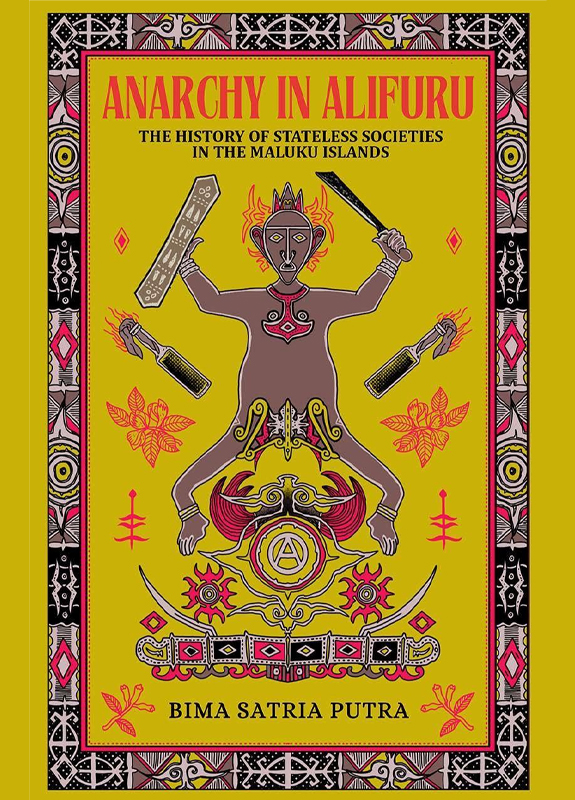
Bima Satria Putra’s new book Anarchy In Alifuru1 presents the Alifuru, which were a group of Indigenous anarchist societies in the Maluku islands of Indonesia. It is a relatively unexciting book that nonetheless sheds light on ways that anarchist societies have existed and why they chose to live that way.
The Alifuru were on the periphery of both the state and colonialism in Maluku, and set themselves apart from the Sultanates of Ternate and Tidore and European colonizers like the Dutch by actively resisting state formation.
What the colonizers depict as horrendous and evil is actually a description of an anarchic society. There are two general ways to define of “anarchism:” the historically-situated political and social lineage that came out of the French revolution and descends to people like the punks of today; and, in this book, people groups who act anarchically regardless of the historical lineage, such as the Alifuru.2
A major difficulty the author faced is that contemporary accounts of the Alifuru come from the colonizer’s pens. Piecing together the Indigenous people’s experiences from the time period considered in the book3 is a task of implications and piercing veils. Most modern histories of colonizers’ and the state’s violence takes the side of the colonizers and the state because that’s who survived (and killed) to be written down and considered as “fact.” Putra rejects this, and focuses on the periphery of societies in Maluku, supplementing this book with oral histories.
Anarchy In Alifuru jives incredibly well with and reflects other accounts of anti-state Indigenous peoples across the world, such as parts of The Dawn of Everything4 and parts of the Haudenosaunee’s Great Law of Peace.5 Why and how the Alifuru resisted state formation6 is the most attractive part of Anarchy In Alifuru. The accounting of Alifuru history in chapter 1 mirrors how Jesuits colonizing “New France” described the Montagnais-Naskapi in 1644:
Fathers here have no control over their children, or Captains over their subjects, or the Laws of the country over any of them, except in so far as each is pleased to submit to them. There is no punishment which is inflicted on the guilty, and no criminal who is not sure that his life and property are in no danger.7
There are numerous direct quotes from colonizers in Maluku saying much the same: the Alifuru know no masters, have no authority over each other (you must convince others to make them do something,) care little for labor, “disobey” their parents,8 women are not so subaltern, etc. Critically, the colonizers depict this as a bad thing, and that becomes the accepted history.
Though we as modern Anarchists can’t replicate anything in this book, it is a useful waypoint to further center our struggle. Anti-state societies have always existed and always resisted the state in whatever form it takes. Our struggles are not the same and will be waged differently, but it is a necessary struggle, worthwhile, and a struggle many more people than we can imagine have fought for. Anarchy In Alifuru, while short and at times feeling dull, serves a necessary purpose to help us recenter and reinvigorate ourselves for the long fight ahead through the history of the Alifuru. Read this book, and imagine.
Anarchy in Alifuru is available to buy from Minor Compositions for £13 here:
https://www.minorcompositions.info/?p=1596
The text is also available to read on the Anarchist Library:
https://theanarchistlibrary.org/library/bima-satria-putra-anarchy-in-alifuru
roun laliberté
roun laliberté is an anarchist, poet, and well-known binoclarde. roun centers its action in the world of dreams. Check out roun’s site for nifty essays: laliberte.noblogs.org.
1.Bima Satria Putra, Anarchy in Alifuru: The History of Stateless Societies in the Maluku Islands (Colchester / New York / Port Watson: Minor Compositions, 2026), https://www.minorcompositions.info/?p=1596.
2. Zoe Baker, Means and Ends: The Revolutionary Practice of Anarchism in Europe and the United States (Chico, California, USA: AK Press, 2023), 15. Also see the rest of chapter 1.
3. 15th century to the early 20th century.
4. David Graeber and David Wengrow, The Dawn of Everything: A New History of Humanity (London: Allen Lane, 2021).
5. The Great Law of Peace isn’t really a reflection of Alifuru society at all (this book is the extent the readers of this review may come to understand the Alifuru, and the book is comparatively light on details and cannot replace cultural knowledge) it’s more like looking through stained glass: You can catch glimpses and similarities but it’s colored with many lenses at once. For a good version of The Great Law of Peace, see: Kayanesenh Paul Williams, Kayanerenkó:Wa: The Great Law of Peace (Winnipeg, Manitoba: University of Manitoba Press, 2018).
6. Including through unintutive methods (unintuitive to my brain, at least:) war, through the concept of Siwa-Lima. Putra, Anarchy in Alifuru, 67–79.
7. Reuben Gold Thwaites, The Jesuit Relations and Allied Documents: Travels and Explorations of the Jesuit Missionaries in New France, 1610–1791 (Cleveland, OH: Burrows Brothers, 1896), 28:47. Quoted in Graeber and Wengrow, The Dawn of Everything, 41–42.
8. “[A]ll family members had to give advice and opinions,
and if someone said ‘no,’ even if that family member had only been six or seven years old of age, they could not proceed.” Putra, Anarchy in Alifuru, 9.
Further reading:
Baker, Zoe. Means and Ends: The Revolutionary Practice of Anarchism in Europe and the United States. Chico, California, USA: AK Press, 2023.
Graeber, David, and David Wengrow. The Dawn of Everything: A New History of Humanity. London: Allen Lane, 2021.
Putra, Bima Satria. Anarchy in Alifuru: The History of Stateless Societies in the Maluku Islands. Colchester / New York / Port Watson: Minor Compositions, 2026. https://www.minorcompositions.info/?p=1596.
Thwaites, Reuben Gold. The Jesuit Relations and Allied Documents: Travels and Explorations of the Jesuit Missionaries in New France, 1610–1791. Vol. 28. Cleveland, OH: Burrows Brothers, 1896.
Williams, Kayanesenh Paul. Kayanerenkó:Wa: The Great Law of Peace. Winnipeg, Manitoba: University of Manitoba Press, 2018.