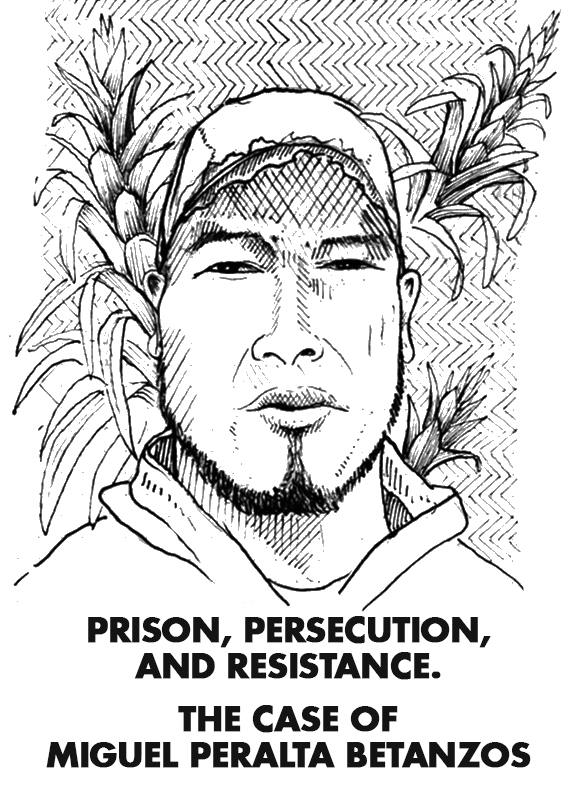
Miguel Peralta Betanzos, community organizer and anarchist, walked out from behind prison walls in Cuicatlán, Oaxaca, more than six years ago. He was originally arrested in April 2015, and sentenced to 50 years in prison in October 2018. Following a legal battle and political pressure from the streets, his sentence was thrown out. A year later, on October 14, 2019, after nearly a month on a hunger strike, Peralta was finally absolved of all charges and released from prison. He spent just under four years and six months behind prison walls on charges fabricated against him.
Miguel’s arrest came following a socio-political conflict which broke out into violence on December 14, 2014, in the municipality of Eloxochitlán de Flores Magón, Oaxaca, when the community assembly was attacked by an armed violent group led by cacique, Manuel Zepeda Cortes. In the ensuing conflict, two people were killed and multiple people injured. This attack, although led and orchestrated by Manuel Zepeda, was used as a pretext to persecute members of the community assembly. Thirty-five community members were charged in case number 02/2015, with other charges coming later. Different community members, including Miguel Peralta, would end up spending years in prison, and while they are all now free from prison, the persecution against the community members continues over ten years later.
Miguel’s father, Pedro Peralta, was previously arrested on August 10, 2012, while participating in a collective communal work day in their community of Eloxochitlán de Flores Magon, Oaxaca. When arrested, he was beaten and tortured. Pedro Peralta would spend almost three years in prison in Cuicatlán, Oaxaca, including a few weeks alongside his son behind prison walls, before being released on July 30, 2015.
Behind the repression and criminalization in Eloxochitlán is the direct link between local caciques and state power, including the weaponization of the justice system against community organizers. Municipal President from 2011-2013, local cacique Manuel Zepeda used municipal funds to enrich himself, in addition to extracting rock, sand and gravel from the community’s river, materials that his own business sold to carry out municipal projects. When community members raised their voices against his authoritarianism, the theft of community funds, and the ecological destruction in the community, he turned to outright violence.
His daughter, Elisa Zepeda, used the conflict in 2014, as a political trampoline, scaling the hierarchy of public authority with a discourse of victimization. She was self-imposed as municipal president for the term 2017-2019, before abandoning the position to run for state congress for the political party MORENA. She has since served as President of the Commission for the Prosecution and Administration of Justice of the Congress of Oaxaca, Secretary of Women under the Salomon Jara government, and is currently serving her second time as State Congresswoman for the political party holding state and federal power. With her political contacts and power, she has mobilized the repressive apparatus of the state, including the judicial system, against members of the community.
Indomitable Resistance
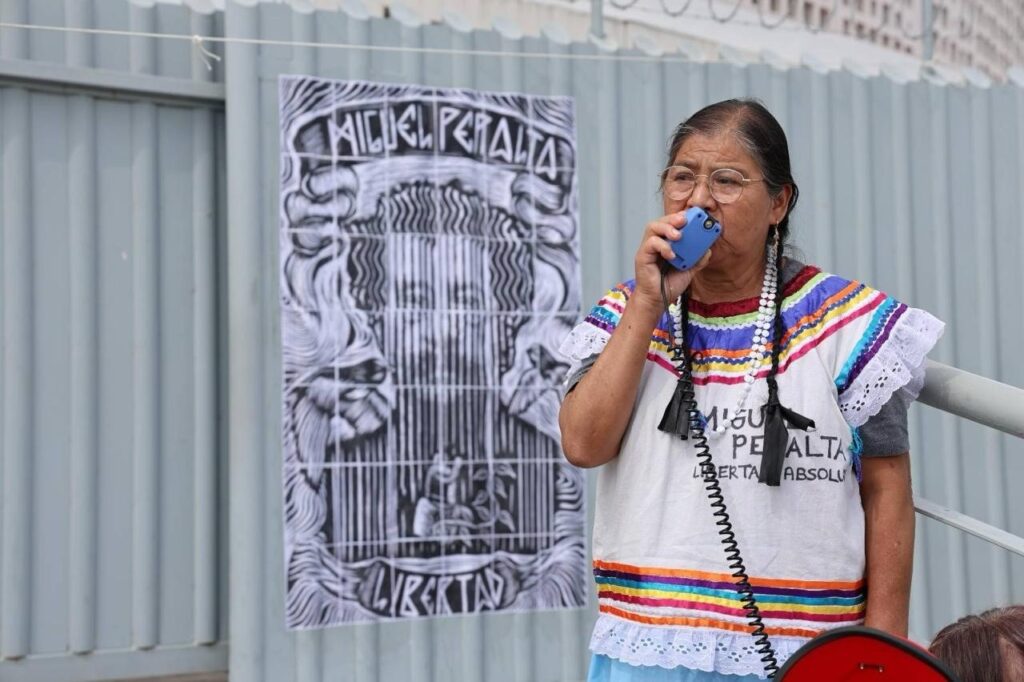
The criminalization, imprisonment, and ongoing persecution of Miguel Peralta is a consequence of his struggle for communal autonomy and territorial defense in his community of Eloxochitlán de Flores Magon. Miguel has been an important voice in denouncing the extraction of resources and caciquismo of the Zepeda Lagunas family. He has also been an important voice in pushing for autonomy and self-determination in the community, against the imposition of cacique and political party power. The criminalization against him is a direct consequence of his resistance, yet it has been unsuccessful in quieting his voice.
As a prisoner, Miguel Peralta was active in the struggle against prisons, in solidarity with other prisoners and communities in resistance, and for the freedom of his fellow compañeros from Eloxochitlán de Flores Magon. In September-October 2016, Miguel Peralta participated in intermittent fasts in solidarity with a hunger strike launched by anarchist prisoners in Mexico City denouncing prison conditions and the oppressive role prisons play in society. In October 2018, following his first final hearing, Miguel Peralta launched a hunger strike demanding his absolute freedom and declaring his body as a weapon of war against imprisonment. In March 2019, Miguel Peralta carried out a fast in solidarity with Indigenous prisoners in Chiapas who had launched a hunger strike demanding their freedom from fabricated charges imposed by torture. Then in October 2019, on the day of his second final hearing, he launched another hunger strike which lasted 26 days, and resulted in his release.
Beyond hunger strikes and fasts, Miguel participated actively in discussions and debates around struggles for Indigenous autonomy, territorial defense, and against prisons and prison society, participating in activities organized outside prison with audios and writings. He released statements and analysis marking the anniversary of the death of Ricardo Flores Magon; October 2 and the massacre of the Mexican state against students in 1968; June 11: the Day of Solidarity with Marius Mason and all Long-Term Anarchist Prisoners; along with others. He also organized activities in prison with other prisoners, seeking spaces of autonomy and self-organization within an institution that seeks total control and total submission.
Following his release in 2019, Miguel Peralta has continued denouncing the cacique-state criminalization of his compañeros from Eloxochitlán. He has continued demanding their freedom in events and activities. He has also maintained active in the struggle for the freedom of other political prisoners, both in Mexico and beyond.
Current Legal Situation
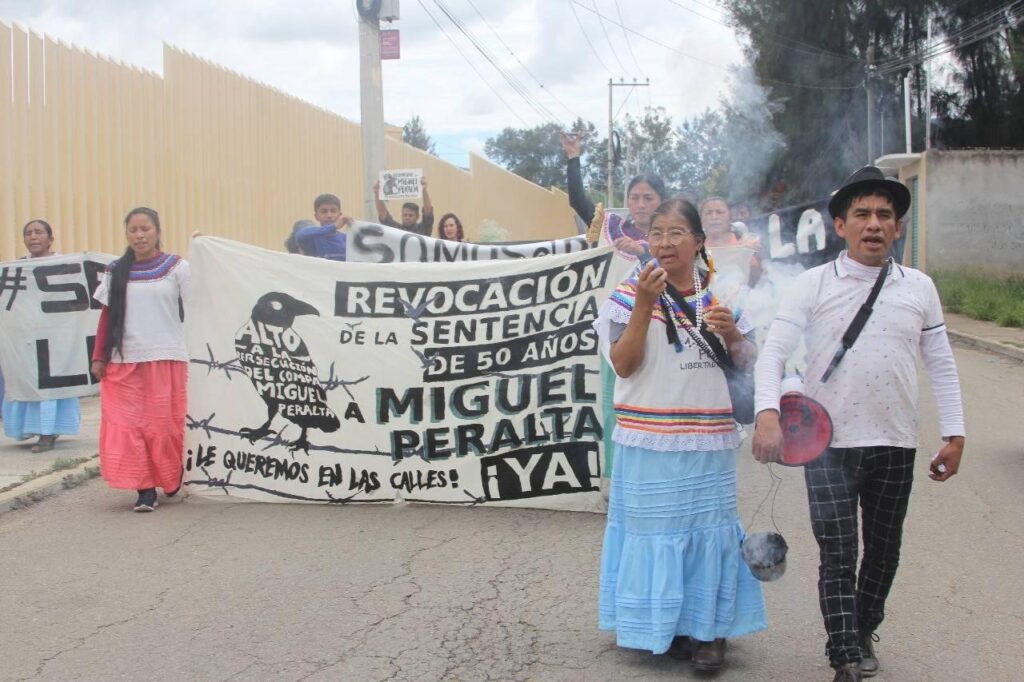
Currently, Miguel Peralta awaits another legal resolution from the Collegiate Court in Oaxaca, this time from outside of prison living beneath political persecution. On March 4, 2022, almost two and a half years after his release from prison, his freedom was overturned by an appellate court and his 50-year sentence reaffirmed. A warrant was put out for his arrest. Since then he has been displaced from his community, fighting for his freedom from political persecution.
His case even made its way to the Supreme Court of Justice of the Nation in January 2024, when they agreed to rule on the amparo 6535/2023 filed by his legal defense. On November 6, 2024, the Supreme Court ruled against the Collegiate Court in Oaxaca, yet fell short of granting Miguel his absolute freedom. Instead, the Supreme Court returned his case to the Collegiate Court in Oaxaca, ordering them to release a new ruling, this time ensuring respect for and recognition of the sociopolitical context of Miguel’s Indigenous Mazatec community, their right to self-determination and autonomy.
Now, again at the Collegiate Court in Oaxaca, the appeal 631/2022 is soon to be ruled upon. Earlier this year, Miguel and his defense were successful in getting the court to admit anthropological studies regarding the context of the conflict in Eloxochitlán, one independent and another commissioned by the federal judiciary. This new evidence constitutes an opportunity for the judges to take into consideration and assess the evidence. The new ruling is likely to be handed down in early February. The judges responsible for the new ruling who can grant Miguel his absolute freedom or continue the persecution against him are: Victor Hugo Cortes Sibaja, Carlos Abel de los Santos Sánchez, and Jahaziel Reyes Loaeza.
The court has the opportunity to avoid the institutional racism that has been exercised in this case for more than a decade; making decisions in offices behind desks without looking at the realities of the communities.
In what follows, we publish a short interview done with Miguel Peralta to talk about life living beneath political persecution, awaiting another judicial resolution, in what seems like an endless maze of trials, appeals, sentences, new accusations, and charges.
Interview with Miguel
Hey Miguel, thanks for being here with us to share some of your thoughts. Let’s go ahead and start this interview. Firstly, how you are doing? How have you been feeling?
MP: Hey, how are you all doing? Thanks for doing the work you all do. First off, I’m a little stressed. I’m not doing as good as I thought I would be, or as I was a few months ago. Yet, I’m feeling somewhat optimistic awaiting the date of the final hearing, waiting patiently, but with a constant feeling of tension.
We understand that persecution brings with it many consequences. We wanted to do this interview with that topic in mind, for you to share with us what it’s like to live beneath political persecution. In the last decade, your case has passed through many different courts, including even reaching the Supreme Court of the Nation at one point. This has resulted in different legal resolutions, yet not one ordering your absolute freedom. The uncertainty has been constant. How does it feel to await a new court ruling that could determine your freedom or your imprisonment, and above all, your future?
MP: I think that persecution is often something we don’t talk about as much in the struggle, as we are often thinking more specifically about physical imprisonment. But for compas who are being persecuted, or living on the run, it is difficult to articulate it all, every emotion. It is somewhat like existing without a clear identity. Being on the run means living constantly with tension. Being on the run means not sleeping well. Being on the run means living daily uncertainty, with the constant risk of being detained. Many things can happen along the way.
Regarding the legal resolutions, or how our legal process has progressed over the last decade. We, or at least I, have always doubted the system of justice in Mexico, in Oaxaca, in Huautla. We have always fought for our freedom with resistance, with the struggle of our community of Eloxochitlán, with the struggle of the compañeros and compañeras who have resisted day after day, in the city, in the streets, in the community, always raising their voices, always putting their bodies on the line and showing solidarity with other struggles.
It has also been something very difficult to navigate. It has been physically exhausting for everyone. We believe that this whole issue of justice is defective, especially with the judicial reforms this last year. Many of us already know how politics function, how they are driven, how the political party in power puts their chess pieces in place.
Eloxochitlán de Flores Magón isn’t an exception. We have enemies who are in power in Oaxaca. The state congresswoman, Elisa Zepeda, is one of them. She has scaled the ladder of governmental power and we know what reality awaits us. We are also aware that it may be an undesirable resolution. Yet, with the resistance that there has been from the community, we believe that the truth is on our side. Reason is on our side. We believe that our community needs justice now. It is time that we have peace and harmony in our community.
With everything that is happening in the world—this world which is falling apart—for the same reasons but on a macro level. People are sick with power, with money, they want to extract rare earth minerals. Yes, but our earth is not rare, it is something beautiful that they are destroying. In a few years they will realize that they have ruined everything, even for their own children. They are not aware of what they are doing to the river, to our community. They don’t have a communal consciousness.
Thus, we have resisted. I have been on this path not to rescue but to defend. To continue reconstructing the community. Capitalism and new technologies are decapitating forms of autonomy, self-organization, and self-production of products from the community. They begin to bring in new things. I think all of this is part of the same system that is destroying us. Capitalism goes hand in hand with militarization, with the entire system of justice, with the narco-state. We are struggling against all of this, and we hope to obtain the justice that is necessary for our community.
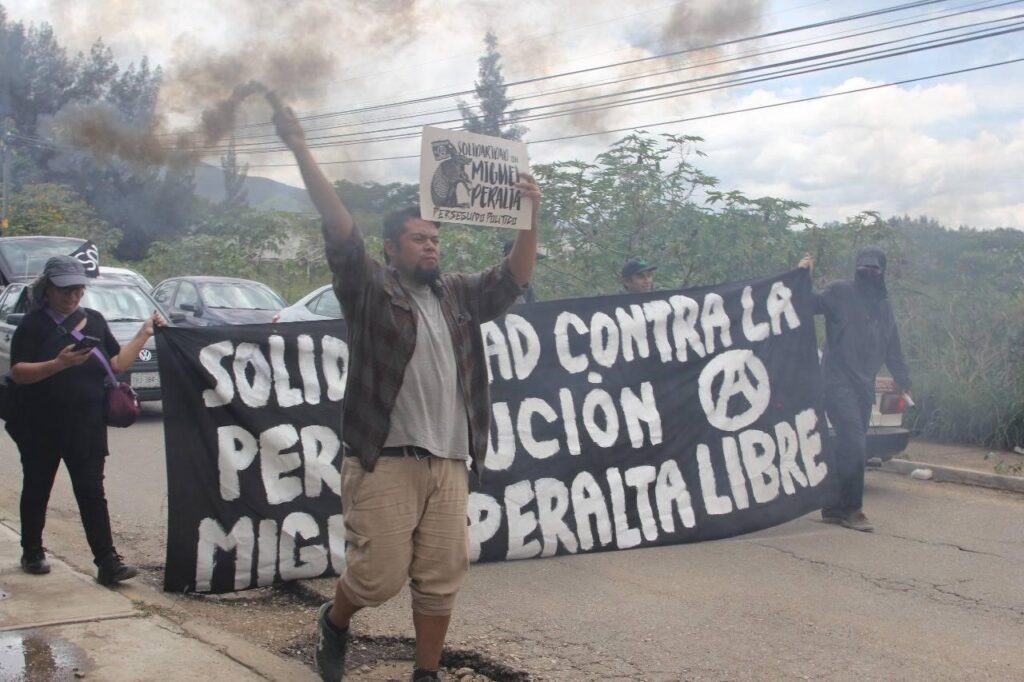
It has been a long journey in search of freedom. You have been persecuted since 2022 and before that you spent time in prison. Throughout these years—when you were in prison and during this period of persecution which has also been quite extensive—you have tried to remain involved in the struggle for your freedom, the struggle for the freedom of your community, and also the struggle against prisons more broadly. In texts that we have read, that you have written since when you were in prison, you have shown a clear position against prisons. Can you tell us about what it is like to participate in the struggle now while living beneath political persecution?
MP: It isn’t easy being involved in the struggle while on the run because you have to be careful of many things. Security, for example, at least with your compas, with the people closest to you, you have to take care of them. But I think that in the end, in whatever geography, in whatever part of the universe, where there is a prison there will always be resistance, to inequality, repression, authoritarianism and capitalism, and these are the things against which we will be struggling. And I think that’s what has happened in my situation.
I’ve slowly gotten more involved in smaller spaces, more closed spaces, trying to be present. Obviously, I haven’t played a leading role, but rather tried to contribute my grain of sand to the struggle. It isn’t easy because—well it’s not necessary to say your name but—sometimes it feels weird to not be able to expose everything.
Regarding the struggle against prisons, something that I think is really important is international solidarity. We have many compas who are in prison throughout the world, and if we forget them, it is like burying them further in the hole they are already in. I think we must not forget them. That is why I participate, not 100%, as I would like to be physically present as well, but I try to participate, although sometimes in a very symbolic manner. For example, the case of the compañero Yorch, who was someone I knew and who I shared certain things with, and I’m filled with rage. I’m also nostalgic, feeling a lot of sadness for not having been able to even be present in his funeral.
I think these are also aspects that build us up in the struggle, in the resistance as compañerxs, bringing us together and making us complicit, strengthening confidence amongst us. Something I think that roots us in the struggle against prisons is confidence. Because there have also been cases, there will always be everywhere, of an infiltrator. There will always be a snitch, an informant, who will point there finger at us. So, it’s important that we take care of those aspects as compañerxs, those who are present, because the struggle against prisons isn’t that common, in spite of there being many prisons throughout the world. And I’m not only talking about political prisoners, because prisons are prisons, and I believe that all prisoners are the same. We are struggling against the same system, and thus it is important to develop that confidence in order to be able to resist.
In the end, being on the run isn’t easy. It’s hard to trust anyone or anything because there is always a risk. But yes, in a way I’m still involved in some struggles, thinking about all the anarchist compas who are imprisoned in the different dungeons around the world, continuing the battle every day and every night.
Another thing we think about with your case is that you pertain to an Indigenous Mazatec community, where community ties and collectivity are really important. You already mentioned something related to this just a moment ago, but we’d like to know, how has the persecution and forced displacement affected your life as part of a community?
MP: Well, firstly, it has taken from me a little bit of my communal identity, my collective identity, because often times I’m alone in many places. I haven’t been able to build that community which roots me, which makes me who I am. I also remember very pleasant moments in my community: the Day of the Dead festivities, for example, or the planting season. Many things that are done collectively and that make you part of a collective entity, a common entity; things that at the same time transform the political, like collective work, sharing words, mutual aid. All of this has been taken away from me by the persecution.
It’s a lot for me being away from my community; not being able to see the mountains makes me feel sad, it makes me feel melancholic. Yet we believe in freedom and we demand it and fight for it daily, which also strengthens us. The fact that there is a vision, a collective vision, something that we are continually working towards together as compañeros from my community, and we aren’t going to stop until we wrest our freedom back, to be able to continue reconstructing ourselves as a community, as Naxinanda.
When compañerxs are in prison, there is usually a lot of activity and movement demanding their freedom. At the same time persecution has many consequences that are maybe not so visible, that sometimes go unnoticed. You’ve talked about emotional consequences, about the effects of persecution on your relationship to your community, but we’d like to delve a little deeper into those consequences that are less evident. Things like health, or economic consequences, social or family consequences.
MP: I think there are many physical and mental consequences. I am going to speak for myself, in my experience. Physically, I’m not doing that well. I’ve been through some stuff due to too much stress; stuff like insomnia, tinnitus, migraines, a lot of depression. Not having the freedom to be able to seek professional help that is needed to counter all these limitations in persecution. And of course the physical consequences as well. My eyesight is failing somewhat. Yet, I can still see the police, or at least sniff them out. My sense of smell is still impeccable. So, I can sniff out the police from near and far.
In order to survive economically, unfortunately, certain relations must be reproduced. Wage labor, for example, as we can’t just rely on the compas for money. I think there are many ways to survive. I also make handcrafts and salsas, and I sell them. That’s how I get by.
Another important element, or perhaps the most important one which I have always emphasized is solidarity. Someone who is living beneath persecution or living on the run, they need a support base, they need folks who can lend a hand, a hug, food, a book, or anything else, no matter how insignificant, and they will find it in solidarity. Solidarity is enacted by people, individuals, who often times don’t even know you, but who are there present.
This is the case in the struggle against prisons. Many times, we do not know the compañerxs who are in prison, but we know about their struggles, we know their histories, and so we feel a connection. We feel affection, we feel anger too because they are imprisoned, and we struggle. That’s how we survive day to day. It’s putting into practice those concepts that many times we only read about like “mutual aid.” We put them into practice at these moments. Complicity is also something very important, something that is present as well.
You’ve spoken to us about the importance of solidarity which often sustains you both emotionally and physically. To conclude this interview, we’d like to ask you two more questions. Firstly, what message would you like to share with the compañerxs or collectivities that have been following your case and who have shown their solidarity in some way over this last decade?
MP: Firstly, that I love you all, that I feel very close to you all. I believe that we think about each other having accompanied each other in some way, even though I am not present. I feel your presence, I dream about you all, I think about you all every day when my mind is wandering, and suddenly BAM, there is something there, there is a light there that is you all: individuals, friends, collectives, communities, comrades from many different places who are there to lend a hand, who show solidarity, who are present, who do something, who protest, who write something, who draw something, who organize a concert, who organize a raffle, who organize a party, who block a highway, who do something, who organize a radio broadcast. There are many things that make me say “WOW” that surprise me. I am often very surprised, I don’t know how to repay you all for this effort of being attentive to the situation in our community.
Now I think we are reaching the long-awaited moment, which is the court’s decision. We will be keeping you all updated. I send you all a fraternal hug, a handshake. From a distance, feel it, truly feel it, because it is with great sincerity, with much affection, with much love, and yes, a big hug.
Thanks for those words. Lastly, can you share with folks how can they continue supporting you, showing their solidarity so that you, as well as your community, can achieve that long-awaited freedom?
MP: I think that we need to continue denouncing the complicity of the state apparatus with the caciques. This relationship that has been forged there, of arrogance and repression against the community. We need to continue to bring to light the situation of injustice that our community is experiencing, by sharing information on the radio, with the media projects that you all have, with the different forms you all have. Of course, we can’t tell you all what to do, right? We are compañerxs and we each have our own forms of struggle. Yet we must make it clear that we are struggling against a state apparatus in Oaxaca and Mexico that is working in collusion with the caciques of our community who are exploiting the river. I think that’s the main thing. We need to denounce the systematic repression that our community has lived through, the imprisonment that we have lived through, the displacement, and the damage that our community has suffered to the community fabric. And you all have your own ways of doing that. You all are very intelligent, you improvise, and you have your own strategies.
Anything else that you want to add? Any words to finish this interview?
MP: Well, thanks to everyone who listens to or reads this. Also, I’d like to send my warmest regards to our compañerxs who are in prison, those who are on the run too, encouraging them to stay strong and keep fighting.
Thanks, Miguel, for this space to share these ideas, we will be awaiting the court’s upcoming ruling. We send you a warm hug. We hope that this also in some way helps break the cycle of persecution, to establish communication and dialogue. We also hope that you feel the love and solidarity of all the compas who are here and who continue following your case. Thanks again, Miguel.
Nolan Peltz