March 8, International Women’s Day, is routinely invoked by governments, NGOs, and pundits as a day to celebrate women’s achievements. Like Pride, Mayday, and Black History Month, the liberal state has consumed it and spewed forth a sanitised, acceptable day of joy, never mind about it’s origins and the spirit at it’s core, deep beneath the performative dance and recuperation of corporates and the state both.
Those origins are found across many fronts in the war against patriarchal oppression such as the New York shirtwaist strike of 1909, which lasted throughout November into the following March. Clara Lemlich Shavelson, a Jewish émigré fleeing ethnic genocide in what at the time was Russia, now Ukraine, she found herself in New York working in the garment industry. A committed socialist she was soon a well known organiser. She was known for her intellect, charm, and resolve, having early in 1909 been of the rough end of a strikebreakers assault on her picket, and soon returned to her sisters, broken ribs and all.
In November of that year she sat Cooper Union, listening to the endless drone of grandstanding and empty rhetoric, endless words. She demanded a right to speak and took the platform by storm.
“I have listened to all the speakers, and I have no further patience for talk. I am a working girl, one of those striking against intolerable conditions. I am tired of listening to speakers who talk in generalities. What we are here for is to decide whether or not to strike. I make a motion that we go out in a general strike.”
Around 20,000 workers were on strike a few days later.
She was just one of the women mostly forgotten by the state in it’s vapid celebrations. Names like Rose Schneiderman, Pauline Newman, and Theresa Malkiel are often forgotten today, but they remain an important memory for us all. Malkiel,a Jewish refugee from the Russian Empire, was part of the Woman’s National Committee of the Socialist Party of America (SPA) who (along with speaking against white supremacy in the Deep South, and organising for a socialist future, and taking time to condemn the “false consciousness” of the bourgeois feminism found in the middle class) would come to champion the need for a “Women’s Day”, which would come to be held on the last Sunday in February in 1909 and the following year.
In late August 1910, inspired by this and similar movements, Clara Zetkin, a German Marxist, introduced a resolution to the International Socialist Women’s Conference of the Second International for what would become International Women’s Day. She spoke before a gathering of one hundred delegates from seventeen countries. Included within the German cadre was her sister and fellow socialist Luise, feminist activist and lifelong socialist Käte Duncker, and Paula Thiede, a print worker and one of, if not, the first women in German to be a full time paid union rep. The vote was unanimous.
The following year, Feb 26, America would hold it’s third (now) National Woman’s Day, while later on come March 19 over a million people across Europe would celebrate the same cause as the newly founded International Women’s Day. The importance of this act of sisterhood and solidarity would be punctuated just six days later when 123 women and girls alongside 23 men who would perish in the Triangle Shirtwaist Factory fire, the stairwells and exits had been locked to keep them from taking breaks.
International Women’s Day was built upon the hard work of hundreds of women such as those named, and so many more, from Louise Michel, Teresa Mañé, Alexandra Kollontai and so many more from across the spectrum of revolutionary women. Each year (the chaos of war not withstanding) saw more and more women using the day to stand up for their very existence and remember those who came before them.
During the seventies, the UN would come to adopt the day and position it with international officiality. Following in their wake the states and corporates of the world, now having to come to terms with the fact they were losing the war against women which has been waged for some 20 or 30 thousand years. The result of this cosumption of a revolutionary ideal is that over the past fifty years we have seen western states use the oppression of women to justify their military actions, only to abandon them when the political tide shits and the profits drying up. The latest of which are the some 40 million women of Iran.
Let us be clear, the war between the theocratic authoritarian states of America, Israel and Iran has absolutely nothing to do with the liberty of women. The rhetoric circulating globally reveals less about supposed solidarity with Iranian women than it does the geopolitical priorities of the men in power. It’s a all too common pattern. Right-wing politicians and commentators suddenly discover feminist language when condemning Iran, despite long histories of opposing women’s liberation, migrant rights, labour organising, and reproductive autonomy in their own countries. They weaponise women’s suffering abroad while disciplining and abandoning women at home.
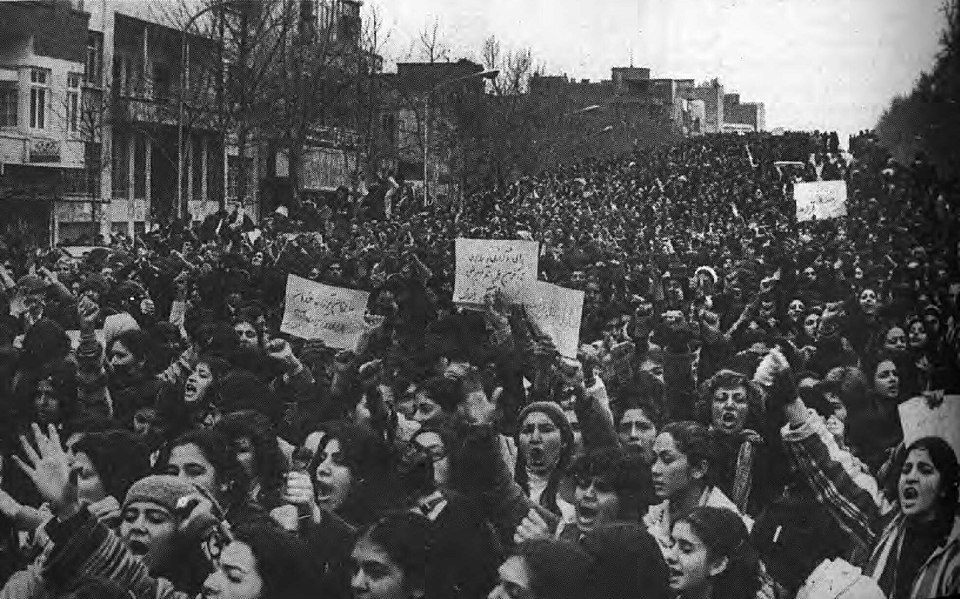
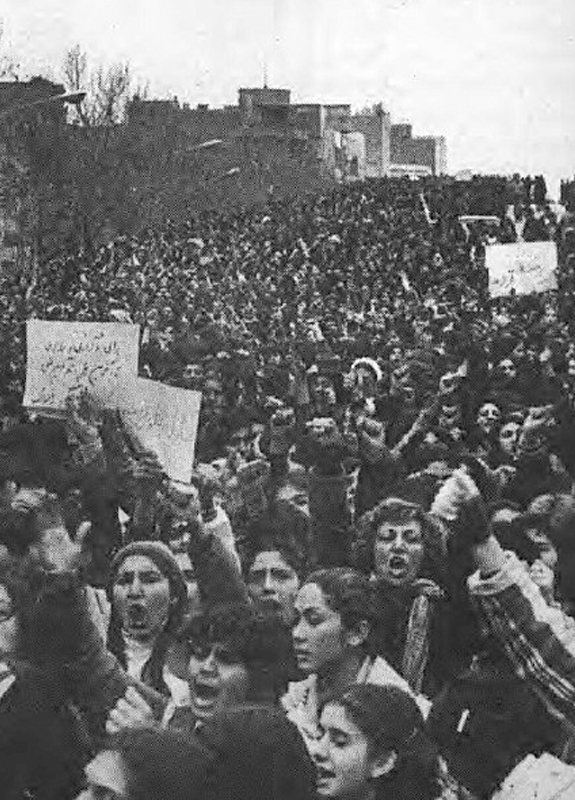
In Iran, March 8 has never been a polite commemoration. It has been a day of confrontation. The Iranian Women’s Rights Movement first emerged after the Constitutional Revolution right back to 1910. During the revolution through ’78 and ’79, the struggle continued. On March 7 1979, shortly after returning to Iran, Khomeini announced that women working in government offices should wear a veil. The next day (International Women’s Day) tens of thousands of women marched in Tehran to protest the new policy and defend women’s rights, the protests lasted days and were met with brutality and violence. For decades women have resisted a system that fuses patriarchal authority with state power, capitalist exploitation, and ideological control. The gender apartheid imposed by the Islamic Republic is not a cultural anomaly but a structure embedded in law, economy, and governance. Compulsory veiling, family law favouring men in divorce, inheritance, and custody, and restrictions on political participation are not relics of tradition; they are mechanisms of rule designed to preserve hierarchy.
Women’s oppression in Iran cannot be separated from the broader political economy. This isn’t the actions of a few tyrants at the top but a social and legal architecture which institutionalises gendered violence. Women who challenge compulsory hijab, organise politically, or confront the regime face arrest, imprisonment, and brutality. The killing of Mahsa Amini brought global attention, and for many this would have been the first they have thought about this struggle beyond a vague xenophobic notion, but Iranian women have resisted state patriarchy for generations. Their struggle did not begin with international headlines, and it will not end with them.
What is so very telling is how this struggle is appropriated in American and British political discourse. Politicians who claim to champion Iranian women abroad routinely support policies that deepen inequality at home, austerity that disproportionately harms women, punitive asylum systems that endanger migrant women, and the expansion of policing and border regimes. The contradiction sharpens when examining the treatment of Muslim women in Britain. The hijab is framed as oppression when worn in Iran, yet Muslim women in the UK face discrimination, surveillance, and harassment. Feminist language is stripped of substance and repurposed as a cultural weapon, reinforcing hierarchy rather than challenging it.
Fascist patriots keen to consume the moderate right are endlessly spewing their toxic bile onto the UK’s streets under the pretense of “defending women”. How many of them hit the streets when two Brits raped a Sikh women in broad daylight in Oldbury last September telling her to ‘Go back to your country’. The likes of Ryan Ferguson attends a rally in Bristol alongside a dozen or so Patriots, They cheer the invasion “liberating Iranian women”, later he screams “Heil Hitler” in the face of two Jewish Antifascists. The Nazi’s mass murdered millions of the wrong type of woman, and would do so again.
Beyond this hypocrisy and selective interest, gendered violence within Britain remains pervasive. The murder of Sarah Everard by a serving police officer exposed the depth of institutional misogyny embedded in policing and the state (See also our series “Cop Crimes Against Women and Kids”). Women continue to confront sexual violence, workplace inequality, and chronically underfunded support services. Yet many of the same voices invoking Iranian women show little urgency when confronting these realities at home.
Across 2024/25 there were 71,667 rape offences in England and Wales. These are just those which were reported. The charge/summons rate for rape recorded in that period was about 2.8 per cent, meaning that only roughly around 2 000 of these rapes saw anything even an approach to the state’s justice. The Crown Court backlog is increasing every month, with over 13,000 sexual offence cases currently waiting to be heard, it’s likely that 20% of these will be dropped after charge, with the backlog being cited by many. This reality is only one of the many reflections in which our continued patriarchial supremacists social order continues to fail the women who live, work, and visit these islands.
None of this is new. Western powers, and those who feverishly prop them up, have long invoked the language of “saving women” to legitimise domination abroad while leaving patriarchal structures untouched within their own borders. Iranian women become rhetorical instruments in geopolitical theatre. Their suffering is amplified; their political demands are ignored. Iranian women do not need selective sympathy. Their movements have consistently linked resistance to state patriarchy with broader struggles against class exploitation, authoritarian power, and social inequality. Genuine solidarity would recognise these connections instead of reducing their fight to a spectacle that erases the most important voice. Their own.
Western politicos and medias repeatedly invoke Iranian women when it serves narratives of intervention, civilisational superiority, or militarised “liberation” and that concern with vapourise when the conversation turns to refugee rights, Islamophobia, border violence, or the sanctions that impoverish the same society whose women they claim to defend. Iranian women’s suffering becomes a device within global power struggles while their demands, many of which challenge capitalism, authoritarianism, and imperialism at are quietly sidelined.
Our feminism should be grounded in a genuine solidarity which rejects this selective framework. Whether we are talking about the women of Iran, Britain, or any other part of the world. Women’s struggle cannot be reduced to a symbol in someone else’s ideological war. It is part of a broader confrontation with intersecting systems of domination: patriarchy, capitalism, authoritarian state power, and imperial geopolitics. The same structures that repress women in Iran also shape the global order that constrains liberation here. International solidarity requires consistency and at that a keen rejection of the instrumentalisation of women by reactionary forces abroad. It must recognise that the liberation of women cannot be separated from struggles against colonialism, racial hierarchy, and class exploitation. There is no Anarchism without women’s liberation.
March 8 should not be reduced to a symbolic celebration. It remains a reminder that women’s liberation has always been driven by radical movements confronting entrenched systems of power. The struggle in Iran continues within that tradition: not as a story of passive victims awaiting rescue, but as one of organised resistance determined to dismantle the structures that sustain patriarchy, authoritarianism, and economic domination, from the Sweatshops of New York in 1909, to the Streets of Mashhad 2026.
We hope today has been a beautiful day of liberation of all women, but especially those of Iran, regardless of whether they stand politically, or what that liberty means and looks like to them.
Woman, Life, Freedom!
Jin, Jiyan, Azadî!
Zan, Zendegī, Āzādī!