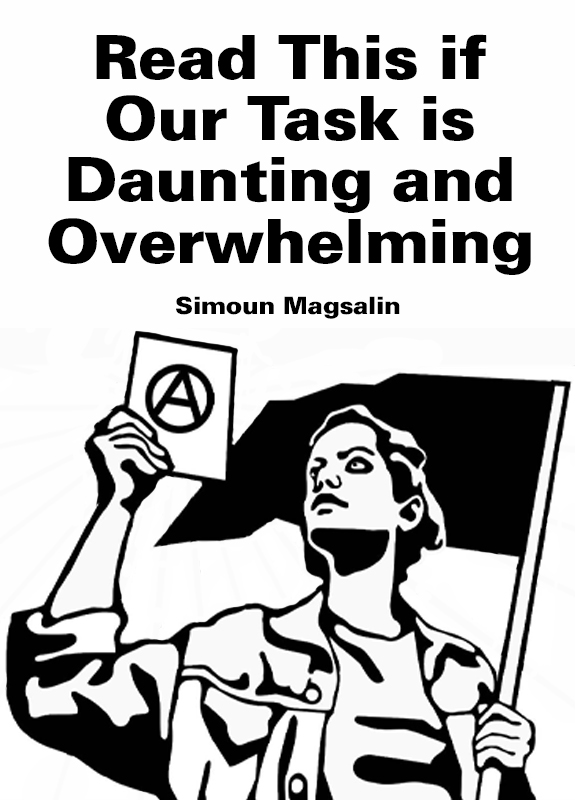
A letter in the vein of Read This When Things Fall Apart
(Not really a) Review of: Kelly Hayes (ed.). Read This When Things Fall Apart: Letters to Activists in Crisis. Chico, CA: AK Press, 2025.
Kamusta mahal na kasama.
Reflecting on the dire state of the world—the breaching of 1.5°C, the triumphant march of fascism in the world, the intensification of the black scare, the failure of insurrections around the world, the retreat of peasant guerrilla movements, another year of genocide in Gaza, Sudan, Yemen, and Myanmar, a brazen assault and kidnapping on Venezuela, the collapse of Rojava, the siege on Minneapolis, the West’s war on Iran, the violence in our own movements inflicted by those we called our comrades—it is easy to feel defeated. Our task is daunting—yes—and it is easy (oh so easy) to be overwhelmed by the gravity of our task. It really does seem like nothing is working, not in our personal politics, not in our social, national, or international work. What is to be done? In such crisis, I was reading Read This When Things Fall Apart: Letters to Activists in Crisis edited by Kelly Hayes. The book is indeed one full of grief and sadness, and of letters by which people have coped with grief and helped others with grief, or even how the grief of defeat drove people forward. This letter is in the spirit of the book, written for my kasamas and also for myself.
Revolution will be full of grief
A comrade and friend of mine told us once, that “revolution will be full of grief,” yet despite this grief, and despite this, they hope. We have urgency. The very ecologies of this world we call home are fragile. With the rapidly heating climate, many living beings, and the people who rely on them, will perish. It is no longer as Rosa Luxemburg had said, that it is “socialism or barbarism,” but more of Murray Bookchin’s “anarchy or annihilation.” The age of barbarism has long been here, and we are now moving to annihilation. Yes, we must act quickly. We must: we win or we die.
Last October, a leftist legal aid group working on the cases of those illegally detained and tortured at Mendiola last September 21 tried to organize families of detainees and defendants of those accused of the events at September 21 against the issue of “police brutality” that occurred at Mendiola. Rather than an effort to organize against institutions of policing and incarceration, for getting some accountability from the police, Interior Secretary Jonvic Remulla, or the Bongbong Marcos administration for the horrors and terrors they inflicted last September 21 and its aftermath, they wanted to make noise, to let the public know about the brutality of policing, and then perhaps expand the mass base of their political organizations. At the time, the Bar Boys musical was also being played, which is quite different from the film. Its second act deviated from the film and had a compelling legal drama. What struck me—and what connected for my own context—was that the characters called for a strategy of letting the public know about the systemic safety violations of a factory owned by politikos and oligarchs, since legal strategy is difficult and long-drawn out. Days after that, a kasama reached out and asked for “media work” to bring the plight of their urban community being evicted, whose land was desired by a large real-estate company, and whose legal battle against eviction is in retreat and defeat (already in the eviction stage), and the only action left possible is “media work”—to let the public know of their plight to pressure the government to provide the monies that ought to be afforded to evictees.
Our vocation is grief, yes. I realize that since I took up the name Magsalin, that much of what I did was “media work,” was to “make noise,” was to let the public know. But who is listening? Those who listen, those who read, are already those who are “awake to the world” (as a comrade phrased), or those who are in the process of waking up. And those who are awake to the world, we all are constrained by whatever peripheries we construct—whether territories, affinities, organizations, networks (informal or formal), or as parties. Others who are just waking up to the world oftentimes find they have no place in it. Nor is it the case that the vast majority of people are simply unaware of what is happening in the world. Everyday people know the world is the wrong way up (irregardless of how they understand that) and the general public was never a herd of gullible naïve sheep. What we see as the apolitical condition or apolicity, cannot be because of mere ignorance. Generalized apolicity is not necessarily the result of the sum of mass apathy, nor of consent nor compliance, but real or imagined limits to becoming awake to the world.
We can keep making noise—and indeed, we should—but the apolicity of the world writ large was never because the many were not listening. We remain as peripheries and, even if we can establish the partial unities between peripheries under periods of normalcy, we cannot unite the whole of humanity—at least not yet. We can make space for those waking up to the world to become our comrades, but at some point we may have to accept that, even while the many do know what is wrong, there are real limits that prevent the majority from moving into action. Our vocation is a lonely one as well.
We want the whole world, and we want that for everyone
We want the whole world, and we want that for everyone. Yet the centrality of our society, of our world, belongs to the very murderers and plunderers of the world. Even for those who take state power are unable to occupy the centrality of society—their populations often unable or unwilling to adopt revolutionary political cultures—or otherwise their territories are isolated as peripheries the size of countries (often both).
The truth of the matter is that for 500 years since the beginning of the revolutionary era (arbitrarily marked with the Reformation), we have seen intense cyclical periods of class struggle. In the Reformation, women were at the forefront in grand episodes of class struggle. In defying the Church and Her Papacy, ordinary women and men started revolts and revolutions to overturn all kinds of domination—feudal relations, patriarchy, religious domination. A grand holy alliance of Catholics and Protestants emerged to destroy the militancy of the working class. Witch-burnings were instituted to terrorize women and re-consolidate male domination, the aristocracy, and the temporal power of the Church (regardless of confession).
The same grand dance emerged in the English revolution. The debates at Putney saw the articulations of commonism and the abolition of slavery. Progenitors of anarchism and communism emerged with the Diggers. In the end, Oliver Cromwell’s dictatorship crushed the working class in both England and Ireland, leading to the restoration of the monarchy after Cromwell
This grand dance resumed in the great French revolution. Sans-culottes fought for egalitarianism and radical republicanism. We know how that ended: with their crushing and the rise of Napoleon Bonaparte, ending all the way to Waterloo and the restoration of monarchies through the Concert of Europe.
In Haiti—perhaps the most significant revolution in modern history—the maroons and the enslaved fought for the self-abolition of the enslaved. Haiti was the only event in modern history where a class of workers (being unfree enslaved laborers) successfully abolished themselves as a class. The new Haitian state was riddled with the question of profitability and extraction, the solution of which the government answered with legalized forced labor—while affirming the abolition of slavery! Those who did marronage found refuge and autonomy in the boondocks, constrained to peripheries.
In Karl Marx’s own time were the German revolutions of 1840s, the Paris Commune thirty years later, all crushed—but whose light inspired revolutions later. Our own Philippine revolution in the twilight of the 1890s is in this tradition as well, with working class and peasant movements subordinated or repressed by the emerging Filipino oligarchy, which in turn was forced to submit to the Americans. Following those were the revolutions that ended the First World War and in the interwar period—Russia, Ukraine, Hungary, Germany, Spain, Italy, Greece. Then those of the post-War period: Vietnam, Indonesia, China. Then upsurges in the long sixties—the Great Proletarian Cultural Revolution in China, the Black Panthers Party in Black America, Paris 1968, Chile 1972, Portugal 1974, Iran 1979, Solidarność in Poland 1980, and many many more.
Within the past few decades, we saw the insurrectionary waves across the Arab Spring, then more recently in the United States, Hong Kong, and Thailand. In the past few years, we saw the campus occupations in solidarity with Palestine and Zionist genocide in Gaza, the mass insurrections of 2025 in Indonesia, Nepal, and Madagascar, and the direct action at Mendiola in the Philippines. All have ended in demobilization, subordination, co-option, recuperation, and defeat. Some lasted glorious, glorious moments. But all episodes ended. Revolution is full of grief, failure, defeat. Yet we persist. We must.
Revolution is hard
Commodity relations had existed since antiquity. Perhaps the truest proof of value as a social relation that mediates between people was the legend in Sparta which purportedly used currency made of iron spoiled with vinegar to make it brittle and corroded—useless even as scrap metal. While other Hellenic polities used precious metals as sources of value (which could be reused as precious metals) the mythical Spartan currency made out of rust is based purely on how much people agree it is worth, akin to paper or plastic currencies today. Yet it took thousands of years for the seed of the commodity to generalize and conquer the whole world—very rapidly in the past 500 years compared to the past 5000.
Just in the same way, seeds for a wholly different mode of life has also existed since antiquity. We find archaeological evidence for egalitarian settlements. Throughout history such different ways of living can be found in various accounts. And we can readily find these seeds today in the peripheries we have built and in the affinities we share with others. But we are not satisfied with peripheries: we want the whole world, and we want that for everyone. And we don’t have 500 years for the seeds of the party of anarchy and communism to generalize the whole world. We continue, to cultivate, yes, but we may not even have half a century because of the climate crisis imposed by the capitalist mode of production. The urgency has always been real, and it drives us to despair.
“Hope is a discipline,” Mariame Kaba says. “Hope is a discipline and that we have to practice it every single day.” Kaba continues that we can’t control the social forces outside of us, that dominate the whole of social life, but we can practice hope. Hope is not optimism, as she clarifies; we won’t know if things will turn out well. But she says hope is something we cultivate even as we grieve.
While crashing out from the perceived futility of all I have done since taking the name Magsalin, of how no-one except those who are already awake or waking up to the world are listening to what we have to say, of how all the affinities I have contributed to remain as peripheries, my partner reminded me that I talked to them about passive and active nihilism once before, in the 2022 Philippine presidential election. I told them then that since our votes really don’t matter, we might as well vote for whomever we want or not vote at all. Having no effect on the outcome of the election, we are free to do literally anything with our vote. Free from any illusionary obligation to vote tactically, we can vote based on our principles, abstain based on our convictions, or spoil our vote as a celebration of absurdity. I reflected on this again on defeat and failure.
Revolution is hard. Our earliest evidence for domination is probably 7000 years ago in the Neolithic Y-chromosome bottleneck, which mayhaps be evidence for the cohering of male domination. Domination—over women, classes, peoples, nature—has existed for thousands of years and perfected into the capitalist mode of production that has since subsumed all previous modes of domination into its totality. Liberation isn’t merely the autonomy of some territory that can be won by armed struggle, but the subversion of every domineering social relation ever. The gravity and scale of liberation is overwhelming, almost unimaginable—indeed, astronomical—like trying to comprehend the size of the sun, distance between planets, between stars, or of galaxies. A friend asked me if I wanted to cover the whole world in leather. It drives us to see how small we are to the task at hand. For liberatory struggle, it is easy to despair, for the peripheries we build and have are minuscule to the world we want for ourselves and for all.
To realize the futility of it all is passive nihilism: that nothing we do matters for the total liberation of the world we want, because the truth of the matter is that the peripheries we build have very little effect to total liberation, especially given our dire urgency. Yet to realize that can indeed be liberating, which is active nihilism. If we, as affinities and as peripheries, can’t usher in the grand world revolution ourselves, of anarchy and communism, then we are free to choose our own goals and values, and we are free to choose whatever strategy we want for those more immediate goals. If we are limited by what we can do under the imposition of normalcy by the party of order, unable to move past affinities, peripheries, and partial unities… if this is all we can do under the imposition of normalcy, then we can endeavor to do what we can and do it well. Even if all we can do is build a discipline for hope, even if all we can do is keep ourselves or each other alive, to keep trying to understand our present moment, then I hope we can do that well.
A comrade told me they were struggling with grief and despair, of passive nihilism, of feeling that what their mobilization against Trump and for Gaza did nothing, not even slow the genocide being committed by Israel in Palestine. Nor could such a mobilization have any material effect in ending genocide in Gaza, much less liberate all of Palestine. Yet what they did inspired: they moved people to action. The whole world is against us, but they did what they could well.
Mahal na kasama, you’re doing what you can well. I can only hope that I am doing what I can do well, or at least well enough.
The naming of our demons is the first step to their exorcism
What happened at Indonesia, Nepal, Mendiola clarifies the limitations of insurrection, that there are material and ideological limits that prevents insurrectos from escalating insurrection, that forces them to demobilize and retreat. It isn’t a question of “what should insurrectos have done instead?” but rather “how could they have not?” There are key constraints imposed by the whole world, of the mode of production, and the intersections and networks of power and domination that limit us from escalating even a peaceful protest to direct action, to a riot to an insurrection, an insurrection to a revolution, and a revolution to the unification of humanity.
These limits are inevitable, but our imprisonment within limits are not. The naming of our demons is the first step to their exorcism. Philosophers are wont to say that it is wiser to know what one does not know, and Marx was wont to say that point of philosophy is to change the world. It is then the cognizance of our limits that allows us to engender ways by which we can transcend and overcome these limits. We cannot transcend and overcome what we cannot perceive or comprehend. We act, then, in cognizance of our limits, and strategize for how to overcome these. If under the conditions of normalcy, we feel forced to act within the imposition of material and ideological limits, then even that intentionality of choosing when to act within limits and then testing those limits has its utility (more so than ignorance). Even despite the urgency, we can note that there are still things we can do, and do well.
What if this is all we can do?
It is true there is an urgency, but hope is a discipline. It is true much of nature we enjoy today, that the world takes for granted, is already on its way out. But we must hope and struggle for each fraction of a degree above 1.5°C. Exceeding that, then we must hope and struggle for each fraction of a degree. For each fraction we fight for, the more of this world and our people we can save. As we grieve for each fraction lost, we actively hope for each fraction fought.
While life on this planet is fragile, life is also resilient. So is our species. This is not to say that we will not lose of the many wonders that make up our world, non-human and human, but that we can and will adapt. It is inevitable that we will grieve for much that will be lost. But must we borrow grief from the future? I have to hope in what we can retain and rebuild, and there is so much we can still save!
The greatest insight from social ecology is that the root of ecological problems are in social problems, precisely because that domination in society makes thinkable and possible the domination over nature. Humanity is socialized to treat nature and climate as disposable only because our society is configured to see our neighbor as disposable, starting with the most vulnerable—children, women, those with disabilities, the mad, the stranger, the different—and then extending this disposability to whole classes. Ecological struggles aren’t ultimately futile, but the solution to the climate crisis is ultimately in addressing domination itself. If social domination makes possible planetary domination, then the abolition of domination in the social sphere makes possible the end of domination over our relationship to our planet. We should still empower coastal and forest communities, build resilience, and such. But these remain bounded as peripheries, all the while the centrality of society is still held by the murders and plunderers of the world. But again: if this is all we can do right now, then we should do it well.
Reaction is inevitable, revolution is not
The ultimate solution still lies in the mass self-activity in an insurrection. The social rupture in how we relate to one another provides the basis for the rupture in our socialization of our common relationship with the natural world. I cannot pretend to foresee if and when such an insurrectionary wave returns to our part of the world. In the Philippines, some have expected another insurrection in the February 2026 anniversary of the People Power Revolution, after the usual Yuletide demobilization of students and workers end. Some militancy by committed cadres and militants did emerge on the streets, undermined by marching in place and then a kettle at the EDSA Shrine. Then again, the current world crisis in energy brought on by the Zionist war on Iran has worsened the energy demands in the Philippines, the government of which had knowingly tied itself to global fossil gas import markets without expansion of renewable energy. (Not that a complete replacement of all fossil fuels by renewables be good, for the problem is the extreme energy demands needed by capitalism itself.) This, combined with the expectation of the worst El Niño to come (and worse even expected), will create a cost-of-living and heat-induced health crisis. This crisis has resulted in waves of class struggle that had increased the morale of the class, but only slightly and highly unevenly. Know, however, that these insurrections come in waves, and have been for past decades. We mayhaps be impatient for the next one—given the urgency of the climate crisis—but our day will come. Class morale increases in counterrevolutionary eras such as this, and can just as easily tip towards a threshold towards another insurrectionary wave or towards an intensification of normalcy. We must cultivate the hope for our day. Part of that cultivation must mean keeping each other alive, for survival programs need not be gradualist or reformist if we have clarity in our intentionality. (Or to put it another way, survival programs may be gradualist or reformist, but we struggle for beyond it rather than an end-in-itself.)
And even if hope is lost, then perhaps “[w]e must do without hope,” to quote J.R.R. Tolkien through his character Aragorn, lamenting the untimely death of Gandalf the Grey in The Fellowship of the Ring. Without hope, “[a]t least we may yet be avenged. Let us gird ourselves and weep no more! Come! We have a long road, and much to do.” There is agency and power with hope, and even in the active nihilism of acting regardless of hope, in persevering anyway.
When the insurrectionary wave comes, it is the tasks of the pro-revolutionaries to join, to overcome the material and ideological limits of crisis, riot, insurrection, communization, revolution, revolutionary isolation, all, all until total liberation, towards abolition, anarchy, and communism. The specific teleology of this progression and transition is never certain: reaction is inevitable; revolution is not. While there will never be a tactic we can develop in advance for overcoming the limits of an insurrection and revolution, history and experience provides us with ample evidence of what limits to expect, and how past revolutionaries have overcome limits only to be defeated by more limits.
This focus on the social and its limits isn’t to say that the ecological sphere is to be neglected, but rather the struggle of the social and ecological have always been hand-in-hand. Our ecology provides us with life, and it is human social life that conditions our social relations with our ecology. At some point, the ecological and climate crisis can—and may very well will—be the very material and ideological limits to the capitalist mode of production that would produce a crisis by which the old ways would be impossible to be reproduced again. We are living through that apocalypse now. In the meantime, there will be many things to do to push the material and ideological limits more and more, and transcend our own limits in our own lives, affinities, and solidarities.
What makes us brave?
One of our key tasks under the imposition of normalcy is the cultivation of bravery. We often talk of “safety” and “safe spaces,” especially in the context of intimate violence and abuse. Without such safety, how can we expect more than half of the world who are not men to meaningfully participate in liberation and revolution? To allow harm and predation to exist in our spaces is to drive people away from our pro-revolutionary vocation. But it simply will not be enough to cultivate safety. How could we make the peripheries we do have as brave spaces where such issues and more can be addressed openly?
Perhaps the elimination of fear or risk is impossible, but bravery is only required of us if fear and risk exist. That is to say, we can only be brave when we are afraid. Indeed, as a child, Bran asked his father, “[c]an a man still be brave if he’s afraid?” and his father replied, “[t]hat is the only time a man can be brave” (A Game of Thrones, 1996). We must ask: what makes us brave enough to confront fear and risk?
In the same way, escalation from a delimited and timid protest towards direct action, riot, insurrection, and revolution will never be without fear or risk and such safety is impossible, yet bravery is key to escalation. Just as limits have material and ideological bases, so too does bravery have material and ideological basis. More importantly, the material and ideological basis for bravery are based in building the capacities towards breaking with the party of order and the imposition of normalcy.
In an insurrection, as we have seen in Indonesia and Nepal in the fateful months of August and September of 2025, safety is impossible to secure. There will always be threat of violence on everyone, whether insurrectos, goons of the party of order, or everyday people caught in the crossfire. The key has always been to break the imposition of dependence on our class by the party of order and the false safety our collective dependence has from imposed normalcy. This means that we have to figure out the hard questions of feeding the insurrectos through the interlinking struggles between town and country. While safety is momentarily impossible, cultivating bravery means preventing goons and opportunist elements from attacking and assaulting students, workers, women, minorities, else insurrectos will find that they have no choice but to submit to the security apparatus of the party of order and the reimposition of normalcy for some semblence of safety. We will have to figure out how to keep hospitals and systems of care running and supplied. Indeed, as a person with a number of disabilities, I have material reasons tying me to the maintenance or resumption of normalcy so that I can keep living—so does millions of other disabled people and their families. The opportunity for unifying the various peripheries (territorial and factional) can only occur in times of crisis, rupture, and insurrection—but how will various territories and factions resolve their differences and transcend these divisions to cohere the party of anarchy?
In the Philippines, at the 21st of September 2025 in Mendiola, the limits of insurrection and the necessity of bravery was revealed again. The bravery of our class in Indonesia and Nepal brought out the bravery of our class in the Philippines. To know that power is vulnerable elsewhere is to see it is vulnerable everywhere. For those organized in the “legal” left—some of which have duly recognized representatives in congress—the recognition and reaffirmation of their legality tied their materiality and ideology to normalcy, because to forego legality means very real demobilization through overt repression. This constrains their bravery under normalcy, and especially so in an insurrection as we saw in Indonesia and Nepal. In Nepal, the legal left composed of various Marxists and Maobadis was the government itself, was itself the party of order. So it was that different affinities among urban poor youth organized violent direct action that triggered the second battle of Mendiola on Setember 21. These affinities were traditionally considered “unorganized” but were actually organized into seemingly non-political affinities that had no formal ties or accountabilities (not even fronts) to “legitimate” leftist groups (whether legitimated by legality or ideology). With different constraints on their bravery, these direct actionists acted where the “legitimate” left could not, and the legal left found themselves fearful of intervening in the riot that prevented it from escalating to an insurrection, much less a revolution. This isn’t to say we must immediately forego legality, because again we have to have intentionality of what we can and cannot do, should and shouldn’t do, while constrained by the imposition of normalcy; we do what we can do and we must do it well.
Under periods of normalcy, we can cultivate this bravery in only a partial manner because of how domination and its subsumption under the capitalist mode of production conditions and inevitably shapes literally everything we do under the imposition of normalcy. This partiality is not something that can be overcome by voluntarism, by willing ourselves to overcome domination and capitalism voluntarily (whether armed action or more mutual aid), but is something inherently structured by the totalizing logic of capital which has subsumed previous modes of domination. This is why, under normalcy, gradualism like electoralism, reformism, or prefiguration are all ultimately threatened and limited by co-option, repression, or inevitable peripherality and isolation. It is in the rupture of an insurrectionary moment can people find the bravery to rapidly do differently. Indeed, it has always been the case that mass revolutionary consciousness stems forth from mass revolution—that the revolutionaries are made by the revolution rather than the other way around. (Hence why under normalcy, we can only be as “pro-revolutionaries” as only a revolution can create revolutionaries.) But the failure to overcome and transcend particular material and ideological limits constrains and often demoralizes bravery, and in doing so, demobilizes and dissolves the party of anarchy. It is in the demoralization of bravery that the siren song of a reimposition to normalcy becomes the loudest. Reaction is inevitable, but revolution is not.
We cannot trigger a revolutionary rupture voluntarily or by sheer willpower alone—this is clear from history. But we can build capacities for bravery in whatever partial manner we can and irregardless of its partiality. Remember: if this is all we can do, then we better do it well! If feeding our communities and building capacities for solidarity economies through interlinking struggles in town and country even while it is impossible to break with commodity relations under normalcy, then we better do that well. Survival programs, after all, can form the basis of a class muscle for self-direction and build capacities for bravery, even with the cognizance and threat of the limits of gradualism and localism. If fighting for land and ecological struggles empowers communities to build a level of autonomy (no matter how partial!), then just the cultivation of that bravery and the capacities it builds is worthwhile. Expunging remorseless abusers and apologist coddlers from our ranks, fostering accountability, equalizing gendered and emotional labor, and minimizing and reducing harm in our affinities won’t abolish patriarchy or gender under conditions of normalcy, but it can capacitate us quite a bit on how we could try generalizing it in times of rupture and towards the final abolition of carcerality. (Besides, is it not a good practice in of itself?) Building ecumenical and pluralist forums for dialogue between pro-revolutionary tendencies simply can’t unite all pro-revolutionaries into a single party of anarchy and communism under conditions of normalcy, but it does provide us with some basis for trust and capacity for cooperation in times of crisis, insurrection, and rupture. Enlarging whatever peripheries, affinities, and solidarities under normalcy can be what we can do well.
We can even forsake any goals at all! We do not really need any such theory of change choose kindness, to act on conviction. Kindness and support to our comrades, to the abused, abandoned, incarcerated, unhoused cannot change the world, of course. Demand-side consumer movements simply don’t work on their own and are often immaterial as with boycotts in solidarity with strikes and pickets. Participating in the Boycott, Divestment and Sanctions movement simply cannot liberate Palestine. Neither will practicing veganism save animal lives through consumerism. Nor would community pantries or Food Not Bombs do anything more than feed the hungry. Yet are these not worth doing for its own sake?
If I look back, I am lost
Yet we are beset by all sides by illusions. We are easily enamored by the great revolutions of the past without necessarily understanding the socio-historical context of the era or of the mechanisms and calculus of the contemporaneous revolutionaries.
Some Trotskyists came and visited us to talk about world revolution. The topic of the 2025 insurrections came up. I asked one of them what they would do to overcome the limits of the insurrection. She replied that it would be necessary to win over the rank-and-file soldiers because this is what was historically necessary for the Bolsheviks to win power in the Russian Revolution. Yet will 1917 come again next year? The workers are here, on this side of the barricade. Of course the military question can never be avoided, but it is never central because the party of anarchy coheres precisely in subverting the whole of society, of 7000 years of domination perfected, not merely with the possession of some rifles.
It may be so that the specific material bases of domination, capital, patriarchy, hierarchy are invariant, yet the contextual and contingent configurations of how the totalizing logic of this hellworld varies from era to era. Pro-revolutionary vocation has become ritualistic. We desire new “New Deals,” great revolutionary organizations patterned after the Bolsheviks, the CNT-FAI, the FAu, or the CPC in their heydays. As the so-called “cargo cult” movements from the previous century built airstrips and jetties in anticipation for the arrival of commodities that would user in the end times, now do the pro-revolutionaries today build poor facsimiles, copying the form but not the function and much less the content, and under totally different circumstances that no longer exist.
It really is that the traditions of all dead generations haunts the brains of the living, that the social insurrection of today necessitates we take our poetry not from the past, but from the future. Our pro-revolutionary vocation is unlike chemistry and physics where students have a “professional amnesia” where they must not learn the specific outdated contributions of Nicholas Flamel or Issac Newton and instead refer to modern knowledge that has superseded older knowledge. Rather, our knowledge is always-already in conversation with the past. The past guides us in terms of a grand negative strategy of things to not do, informed by blood and death. In this sense, our study and evaluation is too a matter of life and death.
That being said, I—like everyone else in the Philippine left and post-left—grapple with the legacies of those who came before us. The way the heirs of Fileman “Popoy” Lagman talk about Ka Popoy often reminds me of how many characters in George R.R. Martin’s A Song of Ice and Fire talk about Rhaegar Targaryen, the once crown prince of the Seven Kingdoms. In the book series, we never meet Rhaegar and we only learn of him from other characters. In the same way, the youth activists of today only learn of Popoy from story and memory. We are like Daenerys Targeryen not as the conquering-liberating queen, the breaker of chains and mother of dragons, but Dany the orphan, who only learns of her brother Rhaegar, her family, and her heritage from others. This is the character of the Philippine left today: as orphans to a legacy we can only learn about from others. Like Rhaegar, the lost generation of those who resisted the dictatorship continues to haunt the narrative. The legacy of defeat, not just by the state, but by atrocities committed by comrades on comrades, informs a deep trauma in the left. Like Dany, we are born already alienated from our legacy. As Dany ruminates alone and far away from the homeland she has never seen, “[i]f I look back I am lost.” So too are we lost in the maze of ghosts, legacies, and shadows. As if we must take our poetry, not from the future, but from the past, the Philippine left still debates over the present as if it were the past with questions of “semi-feudalism” or “backwards capitalism,” constantly mistaking appearance for content. We are simultaneously orphaned from, yet still weighed down by, the tradition of dead generations. Perhaps it is precisely because Dany refused to look back that she became lost—entangled in the quagmire of her newly founded abolitionist kingdom at Meereen, always at the threat of the restoration of chattel slavery. Forgetting her own legacy as a Targaryen queen, she lost sight of her brother’s dream of their family’s restoration in the Seven Kingdoms. Perhaps, then, looking back is precisely the means to remind us of where we are going.
Would we have it any other way?
We don’t have to do everything, and indeed: we cannot do everything. Yet a line from the Martial Law-era film Sister Stella L (1984) reminds us, “[k]ung hindi tayo kikilos, sino ang kikilos? Kung hindi ngayon, kailan pa?” (If we don’t act, who then will act? If not now, when then?). Yes, there is a lot we cannot do despite the urgency and dire need of our situation, but we need not fall into passive nihilism. As was once told to me recently, “I’m here because this won’t be enough.”
Seeing our dire urgency, our grief here spurs us to action because grief is love—love for what we have lost, love for what we have (each other!), love for where we live (our only home), love for what we can save, and love for what can be when we win. For anarchists, our flag is black because black is the color of mourning. To be anarchist is grieve for the world, yet to choose to act anyway, not just in spite of our grief, but because of our grief, to be driven by our mourning. And, after all, “what is grief but love persevering?” (knowing it is incredibly passé and corny to quote so from WandaVision, 2021…).
It is the cultivation of hope and bravery that arms us with perseverance as when we grieve for how daunting and overwhelming our tasks are in the face of what we have lost or what harms we have experienced. It will be in the active nihilism, of cognizance of what we cannot do (for now!), and the intentionality of what we can still do now that forms a re-commitment on my part to this liberatory vocation of ours.
If we give up revolution, shall we give up love too? “In the dark times, should the stars also go out?” (Disco Elysium , 2019). Our vocation is hard and full of grief, failure, defeat—yes. Some days, it really is so difficult to continue to work towards being as anarchists, abolitionists, communists—as pro-revolutionaries. But would we have it any other way?
We have a world to win.
As always, pag-ibig at galit,
Your comrade and kasama,
Magsalin.
P.S.
All writing is autobiographical, moreso with political theory. Dedicated to lovers, comrades, kasamasa, kaoomchies, and kaibigan—to all who persist. D—, K—, P—, T—, H—, N—, H—, I—, R—, H—, I—, A—, A—, M—, R—, B—, J—, K—, P—, A—, M—, A—, P—, L—, G—, J—, I—, M—, A—, A—, V—, A—, 1—, R—, R—, PM, ISE, BI, TDP, A!, PS, MF, and many more.
Simoun Magsalin is a reader of various books (who hasn’t been able to read as well as they used to), a writer of various things (of minor note), a dilettante (in most things).