Indigenous modernity, Myanmar’s Spring Revolution and the Fourth World War
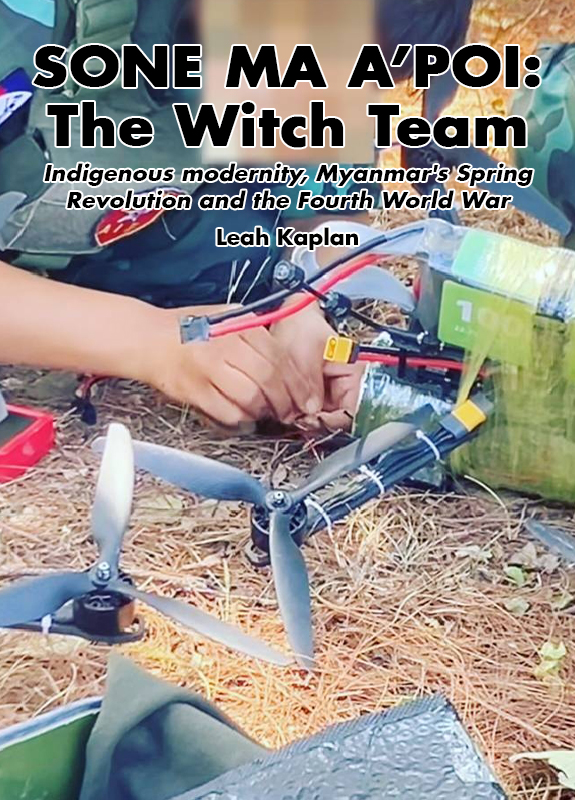
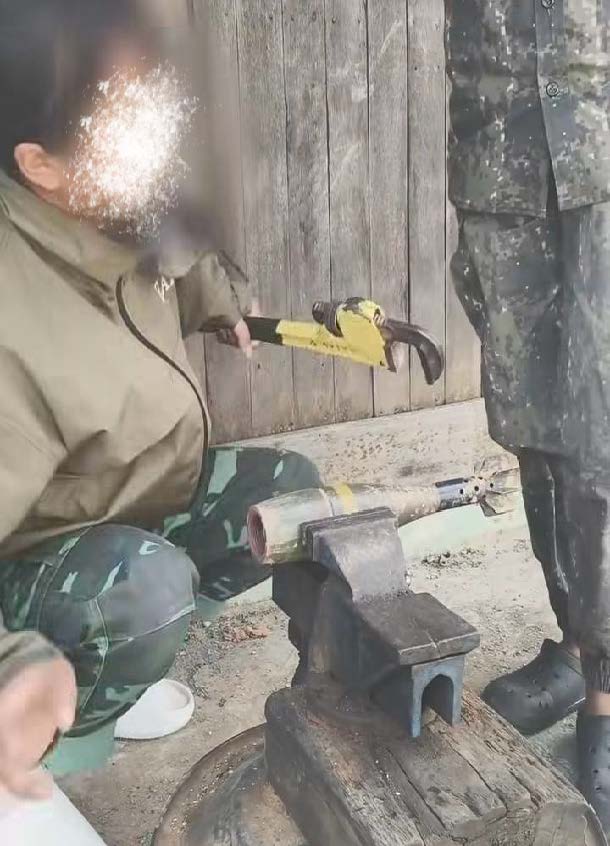
A large cauldron bubbles on an open fire, steam rising from its round black base. In the corner a wooden broomstick leans against the wall, knobbly handle flowing down into a roughly tied collection of sticks poking out at odd angles. To the right of the cauldron a cluster of young women sprawl across the floor, surrounded by tape, wires and batteries. A bluetooth speaker blasts a rotating medley of Burmese pop, Chin alt-rock, and the worst American top-40 from ten years ago. To the left of the broomstick sits a fat, half empty sack of rice, and past that piled against the wall is a large stack of munitions, liberated from a nearby enemy base and reanimated with coat hangers and stripped copper wire. S., our munitions expert, sits cross-legged with her multimeter testing connectors, while our pilot shows one of the new girls how to connect antennas to the flying monkeys. I sit with a roll of packing tape, listening to it stretch and crackle over the music as I wrap drones, batteries and munitions together into a tight package, to be sent off tomorrow morning, express airmail. When we have finished prepping our drones for tomorrow I grab the broom from the corner and start sweeping up our workspace, while another girl checks the bubbling cauldron. The rice is almost ready, and the leftover curry from lunch is still warmish. We wash up and prepare to sit down for our evening meal.
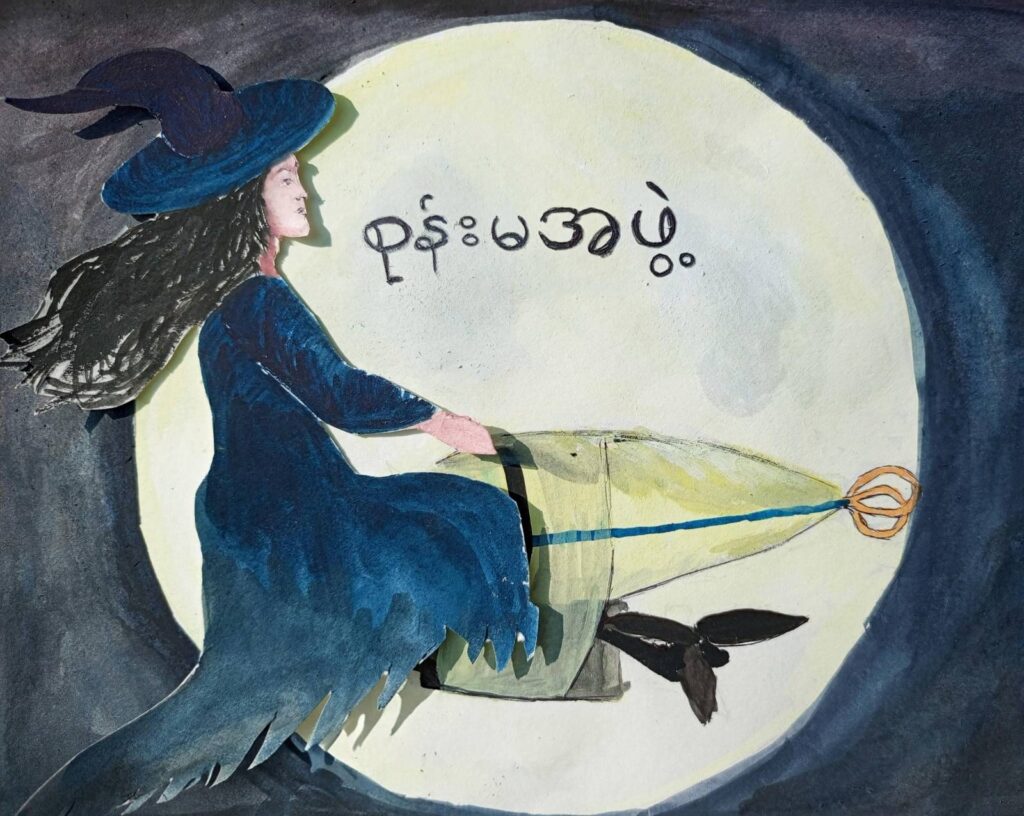
After dinner the girls move into TikTok dances, a nightly ritual. They are a magnificent fusion of popular trends and traditional Chin and Mizo dances, flowing seamlessly into each other. The traditional Chin dance has a bird- like quality to it, a swooping and circling and flapping of arms that the girls tell me is meant to imitate the Great Hornbill, a sacred bird native to these mountains with deep cultural ties to the Chin and Mizo peoples. The Hornbill is everywhere here, on flags and patches and painted on buildings, and from the corner of your eye you can almost see it taking flight. I am much too old for TikTok dances, but I watch the girls as their laughter boils over, hotter than rice, and a warmth and softness settle in my chest. They are Sone Ma A’Poi, the Witch Team, casting spells from the mountaintops with a drone and a broomstick.
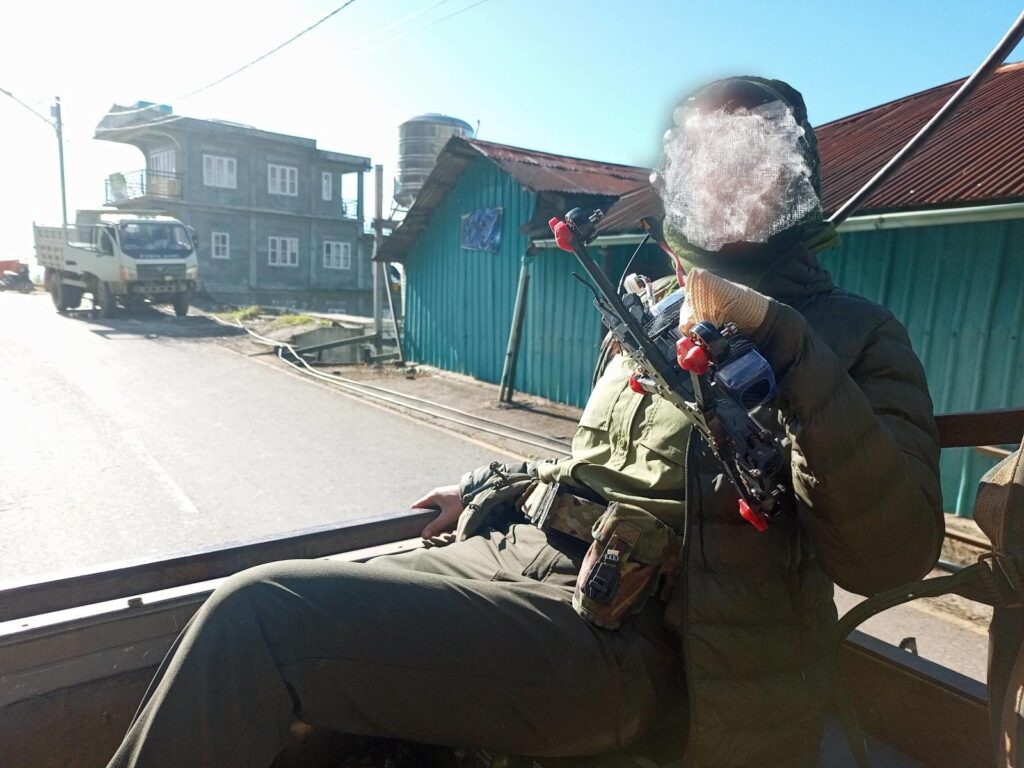
Sone Ma A’Poi is the first all-women’s FPV drone team in Myanmar, and one of the first in the world. Though mostly Chin, women come from all over the country and even across the world to train and fight here. They are mostly in their late teens and early twenties, a selection bias probably related to the nature of the technology, and their fingertips crackle with what to my elder millennial eyes is clearly magic. “Sone Ma A’Poi,” the Witch Team. Our youngest pilot chose the name. She loves to fly. It strikes me that the iconography associated with witches in the West—cauldrons, wooden brooms, etc.— is not only traditional tools of women’s domestic labor, but also persistent technologies of indigenous daily life in many parts of the world. The demonization of “witches” has not only served to suppress women’s traditional knowledge and power, it has also been one of many tools used to vilify and isolate indigenous lifeways, casting indigenous people as evil, uncivilized, ancient and frozen in time. The indigenous witches of the Chin hills are anything but ancient. They are explosive, burning with youth and life, drawing power from their sacred past and global present to forge new indigenous futures. They are the creators of indigenous modernity, and they are waging war against everything that stands in their way.
Every girl has a story that brought her here. Some came fleeing abusive homes, some were raised in families who have been in the revolution for generations, some are the sisters and daughters of martyrs, some spent years tortured in junta prisons, and some took to the streets of Yangon or Naypyidaw during the coup in 2021, and were driven to take up arms as they watched their comrades brutally gunned down at their sides. Their lives and stories are as diverse as the lands and cultures they come from, hailing from every corner of one of the most ethnically diverse countries in the world. Throughout time and across continents, mountains have been the destination of rebels, refugees, guerrillas, people escaping enslavement, repression, conscription and state violence, indigenous people resisting colonial encroachment, and those who refuse to be governed by state power. Even for those who remain in the lowlands, knowing that there are people living freely in the hills is a source of hope, a promise that another life is possible. From Nicaragua to Chiapas, Kurdistan to Zomia, the promise of a free life in the hills kindles a spark of resistance in the eyes of those who turn their gaze upward, to the horizon beyond the city.
Taking to the hills: shatter zones, EAOs and the Spring Revolution
On February 1, 2021, the world watched on Facebook as black vans rolled in behind Khing Hnin Wai as she recorded a fitness video in the streets of Naypyidaw. Behind the technopop and bouncing spandex, a military coup was under way that would displace the democratically elected National League for Democracy (NLD), restoring to power the military dictatorship that had ruled Burma/Myanmari for nearly 50 years before the NLD took office in 2011. Aung San Suu Kyi, charismatic figurehead and chairperson of the NLD, was arrested along with other key members of her cabinet, and remains in military detention at the time of writing in March 2026. ii A state of emergency was declared, curfews were imposed, dozens of ministers and deputies were deposed and detained, military generals reigned over the halls of parliament and tanks rolled through the streets of Naypyidaw.
The nation exploded. Within days, hundreds of thousands had taken to the streets of Naypyidaw, Yangon, Mandalay, and across the country. Industrial workers organized strikes, students led walkouts and boycotts, and community groups and organizations from every walk of life flooded the streets, rejecting the coup and refusing junta rule. Repression was swift and brutal. Civil protests were met with live fire, entire neighborhoods were placed under siege, internet and cell service were cut across the country, and raids and mass arrests terrorized protesters. Within the first two months over 700 protesters were killed,1 a number that would climb to over 7,000 over the coming years.2 Popular resistance had less to do with love for the NLD and more to do with hatred for the military and its brutal repression. “Most of the people in the country knew [the NLD] wasn’t real democracy,” explains youth protester and photojournalist Andy in an interview with It Could Happen Here. “I think Aung San Suu Kyi used to be this hope that was the opposition against the military, but once she got power she couldn’t do all the things she promised to do. Before we looked at her as hope for everyone, for all the ethnic groups in the country, but once she came to power she mainly focused on the Bamar people. The military was still killing people, killing ethnic groups, so for the ethnic groups, what’s the difference?”3 But despite the NLD’s failures, the Tatmadaw (Burmese military) was an unambiguous villain. The dictatorship’s cruelty brought people into the streets, and the power of of collective solidarity kept them there. “I’ve never been to protests,” Andy recounts, describing the early days of resistance after the coup. “When I went there, the first day I arrived there were 200,000 people on the street protesting. This big group of people walking street after street, and everyone coming out of their house and we have this symbol, three fingers, from Hunger Games I think, that’s our symbol for democracy, for our movement, and everyone comes out of their house doing that, giving us water, food, everything. It was something else. From that day I was hooked. I was like ok, this is what I’m going to do now.”4 The military dictatorship, which had oppressed and terrorized the people of Myanmar for decades, welcomed itself back to power with totalitarian fervor. In doing so, it stoked the fires of rebellion, and kindled solidarity among wildly diverse communities and sectors of society.
In the face of vicious repression, resistance escalated. What began mainly as strikes and peaceful protests evolved quickly into occupations, barricades, slingshots and molotovs. As the military used lethal force against unarmed protesters, the protesters began recognizing the need to arm themselves, to defend their comrades and communities against the junta’s violence. Many young people started making homemade guns and building improvised explosive devices. The Tatmadaw eventually regained control of most major lowland cities, but resistance in the villages and countryside grew. Former leaders ousted during the February coup reconvened in April, forming the opposition National Unity Government (NUG) in exile, including its armed wing, the Peoples Defense Force (PDF). While many young people joined the PDF, the force was new, scattered, disorganized and inexperienced. Many more youth realized that if the budding resistance wanted to defeat the dictatorship, their best bet was to turn to the country’s experts in revolution: the hundreds of indigenous ethnic minorities who have been waging war against Burmese colonization since before the creation of the Burmese state in 1948. Alex, a young Bamar revolutionary, explains in an interview with It Could Happen Here how most Bamar people are raised to see ethnic minorities, and especially the Ethnic Armed Organizations (EAOs) resisting in the mountains, as barbarians and terrorists. “Before this we had been brainwashed by the military pretty much our whole life. We always thought ethnic groups will kill us whenever they see us, they are just terrorists… and I was kind of scared to join them because I didn’t know how to live there or if they were going to kill me just because I don’t speak Karen.”5 Yet despite these fears, he and hundreds of other Bamar youth went to train with the Karen National Union and other EAOs resisting in the mountains. “During my time there I did some observing of them,” Alex explains. “It’s not the Karen people fighting the military. The military has been invading Karen land, burning down their villages, raping the women, killing the people for many years. So they can’t do anything except fight back. They have to fight back to protect their land.”6
This shift in how Bamar youth understand the plight of ethnic minorities is transforming the landscape of the revolution. Like so many generations before them, young rebels and refugees are fleeing oppression in the lowlands, joining the barbarians in the shatter zones looming just beyond the horizon.
Zomia
In The Art of Not Being Governed, James C. Scott describes highland Southeast Asia as a shatter zone, a place of refuge where people have been fleeing states for thousands of years. He refers to the region as Zomia, the same Zo as in Zoland and Mizo, a native word used to refer to many of the peoples of this region, with “mi” meaning “people” in most local dialects. The geographic and social landscape of Zomia has made the territory virtually ungovernable, and for thousands of years native communities have resisted colonization by lowland paddy states, ancient empires, Burmese kings, British colonists, and now a brutal military dictatorship. The hundreds of ethnicities that have blossomed in these hills have not simply been a force outside of states. They have constructed themselves in direct opposition to statehood, creating social, agricultural, architectural, linguistic and political structures that resist colonization, reject statecraft and refuse state-formation.7 I will not reiterate Scott’s entire work here, but will direct readers to him for a more detailed historical analysis of these structures. His work is also available in audio, for those of us who prefer the medium.
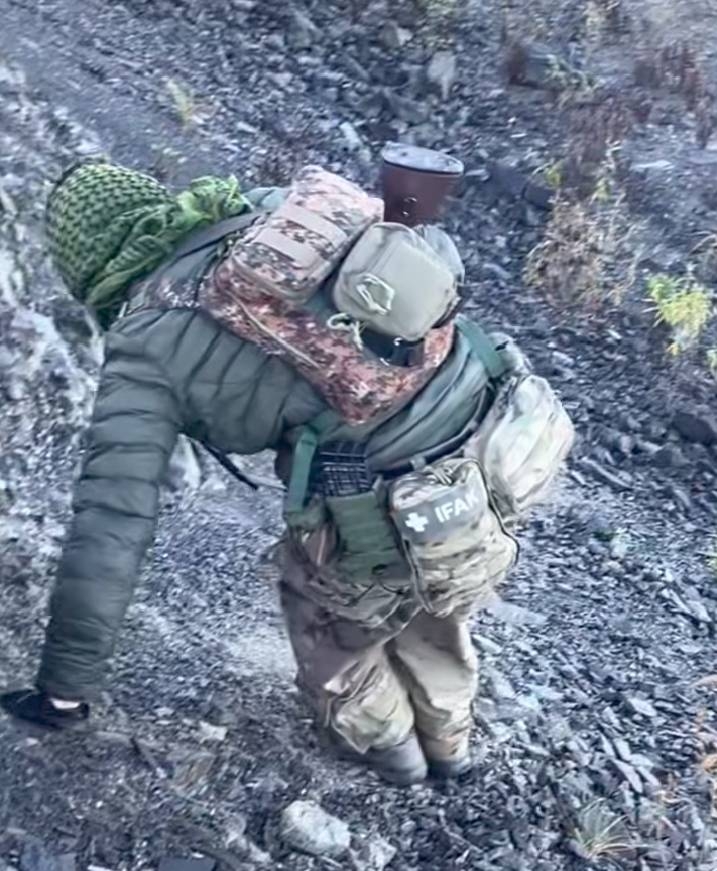
Hidden in a bush with my eye pressed to a spotter scope, I can’t help but conclude that Zomia remains as ungovernable as ever. I watch an enemy soldier struggling to figure out how he will carry his fat yellow water jug up a hill so steep it requires hands as well as feet to ascend. The zoom on this thing is so good I can see the sweat collecting on his brow. The enemy has sent over a thousand troops and spent millions of dollars to conquer this territory, yet a small and decentralized collection of guerrilla armies working in loose collaboration has held off the dictatorship for over a year now. The front line I am watching has not advanced in months, despite the unfathomable numeric and technical superiority of the enemy. We will do everything we can to prevent them from advancing, but even if they do, they will not be able to govern this land for long. They have never been able to.
The indigenous peoples of Zomia have not only resisted colonization for thousands of years, but have also been a refuge for lowlanders fleeing slavery, conscription, debt peonage, displacement, and state oppression. While Scott discusses this history in depth, I have the privilege of watching it in real time. After months learning the local indigenous dialect, a new wave of trainees has arrived, coming from as far as Yangon and Karen territory. Many are Bamar youth speaking Burmese, others are different indigenous groups speaking their own languages, but as Burmese is the shared second-language for most indigenous peoples, all our trainings and programming are now switching to Burmese. I feel like a baby, back at square one. There are new dishes being cooked now, and notably more fried foods. The banana fritters the Burmese comrades make go hard. Some of the comrades are simply here to be trained in sniping and FPV drones, and when finished will return to their own lands and armies. Others will undoubtedly stay. The communities of Zomia have for thousands of years been making and remaking themselves this way, absorbing refugees from the lowland states who have decided they are done being governed.
As Scott describes, ethnicity is a political construction. Ethnic categories are not static and eternal, but rather are constantly being created and recreated in relation to changing political circumstances. To be “ethnic” is itself a political positionality, an identity constructed in opposition to the dominant (non-ethnic) society. Scott describes the creation of the “tribe” as a schismogenic political position. The concept of “tribes” was created in contrast to its opposite, the “peasantry,”8 and in the context of 21st century urbanization increasingly to the urban “citizenry.” While the peasant/citizen are state subjects entrenched in an agrarian or industrial economy, tribes exist at the fringes of civilization. They are the barbarians at the gates, or the terrorists in the mountains, and their existence gives dominant non- ethnic (read state subject) identities their unity and political coherence. To be ethnic is inherently a resistance positionality, a self-definition against the dominant society. It is, in a word, to be a terrorist. Nowhere is this clearer than in the case of the Ethnic Armed Organizations (EAOs)iii that have been challenging Burmese state encroachment since the state’s founding in 1948. Burma’s formal independence from Britain and creation as a nation state coincided with the founding of the Karen National Union (KNU), an EAO demanding autonomy for Karen people in the mountains bordering Burma and Thailand. The KNU has been waging war against the Burmese government since 1949. The Kachin Independence Organization (KIO) in the Kachin territories bordering China and India has been fighting the Burmese state since 1961, and the Shan State Army was created in ’64, a merger of several existing EAOs that had been fighting Burma since the ’50s. There are 135 officially recognized ethnic groups in Myanmar, and 25 formally recognized EAOs, though in reality there are many more, especially since the coup in 2021.9 Many ethnic groups have multiple EAOs, some working in collaboration, others locked in conflict with each other as well as with the dictatorship. Within formally recognized EAOs there are many chapters and branches with varying degrees of autonomy, many operating independently on the scale of one or two villages with little coordination between local and centralized leadership.
The EAOs have been central players in Burmese politics for as long as the state has existed. They are not only crucial armed actors in the conflict, but also essential players in Burmese state narratives, and in the schismogenic construction of Burmese identity. They are the “terrorists in the hills,” the barbarians against whom the “civilized” Burmese citizen can be imagined. Burmese identity has always been contested, especially given that ethnic minorities constitute a third of Myanmar’s population. But the mythology of the “terrorists in the hills” has been under exceptional strain since the coup, as Bamar revolutionary youth and EAOs join forces against the dictatorship, and Bamar majority resistance groups take to the hills to train and fight.
Democratic Federalism
Framing the ongoing conflict in Myanmar as a “civil war” is a political move, one that presumes that the EAOs will eventually lose, and that their territories will be subsumed into the Burmese state. By framing the war as “civil,” we naturalize the borders imposed by British colonists, and affirm the junta’s claim to govern a singular, unified territory, invisiblizing its colonial expansionist aspirations. The resistance forces do not describe themselves as fighting in a civil war, but as waging revolution. While the political aspirations of EAOs are often reduced to “ethnonationalism” in public discourse, the reality is much more nuanced and complex. While some EAOs express explicit desire to establish a state, most emphasize broader ideas of independence, autonomy, self-governance, and democratic federalism.
While there are far too many EAOs to do a full textual analysis, a look at communications from some of the largest and most influential groups reveals both diversity and common themes. Shan State currently has more than 15 EAOs operating, representing a wide range of ethnicities and articulating many political platforms. Some collaborate, some are at war with each other, others both collaborate and wage war against each other, depending on the time, place and circumstance. Of all the different modes of engagement, this last one is probably the most common. Some are committed to full autonomy, others seek self-governance within some sort of democratic federation, others want a “two systems” model of dual governance with rival factions.10 The situation in Chinram, where I am fighting, is very similar. The Chin National Army (CNA), founded in 1988, has found itself in the company of over six new EAOs since the coup in 2021.11 These groups have shifted between various alliance formations, including the Chin Brotherhood (CB) in 2023 and the Chin People’s Union (CPU) earlier this year (2026). While conflict between CNA and the newer EAOs formed since the coup has at times escalated to armed struggle, CNA and CB have been fighting together on the front line since the junta launched its renewed offensive in October of last year. The majority of my time here has been spent fighting side by side with both factions on the front line. Several of the witches with large social media followings have been working to help strengthen these alliances, posting joint CB/CNA selfies from the front and uplifting content advocating cooperation. While these developments are essential, it would be a mistake to dismiss the conflicts between Chin factions as simply “in-fighting.” The divisions are rooted in contradictions that long predate any currently existing organizations. The war against the junta does not magically erase centuries of tribal politics, class conflict, and the myriad social contradictions that shape all human communities. There are wars within wars.
While the Kachin Independence Organization (KIO) was once committed to the establishment of an independent state, its goals are now to “build a new union based on a federal system that ensures self-governance and self- determination, equality for all ethnic groups, and the right to share power and resources.”12 While we could read this as a compromise or scaling back of ambition, to do so would be presumptive. We could just as easily read the shift away from statist aspirations as a reaction to the failures of 20th century state nationalism, and a desire to move toward more flexible and adaptive models. The former is only assumed because our current political paradigm assumes a priori the supremacy of the state form, and unquestioningly defines statehood as the goal of all independence movements. While the Karen National Union (KNU) explicitly calls for a state, it is demanded in the context of “a genuine Federal Union comprised of all the states of the nationalities in Burma on the basis of Liberty, Equality, Self-Determination and Social progress.”13 Again we see self- determination and federalism as core tenets of the revolution’s political aspirations, with an emphasis on communal autonomy and intercommunal cooperation.
Almost no EAO or other revolutionary group articulates a specific vision for what a federal system might look like. Western political commentators assume a priori that it will be a state formation, yet it is almost never explicitly described as such. While federalism is often understood to be a system of semi-autonomy united under a central federal government, decentralization and maximal autonomy are emphasized by every EAO I am aware of. Confederalism might be a better word for what most EAOs describe as their political goals. While similar in concept to federalism, confederalism generally emphasizes a greater degree of autonomy among federated members, and does not generally imply unity under a central governing body. While the idea of confederalism may be less accessible to most EAOs due to its relative global marginality, the concept more closely approximates the practical aspirations and expressed visions of indigenous revolutionaries across Myanmar. The Kurdish revolution, guided by the ideology of democratic confederalism as articulated by Abdullah Öcalan, has not missed this resonance, and has been actively cultivating solidarity with the revolution here. The solidarity flows both ways. Many of the revolutionaries here are deeply inspired by the Kurdish movement, and the works of Abdullah Öcalan have been translated into Burmese. The chant Amiudami Buah, Lu’ Miau Jie, Burmese for Women, Life, Freedom, a central slogan of the Kurdish revolution, has become a daily incantation on the Witch Team.
This push against centralism and toward decentralized models that might be better understood as confederal becomes especially clear when we look at the differences between the EAO’s articulations of federal democracy and the real structures and policies of the National League for Democracy over the course of their five years in power. The NLD also claimed to be building a federal democratic union, and yet its model for such a union was ultimately centralized governance under Bamar-majority rule, reinforcing policies and practices that infringed on the freedom, sovereignty and human rights of ethnic communities. As Alex and Andy discovered when they took to the hills to train with Karen revolutionaries, and as my Burmese comrades and I are learning here in Chinram, for ethnic communities, the NLD was mostly just more of the same. They continued the junta’s policies of expansionism, land annexation, and resource confiscation, and the NLD’s talk of self-determination for ethnic communities was mostly just that–talk. Because of this legacy, partnership between the EAOs and the National Unity Government has progressed cautiously. While the NUG’s charter expresses commitment to ethnic self- determination under a federal democratic framework, the reality that the NUG is led primarily by NLD leaders in exile has caused many EAOs to approach collaboration carefully, forging utilitarian alliances while taking care to protect their autonomy.
Returning to the lowlands
We have discussed how lowlanders have been fleeing to the hills for centuries. A powerful development since 2021 is that the hills are also coming to the lowlands. The revolution has seen a blossoming of Bamar- majority revolutionary organizations going to the hills to train, and then bringing the war back home. Most of these organizations share similar demands to the EAOs: communal autonomy, self-determination, equality and federal democracy. Foremost among these is the Bamar People’s Liberation Army (BPLA). BPLA is unique in describing itself as an EAO for Bamar people. In doing so it challenges the foundations of Bamar supremacy by situating Bamar people as one of many ethnic groups, indigenous to some but not all parts of Myanmar. According to Maung Saungkha, an activist, poet and chief commander of the BPLA, “among the objectives of the Bamar People’s Liberation Army are to end the dominance of Bamar Buddhists over other ethnic groups and to strengthen the unity of Myanmar’s diverse ethnic groups under a federal democratic union.”14 Formed after the coup in 2021 in response to the brutal repression they faced as street protesters, Saungkha and 16 of his comrades went to the hills to train with the KNU. In doing so they gained not only military knowledge and experience but also a deeper understanding of the plight of ethnic minorities and the consequences of Bamar supremacy. The decision to found their own specifically Bamar EAO was an assertion of both self-determination and ethnic solidarity. “We established the BPLA as an ethnic Bamar armed group and not a group under the NUG’s command,” Saungkha explains. In doing so they sought to “prove that we Bamar are equal to other ethnic groups in Myanmar and ready to build a union in equality.” After three years training and fighting in the mountains, they returned in 2024 to fight in Bamar majority areas in the lowlands of central Myanmar. “We are a Bamar armed group and we always wanted to be based in Bamar-majority territory,” Saungkha asserted in a 2024 interview. “Some say that the BPLA is moving to central Myanmar but this is wrong: we are returning.” 15
Another key player in the Bamar-majority resistance is the Student Armed Force (SAF). Students played a leading role in the 1988 uprisings, and have continued this legacy through the Spring Revolution, leading strikes, protests and street resistance. The first casualty of what would become the Spring Revolution was a 20-year-old student, shot by junta forces in Naypyidaw. The SAF was particularly active in Yangon, and after experiencing brutal military repression turned to the Arakan Army for support and training. While less focused on federalism and indigenous autonomy, they express a commitment to “fight[ing] in alliance with all oppressed people who are trying to create their own destiny,” 16 a softer echo of the same themes. Then there’s the Buffalo Soldiers Freedom Force, iv operating in the lowland Bamar majority areas of Sagaing and Shwe Bo. Their trajectory was similar to the SAF, engaging in street protests until the military’s violent repression led them to the hills to train with the KNU. “Our main goals are self-determination and federalism, which many ethnic groups have wanted for a long time,” a spokesperson for the group explains in an interview with the Yangon Anarchist Association. “A lot of young revolutionaries, mostly working class, have traveled far to get military training from different rebel groups, including us.” The interviewee goes on to assert that “we believe that in a democracy, power belongs to the people. That’s fundamental. Personally, I prefer the grassroot participatory democracy, a more libertarian system.”17 The Buffalo Soldiers emphasize that they are not affiliated with the NUG and do not support any one political party, but rather are focused on building their military capacity and defeating the dictatorship. There is also the communist People’s Liberation Army, inactive for over 30 years, that has reactivated since the 2021 coup. They are currently fighting in the jungle alongside the EAOs, and are focused primarily on building alliances and strengthening their military capabilities, with far less emphasis on political ideology.18 In addition to these groups there are countless autonomous “People’s Defense Forces” that use the name but are not actually under the command of the NUG. PDF Zoland here in the Chin hills is one such group. They are a local, youth-led, grassroots resistance force organizing autonomously to defend themselves against the dictatorship, in close collaboration with other local EAOs. There is no direct line of communication or chain of command with the NUG. Rather, the idea of the “PDF” is a symbol of the resistance born during the 2021 coup. This resistance has a life of its own, and its spirit reaches far beyond the control of the NUG or any other central governing body.
Coalitions
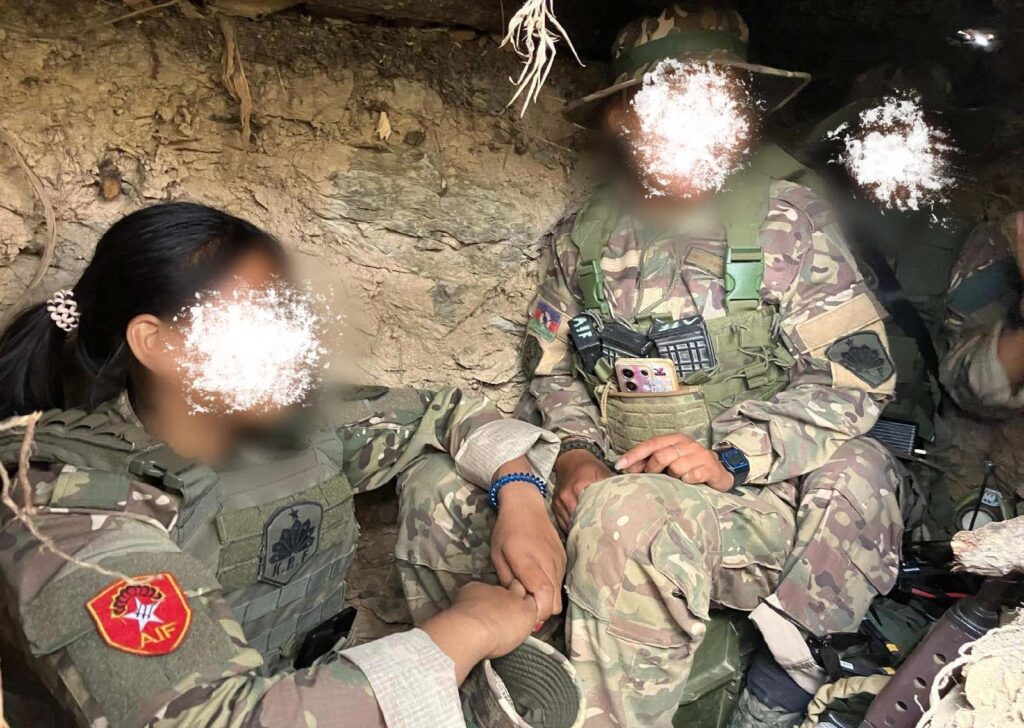
EAOs and Bamar-majority revolutionary organizations have formed a wide range of alliances. These formations have been diverse, complex and sometimes tumultuous, and are constantly shifting and evolving. While there have been significant challenges and sometimes bloody conflict within and between alliances, these coalitions have ultimately been the lifeblood of the revolution, giving shape, structure and power to a wildly diverse collection of resistance forces. Though practical and at times utilitarian, these coalitions are not just temporary tools to accomplish specific goals. They are a form of intercommunal praxis, creating a lived experience of federal cooperation that can set the stage for a functional federated union or other confederal structure.
One such coalitional is the General Strike Committee of Nationalities (GSCN), formed in 2021 in response to the coup. The GSCN is a coalition of 31 ethnic groups, and has played a leading role in street protests and the Civil Disobedience Movement. Their statements highlight for the broader anti-coup movement how ethnic minorities have been repressed by and have been resisting the government in Myanmar long before 2021. “For some, the nightmare has returned, but for ethnic people, the nightmare never stopped,” declares Karen activist Esther Wah in a public statement on behalf of the GSCN. “But just as our nightmare did not start with the coup, neither did our struggle.” She goes on to outline the demands of the GSCN: “release political detainees, abolish the dictatorship, abolish the 2008 Constitution, and build a federal democratic union based on equality and the right to self-determination.”19 Among the EAOs, coalitions and alliances constitute the basic organizational structure of the revolution. Most EAOs are a member of several, with new ones forming every few months. While there are far too many to list here, one major one worth naming is the Three Brotherhood Alliance, comprised of three of the largest EAOs: Arakan Army, Myanmar National Democratic Alliance Army, and Ta’ang National Liberation Army. Formed in 2019, its creation marked a significant development for the resistance. In October of 2023 they launched Operation 1027, a massive offensive against the Tatmadaw in northern Shan State. This offensive has made significant gains against the enemy, and has received overwhelming support from revolutionary organizations across Myanmar.
If the Three Brotherhood Alliance represents coordination between the largest resistance organizations, the Spring Revolution Alliance (SRA) represents the opposite side of the spectrum. Formed in December 2025, the SRA brings together 19 smaller armed resistance groups, operating independently of the NUG and the “Big Beasts,” Myanmar’s large and long- established EAOs. Among the members of this coalition are the Karenni Nationalities Defense Force, Bamar People’s Liberation Army, Chin Brotherhood, Danu People’s Liberation Front and Student Armed Force. “Now the junta is preparing to stage a sham election, and some major ethnic armies are entering ceasefire arrangements, so smaller, more scattered resistance groups like ours need a coordinated path forward,” explained Khun Bedu, a prominent Karenni activist, KNDF leader and SRA spokesperson in an interview just before the 2025 sham election.20 Through our partnerships our team is closely connected to this new formation. We are excited for the opportunity to share our skills and grow our work, and for the broader political possibilities this independent alliance opens. There may be some new witches in the making soon.
Fourth World Resistance: indigenous autonomy and intercommunalism on ungovernable lands
The conflict in Myanmar is viewed as chaotic and incomprehensible in the West because it does not fit into the paradigms of Western colonial politics. Neither liberalism nor Western leftism can grasp the conflict, because the Left/Right binary we imagine as universal and absolute does not meaningfully map onto the local political landscape. Attempts to superimpose the model obscure more than they clarify. But viewed through the lens of indigeneity and indigenous resistance, the conflict has remarkable political coherence and global resonance.
As discussed previously, ethnicity has always been a resistance positionality. But the history of 19th and 20th century ethnonationalist revolutions has reshaped our understanding of the term. While once synonymous with tribality, ethnicity is now almost always assumed to be nationalistic and striving towards statehood. Nationalism itself is assumed a priori to be statist, whether or not it articulates itself as such, and whether or not the lived realities of the societies involved are anything like a state. In this context, adopting the framework of indigeneity is useful because it rearticulates the terms of struggle. Indigeneity refuses the state’s narrative of “minority separatism,” and instead frames the conflict in terms of global anticolonial resistance. Indigeneity reframes the discourse to more accurately account for what is being contested: relationships to land, community, state and society.
Like ethnicity, indigeneity is a political positionality. It is a relationship to both land and social organization, and though invariably a resistance position, it is not simply schismogenic or oppositional. It is a critique, a proposal, and a lived reality, a collection of worlds within worlds locked in an ontological battle for the soul of humanity’s future. Indigeneity rejects the entire colonial world order, including the limits of its political binaries and social imaginations. It proposes radically different political structures, forms of sociality, and relationships to land and life.
George Manuel describes indigeneity as the Fourth World, a world that already exists within and against the existing colonial world. Its foundation is self-determination, and its practice is intercommunality. Indigeneity centers cooperation without incorporation, and practices interdependence built on respect for the autonomy of diverse communities. It is by definition multitudinous, the living manifestation of the Zapatista demand for un mundo donde quepan muchos mundos, a world where many worlds can fit. “The route to be followed to the Fourth World will be as diverse and varied as are the Indian tribes,” Manuel asserts. “The Fourth World is not, after all, a Final Solution. It is not even a destination. It is the right to travel freely, not only on our road but in our own vehicles.”21
While not necessarily anti-nationalist, indigeneity is a position against the state. It is a critique of 20th century Third World movements that imagined victory as the mere establishment of independent states, modeled after colonial governments and understood through colonial political paradigms. As Vine Deloria Jr. describes in her forward to The Fourth World: An Indian Reality, “[Manuel] rebels at the thought of the national state which is so rigid and shortsighted as to attempt to substitute ‘citizenship’… for the living cultural traditions of peoples.”22 Manuel argues that “no contemporary political and economic structure has to be,”23 and that political structures must reflect and serve the communities they shape, rather than imitating models imposed by colonization. The Fourth World does not seek state-formation but self-determination, a project rooted in indigenous epistemologies and shaped by indigenous lifeways. In doing so, “the Third World will no longer need to imitate and compete with the European empires from which they have so recently escaped.”24 The Fourth World critique of Third World politics comes from indigenous peoples excluded from Third World liberation movements due to their geographic location under the boot of settler colonies like the US and Canada. That said, its application in so-called Third World contexts sheds light on the perceived chaos and “civil wars” that followed formal decolonization in most of the world. The newly liberated Third World “nations” have never been singular, unified nations. Rather they are an amalgamation of indigenous communities with a diverse array of cultures and lifeways, and with their own histories of conflict, power, and colonial relations. The modern nation state of Burma (now Myanmar) was imposed on a territory already enmeshed in centuries of conflict and colonial struggle between lowland paddy states controlled by the Bamar majority (itself a politically constructed and contested category) and a wide range of mountain peoples whose land, resources and freedom were constantly encroached upon, and whose communities straddle the colonially imposed borders with India, China, Thailand and Bangladesh. To imagine that a Bamar nationalist project which had failed to conquer these mountains for hundreds of years could suddenly peacefully govern a unified Burmese ethnostate because the British sanctioned their “independence” is absurd and ahistorical.
A Fourth World framework allows us to understand this conflict within the context of its own colonial history and relations. Rather than imagining the peoples of Burma as a unified front against a monolithic Western imperialist enemy, we can situate them within a multifaceted matrix of colonial encroachment, class conflict, shifting regional alliances, intertribal relations, intercommunal cooperation, struggles for autonomy and competing visions of indigenous futures. The forces of indigenous resistance were fighting in these mountains long before 1948. They are alive and evolving, and are crafting indigenous modernity at the intersections of colonial violence and Fourth World resistance.
An essential intervention indigenous people are making in this revolution is a historical grounding in this longer history of colonization. In a statement on behalf of the General Strike Committee of Nationalities, Esther Wah, an indigenous Karen activist, describes how the war on indigenous peoples and theft of indigenous lands across Myanmar has not only been perpetrated by the junta, but also by the National League for Democracy, the elected government headed by Aun Sang Suu Kyi and disposed in the 2021 coup. The NLD spearheaded policies such as the Farmland Law and the Vacant, Fallow and Virgin Land Management Law in 2012, authorizing mass annexation of indigenous lands and displacement of indigenous peoples. “Land confiscation by the government and private companies became legalised,” Wah explains. “Land grabbing and natural resource extraction increased in ethnic areas that were subject to decades of brutal offensives by the military… Our customary lands were categorised as ‘vacant,’ as though we did not exist, and were subsequently handed out to private companies or local officials to control and exploit as they wished. Customary land tenure and rights, integral to our survival, have never been protected under Myanmar law.”25 This story, familiar to indigenous peoples all over the world, is a trademark of settler colonialism. The use of “nationalization” laws to facilitate the transfer of indigenous land, waters, timber and mineral resources to state and private actors is a colonial strategy displacing Fourth World peoples across the so-called First and Third Worlds.
Much of the language used by Manuel to describe the Fourth World echoes language used by EAOs to describe their political platform. Manuel proposes “the principle of ‘home rule’ institutionalized through some form of federalism or treaty-relationship”26 and argues that “an integration of free communities and the free exchange of people between those communities according to their talents and temperaments is the only kind of confederation that is not an imperial domination.”27 He uses the term “cooperative federalism”28 to describe such a relationship. This language echoes the language and practice of most EAOs, as discussed in the previous section. Their emphasis on self-governance, self-determination, autonomy and some form of federal democracy is a living manifestation of Manuel’s “cooperative federalism,” with all the messiness, conflict and complication involved in building such systems. The exact shape of these systems must, by definition, be created by the participants, through compromise, generative conflict and democratic collaboration.
The absence of a clearly articulated shared political vision is one of the main criticisms the revolution in Myanmar gets from the outside world, both from the liberal political establishment and from the Left. It is an old complaint “we know what you are against, but what are you for?” This criticism ignores the fact that negative solidarity may in fact be the strongest base for intercommunal resistance and Fourth World sovereignty. We are not fighting for a single, unified world in which we are all “for” the same thing. We are fighting for “a world where many worlds can fit,” as the Zapatistas say. Many worlds, but not all of them. There are many worlds we stand firmly against—the worlds of the colonizer, the white supremacist, the homophobe, the patriarch. It is precisely our negative solidarity that unites us without unifying us, allowing us to cooperate across difference, creating a base for respectful inclusion while maintaining communal autonomy. Anti-politics is a common thread in many 21st century indigenous revolutions, and may be the strongest basis for indigenous modernity.
Whether or not visions for the future of these lands imagine themselves as existing under a central state, we must account for the more fundamental question of what is actually possible here. No central state has ever been able to effectively govern this territory. Non-state social organization has been the daily reality here for thousands of years, and this legacy shapes people’s daily practices and political imaginations. In the West, non-state social forms are often described as utopian and unrealistic. Here, it may be that a singular, centralized state at peace with itself is the utopian and unrealistic fantasy. Regardless of intention, the revolution here is not creating a new state or states. It is creating a new framework for indigenous autonomy and intercommunalism, a world of many worlds. The revolutionary experiments unfolding in Myanmar are discovering what it could mean to build such a world. And where better to do so than in an ungovernable land?
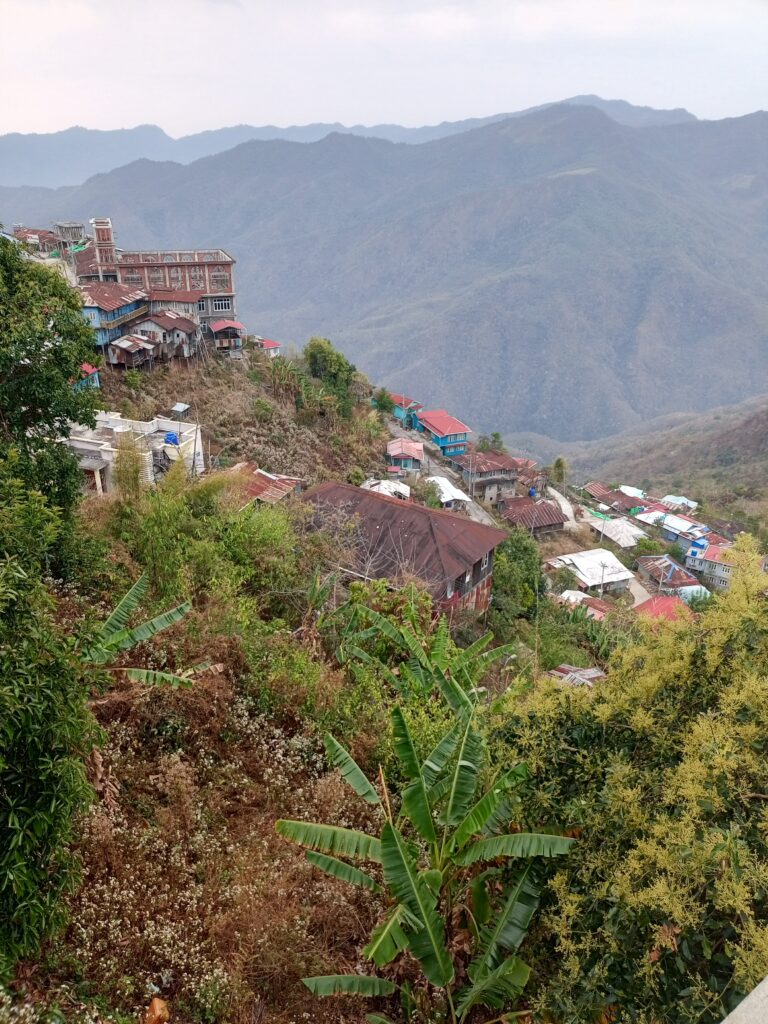
Chinram: indigenous modernity and the experience of not being governed
We wake half an hour before dawn and boil water on a fire next to the cauldron that has cooled with yesterday’s rice. After coffee, a banana and some cold rice we load into the back of the pickup, backpacks weighed down with batteries, wires and steel. The sun is just beginning to rim the hillsides, and my rifle bounces against my knees as we trundle down the pockmarked road. Between my armor, rifle and bag I must be carrying 30 pounds of gear, yet I feel lighter than I have ever felt. For the first time in my life, I am not under the boot of a state. Even squeezed between my plates I can feel my lungs expanding wider than they ever have before. I am not safe, not comfortable, not certain that I will be alive tomorrow, and yet I can feel something deep inside me breaking free from a cage I didn’t know was there. As a Westerner born and raised in one of the most draconian surveillance states in the world, to be sitting in the dawnlight with my enmity to the structures of power strapped openly across my back, knowing I am protected not by clandestinity but by the physical power of our collective resistance, is a freedom I have never known, and will never recover from. The cage inside me is broken. The bird has taken flight.v
We approach a bend in the road and slow to a crawl, pulling our truck off into a thick banana grove. We will walk from here, moving in the shadows before the enemy wakes. To assert that we are not under the boot of the state is not to claim that we are no longer in relation to it. Instead of under its boot we are now facing the muzzle of its gun, with the muzzles of our own pointing straight back. So long as states exist, to be stateless is to be at war. The freedom I feel is not freedom from fear or want, nor is it freedom from structures of power. Chin society, the rebel militias, the EAOs, the clans and the churches all have their own power structures, as do the supra-state forces of capitalist culture, the global economy, and neocolonial ideology. To be stateless is not to be outside relations of power, but rather to choose a particular position within them. It is to navigate the complex web of relationships beyond, above and below the state, and to confront state power with our unrelenting refusal to be governed.
There are forces in Chinram that would like to become a state to be certain, but by and large they are deeply unpopular, especially among the youth and those who have joined the revolution since the coup in 2021. “Politician” is an insult here, and the political ambitions of some traditional elites have not allowed them to secure a monopoly on popular representation or the legitimate use of violence within Chin society. Governance is an amalgamation of old and new, formal and informal, with kinship networks and village councils continuing to be the central governing structures. Larger organizations interface with the diaspora and external funders, but the daily social care, maintenance and decision making remain overwhelmingly in the hands of small tribal and village systems. Incarceration and punitive justice exist in a gray zone between the formal and informal, the mid-scale and the micro. I recently accompanied one of my commanders on a medical visit to a POW camp that also houses civilian prisoners. The patient I was treating was a civilian incarcerated for domestic violence, and though the military structure wasn’t really set up for him, they were housing him because his village was not ready to accept him back. There were ongoing conversations between his family, the village council, and the officers running the camp, trying to come up with a plan to eventually integrate him back into his village in a way that was acceptable to the people he had harmed. It was not an ideal system, especially as the POW camp was not equipped to meet his medical needs, but it was a flexible and organic system that engaged the specific needs of the prisoner, the people he harmed, and his broader community. Like so many things here, it is neither a template for a perfect free society nor “governance” as understood and inflicted by a state. These are the challenges, contradictions and compromises that shape the ceaseless creation and recreation of indigenous modernity.
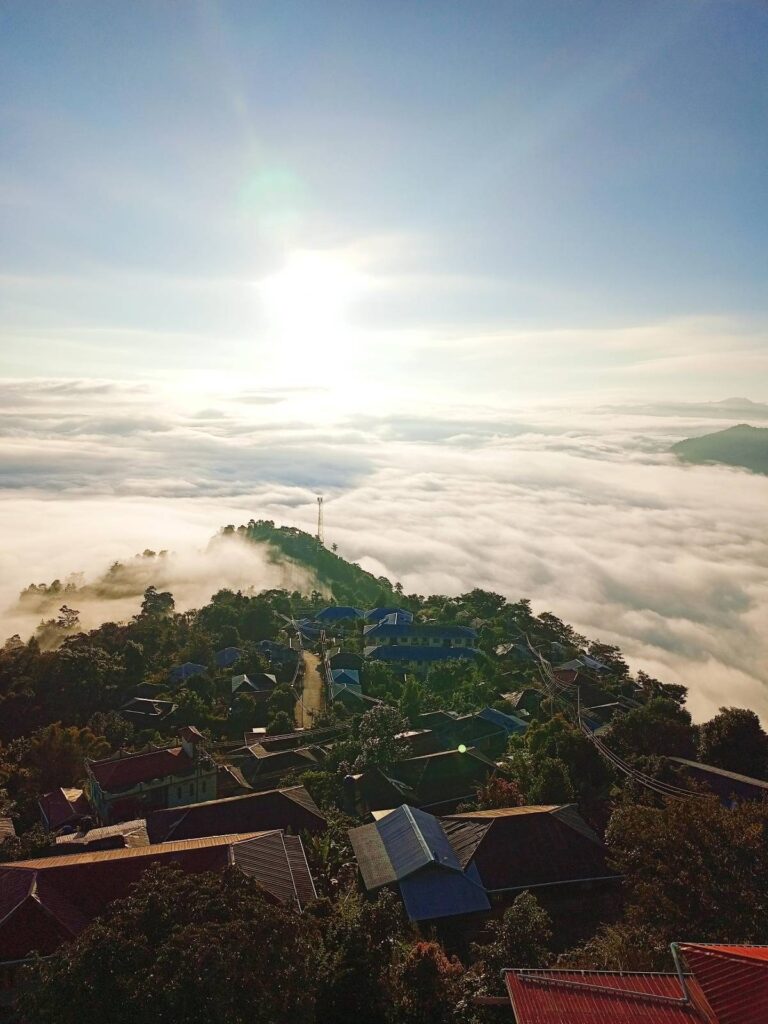
Indigenous modernity is being shaped in every corner, crest and gully of the Chin hills. Old fuses with new, the micro, middle and macro bounce off each other, and tradition, coloniality and innovation wrestle and synthesize to create new indigenous cultures. Water flows through bamboo pipes into PVC faucets, and houses dangle off cliffsides on wooden stilts with satellite internet mounted to their roofs. Rice has replaced corn, cassava and sweet potato as the staple, but small-scale subsistence agriculture, hunting and foraging remain the primary food sources, with only rice, oil, and various processed snacks and sodas imported from the lowlands. Young men ride motorcycles into the hills and then disappear onto ancient hunting paths, armed with rifles, arrows and blow darts. A common symbol in local resistance iconography is a rifle crossed with an arrow, the epitome of tradition and modernity uniting in indigenous resistance. I wear the symbol on patch on my right arm, the flag of one of our local allied armies. Crocs and plastic flipflops peak out from under traditionally embroidered skirts, woven on looms that clack in the shade of wooden porches. TikTok dances slide seamlessly into traditional Chin dances and back again. While most Chin people know at least some Burmese, the daily language is a dozen different local languages, often unintelligible within a day’s drive of each other. Just last week we had a bit of a debacle when our comrades, who are from less than a day’s drive away, struggled to communicate to a local shepherd that she couldn’t walk her goats down the road we were on because we hadn’t launched our drone yet and the bomb was armed. Sign language and a few shared words got the message across in the end, and the goats rerouted. “Pwak ding” sometimes says it all.
Perhaps the strangest fusion to my Western leftist mind is the role of Christianity here in Chinram. The vast majority of Chin people are Christian, converted by American missionaries in the early 20th century. As James C. Scott discusses, these hills are one of the few places in the world where Christianity was embraced with open arms rather than at the barrel of a gun. The embrace of Christianity in Chinram and throughout highland Southeast Asia is the continuation of a long line of prophetic and millenarian traditions among state-evading hill peoples in the highlands. These magical and millenarian traditions, of which Christianity is in many ways a platonic example, act as both a revolutionary promise in defiance of lowland slavery and colonial state encroachment, and as a marker of differentiation from the ethnoreligious majority of the lowlands.29 As a minority religion facing colonization by a Buddhist majority, Christianity has come to be seen as a resistance symbol and a marker of Chin/Mizo identity.vi Among the comrades I met, Christianity was universally and enthusiastically celebrated, even among grumpy teenagers, punks and goths. Rebellion does not mean rejection of Christianity here, because Christianity is itself a rebellious force. While many of the visual symbols of Christianity in Chinram imitate American protestant aesthetics brought by the missionaries, the practices are often fused with folk traditions and even some remnants of traditional animist religion.
One of the most uncomfortable consequences of the omnipresence of Christianity in Chinram is an aesthetic conservatism with no bearing on or relationship to real politics. Theoretical support for America, Israel and Donald Trump are all commonplace here, yet my extensive conversations on the topic with everyone from teenagers to the highest echelons of political leadership revealed not a single actually conservative position, nor even the faintest understanding of the meaning of political conservatism in the West. People here support Trump because he is Christian and claims to support Christians. The comrades here were universally shocked to learn that since taking office he has rounded up, sent to concentration camps and deported hundreds of thousands of immigrants, the vast majority of whom are Christian. I spent hours and days debating the higher ups in Chin political leadership, and can honestly conclude that the disconnect does not stem from anything like Western conservatism, but rather from the incomprehensible chasm in political contexts that separates Western colonial and Chin indigenous politics.
This chasm between First and Fourth World political imaginations explains both the failure of the Western media and political establishment to comprehend the conflict in Myanmar, and the failure of the Western Left to grasp its significance. Many leftists fall into the trap of a simplistic and ahistorical campism, imagining that the brutal military dictatorship in Myanmar is somehow opposed to Western imperialism because it is backed by Russia and China, despite the fact that it does absolutely nothing to resist US imperialism in the region, collaborates closely with Israel, and, most importantly, has been terrorizing its subjects for over 70 years. Even leftists who do not fall into this tired old campism often fail to comprehend the significance of the revolution here, because it does not articulate itself in a language that Western leftist political discourse can understand.
This is not a communist revolution, not an anarchist revolution, not a socialist, feminist, or even liberal democratic revolution, in any coherent or unified sense. It is an indigenous revolution, and the terms of discourse, shared understandings, and modes of engagement exist beyond and outside colonial paradigms.
As Manuel explains, “the imposition of models on those who did not have a hand in the design has been the problem throughout our history. Clearly, the right to design our own model is the first step toward the Fourth World.”30 The models of indigenous resistance being designed in Myanmar are a mixture of new and old, crafted from a thousand different histories and built with “all the ingredients that the tides of history have washed up on our shores.”31
If the Left does not want to be discarded with the rubbish of our 20th century failures, we must reckon honestly with them. Our old ideologies have failed to create the world we’ve been dreaming of, and yet we continue to cling to them, and then wonder why the world has passed us by. The Left has long since ceased to be a meaningful force in global politics. New forces of resistance to imperial domination have arisen. The most obvious of these is political Islam, a global force as complex, diverse, and at odds with itself as the Left has ever been. The Left’s inability to understand and engage with political Islam has reinforced our global marginality, and undermines our ability to map and confront the shifting forces of global power. It has also crippled our ability to engage meaningfully with the current war in Iran, and with the multifront resistances being waged across borders, communities, and political positions throughout the Middle East. Boring, oversimplified campism, orientalism, and liberal hand ringing all supplant a meaningful analysis of the conflict rapidly unfolding in the region.
The other global anti- imperialist force reshaping the world is something even less defined, more amorphous and fluid but no less powerful. It is the ceaseless wave of decentralized, grassroots youth uprisings, mostly led by indigenous peoples across the so-called Third World. The countless Spring revolutions, Gen Z uprisings, “ethnic conflicts” and “civil wars” that have already shaped the 21st century may not share a coherently articulated political analysis, but they share a shape, spirit, position and promise. The war here in Myanmar is perhaps the clearest example of this pattern unfolding across the globe, and its meaning and consequence are still being written.
Pipe bombs and broomsticks: the future of indigenous resistance and intercommunal solidarity
As Glen Sean Coulthard notes in his introduction to The Fourth World, “the shoulders of giants we stand on are not the shoulders of soothsayers.”32 No matter how much we study and consider, how much we engage each other in debate and engage the enemy on the front line, we cannot know what will come of this dynamic, multidimensional revolution. But we do know that whatever happens, the consequences will reverberate beyond the mountains of Zomia, and beyond the barracks of Naypyidaw. This fight is not only for the land and peoples of the corner of the world currently known as Myanmar. It is for indigenous peoples everywhere, and for the future of indigenous modernity. What happens here will have consequences for the entire 21st century world order, and for the tumultuous system of national states grasping at the flotsam and jetsam of the shipwreck of post-colonial capitalist reconsolidation. The power of states, of networks, of coalitions, of tribes and ethnicities, of democratic (con)federalism, and of indigeneity are all vying to shape the future of human society, and by extension the future of all life on earth. There is no predetermined victor. How this war will unfold, not just in Myanmar but around the globe, depends entirely on the choices we make, on the courage we uncover in ourselves, on the intelligence of our strategic vision and the urgent actions we take.
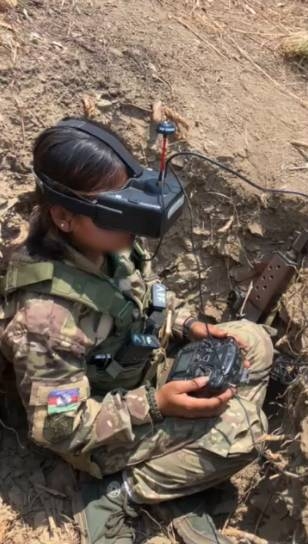
Many theorists and commentators like to speculate about the role of technology in social transformation. There was a lot of clamor about the role of social media in the Arab Spring in 2011, and even more in 2021 when Facebook played a central role in Myanmar’s Spring Revolution. Facebook continues to play a pivotal role in the revolution’s communications systems, a fact the dictatorship knows all too well, as its internet and telecommunications blackouts have demonstrated. New technologies continue to develop, and revolutionaries around the world continue to find ways to utilize them in the struggle for liberation. But early speculation that social media would usher in a new era of grassroots democratic politics has not played out the way many hopeful technophiles predicted. On the contrary, the tech industry, and especially the social media industry, has created new forms of power which allow a small number of tech elites bone chilling levels of control over what information the entire world receives. Technologies are tools of power that exist in a social context. Because technologies amplify power, they tend to reinforce power relations, meaning that on the whole technological development tends toward strengthening state and other repressive forces. But that doesn’t mean we can’t or shouldn’t use them. It’s like guns; the world would be better off without them, but given that they exist, we can’t afford not to have them. Social media’s ability to decentralize and democratize internet communications continues to have revolutionary consequences, even as its devastating consequences unfold in parallel.
Lately I’ve been thinking that, in many ways, social media is to the internet what the FPV drone is to the nuclear bomb. Both the nuclear bomb and the internet have changed the shape and meaning of life on earth in ways that can never be undone. Together they have created what some call the nuclear anthropocene, a new age in planetary history in which human technology has fundamentally transformed, and has the capacity to annihilate, life on earth as we know it. Knowledge, truth, information, communication, conflict and war in the nuclear anthropocene are fundamentally different phenomena, and these changes cannot be unmade any more than an asteroid can unhit the earth. We are simply in a new terrain, and must learn to operate in it. As freedom fighters, our job is to search our new landscape for tools that can help us build freer futures within and beyond this new reality. From the technologies of power and death, new manifestations have arisen that, complicatedly and with severe drawbacks, have nonetheless empowered everyday people to challenge existing power structures. Social media and the FPV drone are both, at least in some ways, democratizing technologies, making forms of power that had previously been monopolized by the state and capital available to a much wider range of political actors. And they are both becoming tools of indigenous modernity. I look down at the patch on my arm, the rifle crossed with the arrow, and imagine that perhaps in the future it will be a broomstick crossed with an FPV drone.
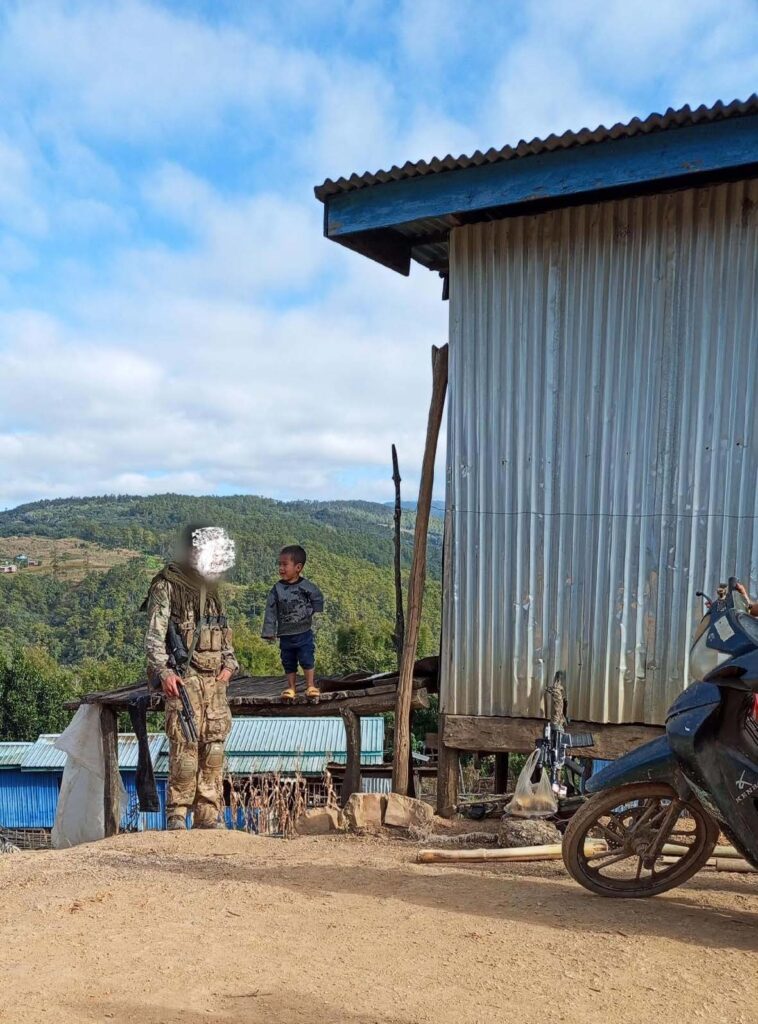
The Fourth World War
The more pressing question for those of us in the so-called First World is where the battle lines will be drawn, and which side of them we will fight on. I was born, raised, and have lived most of my life in the so-called United States of America. America was built on indigenous genocide and chattel slavery, and these legacies shape every aspect of our modern life. We can trace a direct historical line from Manifest Destiny and bounties on Indian scalps to the contemporary prevalence of gun violence and mass shootings, from the plantation to the Prison Industrial Complex, from lynchings to police murders of Black youth, from smallpox blankets to the absence of basic health care services for the majority of Americans, and from the Trail of Tears to the sprawling homeless encampments that characterize our modern cities. The normalization of this daily violence over the past 500+ years has laid the foundation for a suffocating apartheid society governed by a racial caste system and maintained through repression and surveillance.
Some theorists speak of the imperial boomerang and the Third World- ization of the First World. To this our Fourth World comrades shout from the ghettos and reservations, it has always been this way. This is not to argue that there is nothing useful in the theory of the imperial boomerang, but rather to emphasize that it has the same shortcomings as other Third World theories; specifically, a failure to engage with the reality that colonial violence was always originally a domestic project. Whether we are looking at the enclosure of the commons in Europe, the entrenchment of structural patriarchy, and the internal colonization of “ethnic” communities across the European continent, or whether we are looking across the Atlantic at the genocidal violence that created the so-called United States of America, the story begins and ends in blood. Colonial violence is not something originally projected abroad that is now “coming home to roost.” Rather, colonial violence was always the founding condition of any society capable of committing colonial violence. It is not a boomerang, it is a tautology.
This distinction matters because, as we discussed earlier, where we locate the origins of colonial violence shapes how we imagine opposing it. If, as much of Third World theory imagines, the First World is a monolithic colonial power, then decolonization is simply the process of breaking free from that power, and creating state structures modeled after colonial governments holds no contradiction. If, on the other hand, we understand that state-making was always a brutal process of colonizing everything in sight, we are forced to reexamine the nature of state structures themselves, and to look beyond them to other visions and futures. White supremacy and settler colonialism are Europe and America’s number one export, and they have shaped the creation of post-colonial states across the world. This is as apparent in Myanmar as it is anywhere. The specific history of British colonial administration combined with the broader global cultural imperialism of American hegemony has shaped Burmese state- making, both by the junta and the NLD. The junta’s brutal expansionist violence and its close alliance with the Israeli weapons industry demonstrates the classic authoritarian model, while the NLD’s liberal capitalist version of federal democracy was developed in direct imitation of neoliberal American “democracy,” in hopes of wooing sympathetic American statespeople like Hilary Clinton and gaining the backing of the European Union. Of course the empathy of American and European statespeople did very little good at the end of the day, because neither America nor the E.U. were going to stick their necks out unless they had something concrete to gain. The NLD’s fusion of liberal democracy and Bamar supremacy is in fact an incredibly clear imitation of the American model, and it is no surprise that Aung San Suu Kyi became an American sweetheart in mainstream political discourse.vii
Now the face of American imperialism is changing. Neoliberalism is sunsetting, and a more blatant and unadorned version of American fascism is stepping into the light. It is no surprise that the junta’s top military leader Min Aung Hlaing has expressed admiration for Donald Trump, or that the Trump administration has eased sanctions against key allies of the junta. Trump’s policy towards Myanmar has been somewhat erratic, as he contends with his simultaneous desires to oppose Chinese influence in the region, fan the flames of old Cold War mythology to advance new imperialist agendas, support regional strongmen who can advance U.S. power in Southeast Asia, and navigate a bipartisan Washington consensus that has until now at least rhetorically supported the NLD and opposed the military dictatorship. How the relationship between the junta and the Trump administration will unfold remains to be seen, and, like everything about this conflict, will have global echos as the U.S. works to build regional alliances against China’s Belt and Road Initiative. Once again we see how the struggle in Myanmar is in fact a global struggle for a new world order. The people’s revolution in Myanmar is demanding a new future, beyond the NLD and the junta. In doing so they are rejecting the false binary between the old neoliberal world order and its unmasked fascist counterpart. Can those of us resisting fascism in the heart of empire learn to do the same?
And so we come to the question of where Americans will stand in the evolving global struggle against the colonial world order. Will white America continue to cling to the wages of whiteness, which for centuries we have accepted in place of our own dignity, and often at the expense of our own material interests? White Americans have demonstrated time and again that we will support policies directly detrimental to our physical and social well- being if they are sold to us in terms that reinforced our feeling of supremacy in a stable racial hierarchy. White welfare recipients regularly support cuts to welfare programs that we are told subsidize Black “welfare queens.” White working class communities support the pollution of our air and water by deregulated industrial production if the industry promises jobs that won’t be “stolen by immigrants.” White parents support tax cuts that defund our children’s schools if the politicians selling them also promise “tough on crime” policies that incarcerate Black and Native youth, and white communities send tens of thousands of our children to die in foreign oil wars in order to “protect us” from the barbarian Muslim hordes we are told are amassing at our gates. The legacy of siding with the colony is strong, and many current trends show it getting stronger.
At the same time, wherever there has been racial oppression, there has been intercommunal resistance. We have seen moments of magnificent rupture in which Black revolution, Indigenous insurgency, immigrant solidarity and settler sanity have joined forces to reweave the fabric of American social life, and these moments and movements have changed the course of history. From Croatan to John Brown, from the maroon communities of the Great Dismal Swamp to the legacy of the Black Seminoles, and from the Black Liberation Army to the burning of the 3rd precinct in Minneapolis, intercommunal solidarity has repeatedly prevailed against the forces of apartheid in ways that have shaken the foundations of the colonial world order. But the forces of recuperation are always close behind, and every historical moment of interracial solidarity is chased by reactionary forces fighting to reentrench American apartheid. The abolition of formal slavery was quickly followed by the advent of Jim Crow, the insurgencies of the 1960s and ’70s were crushed by the War on Drugs and the rise of the Prison Industrial Complex, and the tides of recurrent Black uprising from Rodney King to George Floyd have been countered by a creeping and increasingly militant white supremacist counter-revolution culminating in the election of Donald Trump. The war between resistance and reaction, between colonization and intercommunalism, rages on.
This is, in many ways, why I came to Myanmar. The revolution here has so much to teach us, about intercommunalism, about decolonization, about coalitional resistance, about alliance across difference, about autonomy, indigeneity and Fourth World revolution. The diversity and complexity of the society here, and the multidimensionality of war and resistance, echo both the challenges and possibilities our resistance faces at home.
What could it look like for us to build decentralized intercommunal resistance coalitions connecting diverse communities in federated networks that center communal autonomy and indigenous self- determination? The possibilities for democratic (con)federalism, indigenous modernity, and autonomy without state power blossoming in these ungovernable hills hold lessons our Western colonial politics could not begin to articulate.
The Fourth World War is underway. The world of many worlds is alive and fighting, holding out its promise for a freer future.
Choosing violence
Of all the things I’ve learned since coming here, perhaps the clearest is that there is no such thing as neutral in the colonial world. The civilian life I left was not non-violent. It was shaped by the structural violence of American apartheid, and my complacency in this invisibilized violence reproduced and reinforced the violent structures of the colonial world. Imagining that I could somehow “opt out” of colonial violence by not being the one to pull the trigger reinforces an individualistic mythology that props up empire by allowing “civilians” to claim neutrality, while ignoring the omnipresent violence that structures and enables our lives. I think about the martyrs in my life taken by femicide, the war on drugs, the plantation industrial complex, transphobia, and every confluence of cruelty this world can meet out. Were they civilians? Can Black and Indigenous people be civilians in the colonial world? The very idea of being a civilian is a white positionality, a luxury of “innocence” afforded only to those deemed human by the white supremacist death machine. To cling to my status as a civilian is to choose whiteness, to choose the privileged fantasy of innocence that protects me at the expense of colonized people everywhere. And so I choose violence. I choose taking up arms and defending the people I love, choose the freedom of the colonized world over the illusions of comfort and safety I have been sold my whole life. Whatever happens, I have no regrets.
My plates stick to my shirt as I sweat up the mountain. The air is thin up here, and my lungs sip thirstily through the straw of my windpipe as I climb. Shoulders weighed down and back aching, I clutch for breath as I reach the hillcrest. Enemy camps sprout like daisies in my line of sight, waiting to be picked. I feel the magic stirring in the ground beneath me, flowing up through the coven as we assemble. We laugh and whisper an incantation. I begin to unzip my bag.
Closer
You are closer now.
The mountainsides on which we faced each other
are pulled together
as the valley between them sinks
with the weight of your body.
A chasm that only missiles could cross
now barely a stone’s throw apart
We could not speak in life
there were too many centuries
of colonization between us.
But in death you are no longer my enemy,
and we can sit
and talk together
of how you got here
to the mouth of my muzzle,
and of the other paths
you never got to walk.
Leah Kaplan (2026)
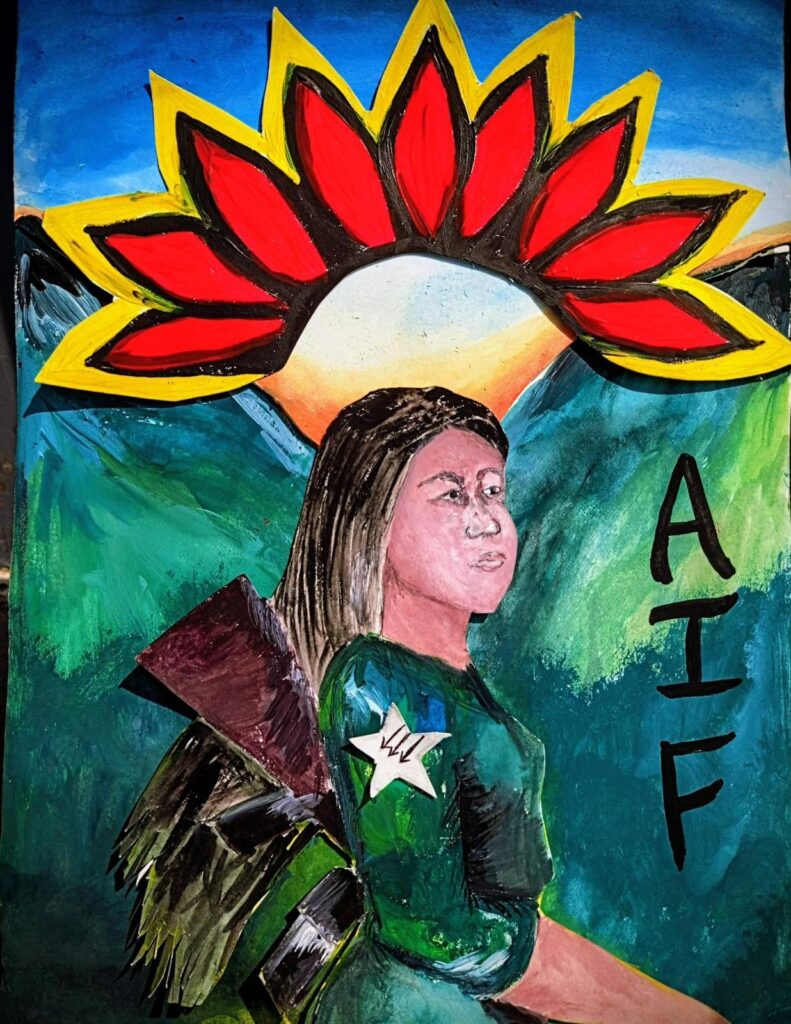
WITCH (Women Internationalists of the Chin Hills)
AIF (Anti-Fascist Internationalist Front)
You will find both across social medias @witchteamfpv @aifmyanmar
This text is available in zine format here: https://aifmyanmar.noblogs.org/post/2026/07/22/sone-ma-apoi-the-witch-tea
Footnotes
i Throughout this essay I use the names Burma and Myanmar more or less interchangeably, with a tendency to favor the name used during the time period being discussed. Some anti-junta activists prefer the term Burma, as the name Myanmar was formally adopted by the dictatorship in 1989, and is generally associated with junta rule. Both terms refer to the ethnic majority group, with Bamar being the colloquial term and Myanma the formal name for the territory’s ethnic majority people. For ethnic minorities both names represent the state’s commitment to Bamar supremacy, and hence there is not a strong preference for one over the other. Young people tend to use Myanmar, while the older generation is more likely to use Burma.
ii On April 30, 2026, Aung San Suu Kyi was moved from military detention to house arrest.
iii The term “EAO” was codified during the National Ceasefire Agreements from 2013- 2015. Before that, terms like “ethnic organizations” and “ethnic resistance forces” were generally used interchangeably, and the criteria for being an EAO remains contested. I use the term broadly here to refer to organizations representing specific ethnic groups that engage in armed resistance.
iv During the uprisings in 2021, a modified version of Bob Marley’s “Buffalo Soldier” became a popular anthem for the resistance. The Buffalo Soldiers as historical figures and the legacy of the American military pitting Black and Indigenous peoples against each other to further colonial expansionism is almost entirely unknown throughout Myanmar. The reference here is entirely to the song.
v I expect some readers will accuse me of romanticizing, and perhaps in some ways they are right. The life-altering freedom I am experiencing as a foreigner in Chinram is not the same as the experience of my Chin comrades. They have never lived under the suffocating hypocrisy or been contained by the imaginative straitjacket that binds life in the capitalist core. My experience here is that of a state subject breaking free for the first time. The physical and spiritual reality of that rupture is qualitatively different from the experiences of those who have lived here all their lives. The dialectical tension between these two experiences is precisely what constitutes a shatter zone. It is a place of refuge, a cultural crossroads where resistance cross-pollinates, evolving as it absorbs refugees, rebels and revolutionaries. We bring our histories and experiences, and change the place as we are changed by it. I am not an anthropologist with colonial fantasies of objectivity, here to observe and report on Chin society. I am a guerrilla, here to fight alongside my comrades in the global struggle against global forces of colonization. I bring what I have to offer, and take what I need to expand the struggle beyond Chinram, to bring the fight back to the heart of empire. In this sense my experience here is much closer to that of my Burmese comrades. We have taken to the hills, and are preparing to bring the war home.
vi When my commander read this piece she added the following: “I think this is largely true, but one thing Scott misses is that the ones ‘welcoming’ Christianity so openly were at least in significant part the already extant patriarchal figures in the local prophetic traditions. They sought to consolidate power in their communities by accepting Christianity and, through their extant positions of authority, imposing it upon their people, especially women. This gendered blind spot is one of my main critiques of Scott’s work. I think the ‘welcoming’ of Christianity here was at least in part an alliance between missionaries and patriarchs, welcoming both a new tool of resistance to Bamar hegemony and a new tool to consolidate power over their own communities.”
vii It is worth noting that the genocide of the Rohingya people, a Muslim minority in Rakhine state, took place while the NLD was in power, under the authority and leadership of Aung San Suu Kyi. While this is sometimes portrayed as a contradiction or evidence of hypocrisy, it is in fact entirely in keeping with the NLD’s policy of imitating American imperial ideology and practice, aligning Myanmar with the West against the phantom of Islamic “terror.”
End Notes:
1 Grace Tsoi and BBC Burmese, “Myanmar coup: The people shot dead since the protests began,” BBC, April 12, 2021, https://www.bbc.com/news/world-asia-56636345.
2 “What’s happening in Myanmar,” Assistant Association for Political Prisoners (Burma), accessed February 26, 2026, https://coup.aappb.org/data-dashboard. 3 Andy, “How to Build a Revolution: Myanmar, Part One,” interview by James Stout and Robert Evans, It Could Happen Here, Cool Zone Media and iHeartPodcasts, November 7, 2022, audio, 11:29, https://www.iheart.com/podcast/1119-myanmar-printing-the-revo-289559181/ episode/how-to-build-a-revolution-myanmar-part-one-289559216.
4 Andy, It Could Happen Here, 27:40.
5 Alex, “How to Build a Revolution: Myanmar, Part Three,” interview by James Stout and Robert Evans, It Could Happen Here, Cool Zone Media and iHeartPodcasts, November 9, 2022, audio, 20:49, https://www.iheart.com/podcast/1119-myanmar-printing-the- revo-289559181/episode/how-to-build-a-revolution-myanmar-part-three-289559214.
6 Alex, It Could Happen Here, 22:24.
7 James C. Scott, The Art of Not Being Governed: An Anarchist History of Upland Southeast Asia (Yale University Press, 2009).
8 Scott, The Art of Not Being Governed, 208-211.
9 Antonio Graceffo, “Backgrounder: Ethnic Armies in Myanmar Civil War,” Geopolitical Monitor, February 27, 2024, https://www.geopoliticalmonitor.com/backgrounder-ethnic- armies-in-the-myanmar-civil-war/.
10 Michael Martin, “The Dilemma of Shan State for Myanmar’s Revolution,” Center for Strategic and International Studies, October 7, 2025 https://www.csis.org/analysis/dilemma- shan-state-myanmars-revolution.
11 “Chinland Council (CC) & Chin Brotherhood (CB): Members,” Khalvontawi News, July 7, 2025, https://www.khalvontawi.in/2025/07/chinland-council-cc-chin-brotherhood-cb.html.
12 “Kachin Independence Organization (KIO),” ISP-Myanmar, August 20, 2025, https://ispmyanmar.com/kachin-independence-organization-kio/.
13 “Our History,” KNU – Karen National Union, accessed February 26, 2026, https://www.knuhq.org/about-us/history?lang=en.
14 Maung Saungkha, “Ready for war: my journey from peaceful poet to revolutionary soldier,” trans. Nu Nu Lusan, ed. Emily Fishbein, The Guardian, February 9, 2022, https://www.theguardian.com/global-development/2022/feb/09/hungry-for-war-my-journey- from-peaceful-poet-to-revolutionary-soldier-myanmar.
15 Maung Saungkha, “Bamar Armed Group Aims to Break Junta Rule in Central Myanmar” The Irrawaddy, November 12, 2024, https://www.irrawaddy.com/in-person/interview/bamar- armed-group-aims-to-break-junta-rule-in-central-myanmar.html.
16 Walter Niehoff, “Student Armed Force (SAF),” Modern Insurgent, April 10, 2024, https://www.moderninsurgent.org/post/student-armed-force-saf.
17 Yangon Anarchist Association, “Buffalo Soldiers Freedom Force,” libcom.org, March 6, 2025, https://libcom.org/article/buffalo-soldiers-freedom-force.
18 Hein Thar, “Red dawn: Myanmar’s reborn communist army,” Frontier Myanmar, December 11, 2023, https://www.frontiermyanmar.net/en/red-dawn-myanmars-reborn-communist-army/.
19 Esther Wah, “Ethnics March Together General Strike – Nationalities Committee Against Coup,” Burma News International, March 17, 2021, https://www.bnionline.net/en/news/ethnics-march-together-general-strike-nationalities- committee-against-coup.
20 Khun Bedu, “Interview: What Is the New Spring Revolution Alliance?” The Irrawaddy, December 19, 2025, https://www.irrawaddy.com/in-person/interview/interview-what-is-the- new-spring-revolution-alliance.html.
21 George Manuel and Michael Posluns, The Fourth World: An Indian Reality (University of Minnesota Press: 2019), 217.
22 Vine Deloria Jr., foreword to The Fourth World: An Indian Reality, by George Manuel and Michael Posluns (University of Minnesota Press: 2019), xxxix.
23 Deloria Jr., foreword to The Fourth World, xl.
24 Manuel and Posluns, The Fourth World, 6.
25 Wah, “Ethnics March Together.”
26 Deloria Jr., foreword to The Fourth World, xii-xiii.
27 Manuel and Posluns, The Fourth World, 12.
28 Manuel and Posluns, The Fourth World, 211.
29 Scott, The Art of Not Being Governed, 319-323.
30 Manuel and Posluns, The Fourth World, 220.
31 Manuel and Posluns, The Fourth World, 220.
32 Glen Sean Coulthard, introduction to The Fourth World: An Indian Reality, by George Manuel and Michael Posluns (University of Minnesota Press: 2019), xxxi.