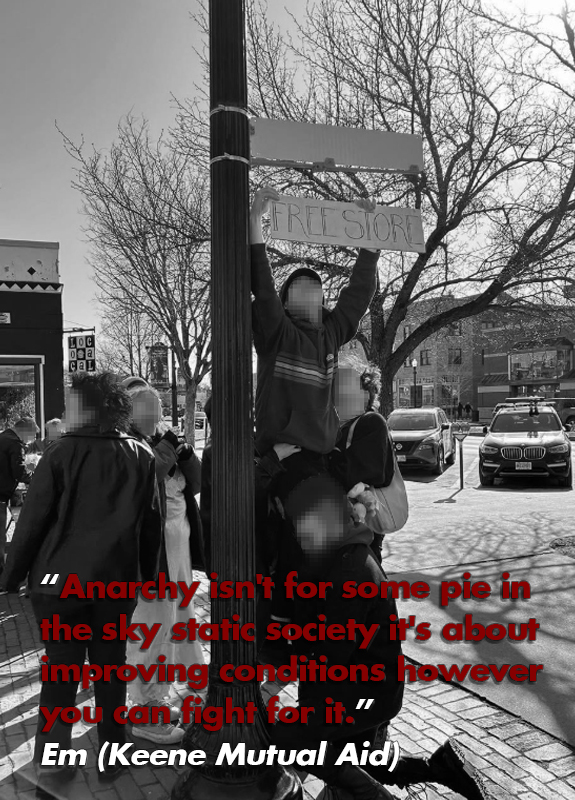
As part of an ongoing series of short Question and Answer sessions with fellow Anarchists who are organising in their local community, today we’re talking Em, to a member of the Keene Mutual Aid, a food distro in the United States of America.
Organise: Thank you for taking the time to answer some questions, could you introduce yourself and your organisation?
Em: Just to be clear I’m answering for myself and not for the group, or in an official capacity. Due to how small the size of the town we work in it’s very easy to piece together who anyone is. So as a best practice just call me Em. I am in Keene Mutual Aid (KMA) which is an organization with roughly 30 non unhoused individuals. We intentionally blur the lines between “customer” and “volunteer” at the Free Store. The Free Store is our premiere project. We give out food, outdoor survival items, hygiene, first aid, clean use materials, etc it’s all on our website and zine. This is done every week, “rain or shine”, outside at a common location in the center of Keene.
O: So where did the organisation start from, what inspired the founder (you?) to address the problems in your community at that time and why specifically take on this role?
Em: In 2020 Keene Mutual Aid started as a stump branch of another organization in the State – so-called “New Hampshire” – with 200 bucks, a few totes and a couple tables. We started working in the dead of winter in the snow. We had to do preliminary work by doing a lot of out reach to camps, shelters, people on the street etc. We had these “Keene Free Store” business cards we’d give people telling about the time and location of the Free Store that we would hand out to people. Some weeks 15 unhoused people would show up and sometimes 5. It would be up and down like that for some time. We had a practice that’s less in use now where we’d make care packages and make our way to people staying warm in their tents. At the moment we are trying to bring outreach back.
Our inspiration for this was multi-faceted but largely it was a desire for direct action in the face of betrayal. Now, new members join for a plethora of reasons and that more accurately reflects the outlook of the group. Personally I had been protesting and rioting for months, Biden just won, and I watched the movement’s momentum get stolen by the DNC and so called “Socialist” parties. Police budgets went up, there was, still is, no justice. People, especially people of color are still being shot, people still going hungry. The Reformists had again successfully managed to, as Howard Zinn puts it, “surround that movement and drain it of it’s vitality” (A People’s History). I guess a lot of us original members came out of 2020 with a bad taste for the traditional, DSA, party form slop. More than anything wanted to see a tangible, material difference get made in our communities after years of seeing nothing come from the reformist left. Some of us carry this energy even to this day, new and old members alike. Our Anarchism is informed and driven by the failures of the left during 2020 and today. Very “¡ya basta!” and an attitude of making shit happen at all costs.
I am going to quote a member that I believe to be one of the most dedicated and passionate Anarchists around today. She said “I don’t need motivation or a book to get me out of bed to help people. Some people bemoan the idea of getting up once a week to help their unhoused neighbors and that’s lame as fuck, I show up, it’s not that hard. I go to a warm bed every night and with a full stomach, my neighbors, people who I laugh with do not. That makes me really fucking angry, I hate to see people suffering, if that’s not motivational then there’s something wrong with you”.
O: It seems Anarchism forms a critical underpinning of your decision to organise here, could you go into how Anarchism informs how the group operates, how decisions are made, requests process?
Em: Everyone who formed the group was an Anarchist. Over half the membership consider themselves Anarchists and everyone is aware of the ideological underpinnings of what we do as do the unhoused members/ “shoppers”. We are more than open about who we are and why we’re doing what we’re doing. Hiding who you are in this line of struggle is a mistake, it also allows us to filter out block heads and opposition whilst normalizing our position. We have a points of unity but we don’t check ideology at the door. KMA follows a traditionally anti-fascist set of norms; we don’t permit racism, sexism, ableism, homophobia etc. Peoples behaviors/ attitudes, not just their stated beliefs, matter. When men speak over women or cis people or trans people we point it out. Most of us including myself are Queer and disabled. We are not dominated by cis white men either. This factors into how we do things.
Ideologically we are a mix, we do not share a totalizing ideological unity because blue print style homogeneity doesn’t work. It is not conducive towards action and developing an Anarchist culture, it’s an unnatural and spiritually top down device. I don’t like to label things like a historian anachronistically labels movements trends hence we, KMA, don’t use traditional adjectives. Most people go as far as saying we are Anarchist and that’s about it. We don’t spend hours writing about the ins and outs of our philosophy.
I am strongly aligned with “the Anarchists of old”, I’ve read all the old dead authors, Kropotkin especially, but I also like the Panthers, Neo-Zapatismo, ARA/ AFA, Queer Liberation, Feminism, Rojava, Palestine, and Indigenous Land Back movements in general. Unfortunately for those who love to dry hump Bakunin things happened after 1936 in the Anarchist world and they are worth learning about. Every member has a different background theoretically, some people don’t read theory, and we come together to critically examine our ideas anyway. Yes discussions about the future, near and far, are had but there is a difference between groups who begin in the drawing room and those who begin in the street. You attract a different kind of person when you practice more than you pay lip service to fighting power.
Lastly we try to take the ideas we are presenting to their logical conclusion. We do our best to engender a radical attitude towards everything. I was never satisfied with “Mutual Aid” groups remaining essentially a cooperative (horizontal) charity then calling it a day. We are a revolutionary movement and aren’t satisfied with weekend warrior routines. Mutual Aid must advance beyond small distros and food lines. Personally I think that eventually everyone in the movement needs to start learning to share and start giving up on notions of ownership. The trend to treat Anarchism as a fandom and solidarity as as a buzzword is something we discourage. Our Mutual Aid project takes seriously the notion that solidarity springs from a set of shared conditions in which we are all in the same boat, something which cannot come about between haves and have nots. Lastly I will say we are extremely indebted to the work of Black Anarchists like Ashanti Alston and Lorenzo Ervin.
Q: So moving on to practicalities, where does your food and sundries come from? How do you make decisions around scarce items? What system do you maintain to keep things routine and steady?
Em: We often default to a first come first serve for our “shoppers” but we don’t like to leave anyone hanging. We aren’t afraid to spend our money personally or from our general fund. Cash comes in mostly from donations and grants, but we do recieve a lot of face to face donations. KMA is filed as a 501c3 so the IRS doesn’t come down on us. We keep a good steady amount of cash coming in which directly goes to the unhoused in the form of goods. I will pass people cash when asked, I often never have it on hand due to this habit. Donations come to us very locally, while we’ll ask for grants it can’t come with strings attached and we have very talented people who help fundraise for us. We also recieve a lot of physical donations from community members. We don’t just give out food, we offer camp supplies, hygiene, medical stuffs from gauze to asprin. What goes on to the free store tables is always shifting based on what is needed that month. We often meet requests for items of higher prices for people like phones and tents. We have a special request method where if someone asks for something reasonable, so not a flat screen, we get it for them next week or immediately depending on how urgent it is.
Decisions are made as democratically as possible when consensus isn’t reached. We’ve never had to have things come down to a vote that wasn’t about selecting a date for a meetup. Recently we had an issue where rough sleepers, people sleeping out doors, could cut the line. This became an issue over time so we addressed it in two ways. Firstly we approached the unhoused community and came to an agreement that while the rough sleepers could no longer cut the line we’d set aside a table specifically with items rough sleepers need. Lastly we advocated, key word, a norm for people to try and self manage how much they grab as people who came late or were just in the back of the line were leaving with very little. It turns out having relationships with the people you express to want to helps matters when problems arise. We involve the unhoused community in decisions as often as we can, we hand out sheets where people can fill out what they want to see at the free store. Lastly we don’t talk to the pigs.
O: How do you find people respond to this work? Not just rough sleepers but the local community, have any of them converted to anarchism yet? How do you measured you successes here?
Em: The short asnswer is yes! People respond differently depending on their position to Keene Mutual Aid. I could go endlessly about the sorts of experiences KMA members have. I’d like to think we make a difference in people’s lives. I am told that we make a difference, people come back even when we set boundaries. Being apart of the more care centric aspect of KMA is an experience I hope most people can try. I’ve seen stay at home moms go from reform liberals to ACAB in months. Doing this work has an inherently radicalizing impact. You really see how the system treats people and for those who don’t think about politics as much that new realization is hard to grapple with.
We get the occasional chud who screams “commie!” when they see our pro trans stickers. Most people don’t pay us any mind which isn’t always the best thing. Our main goal as Keene Mutual Aid is to get people to care about taking care of their neighbors in their communities. I and others do make an attempt to challenge people on their ideas but we don’t stuff Emma Goldman in people’s hands, unless we’re asked, if that’s what you’re wondering. Some people walk up to the Free Store and join that day. People who’ve wanted to come for months just start showing up. Momentum, when you have it, does feel pretty good, as we’ve grown people have begun to take us seriously.
Ultimately the aim of trying to move towards Anarchy isn’t for some pie in the sky static society it’s about improving conditions however you can fight for it. Part of desiring an Anarchist society is forging a better world to live in and hey also the planet is dying. Shifting culture towards resistance improves our whole lot right now, not just in some far way imaginary place. But you have to get there. If you’re just sitting in the same spot forever, constantly just applying band-aids it’s no wonder some people want more.
There is a strong contingent of the Anarchists who do Mutual Aid that are content with being a small club. You can and will be brow beaten thoroughly if you suggest, maybe, we need to do more than table once a week.
“It’s all about helping people” rings hollow when we could easily be helping more people if we weren’t so small. Good sentiments are all well and good until we begin to run up against problems we can’t handle, problems we could address if we were intent on becoming a threat to power. Nothing feels worse than being helpless to fight for people who are being harmed. There must be some priority towards organizing more of the community. Assata said “No movement can survive unless it is constantly growing and changing with the times”.
Q: You mention the odd “chud” causing trouble, have you faced any stress from local business or the state? How do you balance the politics with the necessity of the task?
Em: In small towns, unlike cities, local reputation matters, people are more sensitive to perceptions. It’s not worth most people’s time to mess with community memebrs helping the unhoused. We have friends in local media and elsewhere who would make a fuss if the pigs decided to try something. It’s also most certainly a white privilege to not have pigs destroy our set up and evict us from our physical locations. We get the odd quack who yells at clouds (us) but we pride our selves in conflict management, internally and externally. It looks better for us to send out our bearded millennial white dude to calm some angry maga fuddy duddy down and talk about ye good ole days than to pick a fight. We are always on mission, to meet people’s needs, the balance comes from our openness about our beliefs. We’ve had community forums and there we tell people we’re Anarchists. If you don’t stand on what you believe early it becomes harder later on and people can tell you’re lying. You don’t want to pull the rug out from under people. I’ve said this before but as we help people we keep it Anarchist. We don’t ask the state for permission and we never take money with strings attached. We once had the parks and rec people come ask us about a permit and we said “what permit?” they didn’t come back. Some groups who do this work are extremely sensitive to the directives of the state. We don’t speak to police, collaborate with democrats, or let peoples parties push their slop. Being aesthetically Anarchist means nothing if you’re not acting like one.
Q: Speaking mid to long term, do you think solidarity organisations such as yours can make actual lasting change or is this a band-aid over the results of capitalism with the long term solutions found elsewhere?
Em: I am a dyed in the wool believer as it were. I have never been impressed by the apathetic and submissive notion that one is merely passing around the same couple bucks. I think Mutual Aid programs are as popular as they are for a reason, so called “New England” at this moment in time has an extremely high concentration of Mutual Aid groups, especially Food Not Bombs. Every State and major city in the region has something like that. Community organizing in general leads to gains for all oppressed communities and peoples that can and will roll into and extend capacity to fight the state, capitalism, racism, sexism all the isms. We are looking to eventually start setting up co-operatives and establish safe houses/ community centers in Keene. We want to develop gardens which feed the homeless and youth centers to give kids public space. Keene Mutual Aid is not tackling a specific issue we are fighting capitalist scarcity at it’s roots. Everything starts small and that’s something you have to be ok with. It’s scary/ hard for people to work with especially the traditional left who love to fond over legacy organizations and paper numbers. There has always been a Mutual Aid under current to every movement, people coming together to meet each others needs goes all the way back to the original combination laws of France and Britain. I believe Mutual Aid programs give working class people the leverage and more advantageous position necessary to make attacks against the bosses rather than a meekly supported strike committee. They do the same thing unions do; prefigure the sort of society they are fighting for through working to meet needs collectively and horizontally. Do I think we can share our way to a revolutionary uprising, unlikely, but so far I’ve been able to mobilize and radicalize more people than my contemporaries in the same area. So yes join a union, go on strike, cut down a flock camera, but also form a Mutual Aid group, people are starving in your area and you don’t need much to make a difference in someone’s life.
Q: What criticisms of Anarchist mutual aid do you take seriously? Are there any aspect about Organising in general which you’ve had your mind change on? What would you do differently if you were starting from the top?
Em: I think you’re right I and honestly most of us don’t take criticism from the chronically online left seriously. Most of the actual historical and strategic reasoning behind why people do it is entirely lost on people who experience the movement through a screen. There are actual valid criticisms of the collective survival practice called “Mutual Aid” and the culture surrounding it. A lot of us who do this work aren’t critical enough and are more often far too content for where we are. But those critiques do not come from Class Reductionist/ Reformist camps and especially not online fandom “Anarchists”, “Marxists” & “Socialists”.
Moving on: Many groups who refer to there projects as ‘Mutual Aid’ are just Charity Co-ops in function. I do not think the principle radical ideas which surround the idea of Mutual Aid are being expressed in practice. Many people don’t want to hear that but if we actually desire the abolition of the state and merely handing out less than the bare minimum most people need to survive our practices should change. We need to become more radical with it and do more. Clique culture and the “co-workerification” of the Movement spaces are an incredibly understated detriment to that end. In my experience many groups run into stagnation and the lack of radical anarchist cultural practices bottlenecks growth for our movement on top of leading to harm.
Mutual Aid groups must move past traditional funding models, instead towards large scale collective sharing and re-distribution within a broader community. Reliance on the Charity Markets, Grants and pure moneyed donations lacks the face to face practices necessary for developing Solidarity and Community. If the amount of bread your neighbor gets isn’t based on what you can do but on the comfortability of the economically fortunate then it’s still Charity. We must abolish the distinction between “volunteer” and “recipient” which so defines the relationship of Charity. Stop treating mutual aid projects the way Churches treat soup lines. In KMA our mission is stopping people from starving and dying of the elements. Our mission can’t end when our consumer lifestyles are interrupted. Lastly, to the first point, and people get real upset at this one; we have to deconstructing notions of ownership between “Anarchists” if we intend to lead by example. You don’t need to be Diogenes or a Crust Punk, move at the speed of trust, but also be daring and take the shirt off you back when someone needs it. I am an Anarcho-Communist, I am proud of that, to me property is authority and authority must be destroyed. We all swim or we all sink, simple as. So start sharing your labor time, your car rides, your couches, meals as a community, jobs, whatever you can. Mutual Aid shouldn’t stop at the free store distro it should be a fact of life within Anarchist spaces.
Secondly, Anarchist, Punk/ Hardcore, Socialist, Queer spaces need to end this culture of non-chelant, co-worker attitude bullshit. You all know what I mean. Every Anarchist I talk to in the English speaking world tells me the same thing; we act like strangers towards one another and our relationships are superficial which is reflected in quality of care we provide to the people we call “neighbors”. We suffer from an inability to communicate healthily and lack conflict resolution skills. This all leads to a myriad of issues in the Anarchist movement; rape culture, abusers running rampant, fed jacketing, rumor milling and pointless infighting. I’ve seen queer people run out of spaces by cliques of cis men imbedded in Socialist clubs while ignoring active fascist street gangs. I’ve seen trans women called thugs by “Anarchists” for calling out their abuser friend they brought to a bookfair. We cannot claim to be about Solidarity not Charity when our behavior and practices demonstrates the opposite. So call out abusers and rapists, kick them out by force if necessary, read about conflict resolution. Treat one another with kindness and respect. don’t tolerate assholes or gossip, stand up for your friends. Give to the community more than you receive, don’t be the weekend warrior who shows up to the mutual aid distro and barely talks to anyone.
Q: If someone wanted to start a similar project elsewhere, what advice would you give them?
Em: Anyone can start this sort of project (a free store), but firstly there is probably something like this in your town already, so get looking! When starting from scratch my advise is to start with the most radical version of your project you can. There is no virtue, nothing to be gained with compromise here. Don’t listen to the local government about ordinances, give out propane even if the fire department doesn’t want you to. Be consistent, people, especially those of us who live day to day, need consistency to know it’s a resource they can rely on. Talk to your neighbors. One of the best things we do is consistent outreach. This should go without saying, do not talk the cops, tell no one about someone’s camp location. When approaching camps/ tents announce who your are and your intentions from a safe distance, say you aren’t the cops. Keep community outreach active, people go in and out of this work a lot, you are not an insurrectionary, you feed people or whatever service you want to do. This means that you should be bringing in community members to help as often as you can with out disrupting your service, the feds can peel potatoes for all I care. As I said earlier keep a good communicative relationship with your fellow Mutual Aid group members, you will avoid most conflict this way, when someone does something which upsets you politely voice your concern. Do not be afraid to assert boundaries. Don’t expect gratitude from anyone.
A massive thanks to Em from Keene Mutual Aid for taking the time out to answer our questions.
You can learn more about them here: https://keenemutualaid.org
Are you an organiser and would like to talk to us about your project or organisation?
Get in contact here: organisemag@rise[deleteme]up.net