As part of an ongoing series of short Question and Answer sessions with fellow Anarchists, today we’re talking with Circle-A studies, who are busy working on a game about squatting called “Creatures Like Us!”.
Thank you for taking the time out to answer some questions, to kick us off, please introduce yourselves.
Hi! We are Circle-A Studios, and we make radical video games for under-represented gamers. We are currently working on our first title together as a team – Creatures Like Us – which is a narrative focused simulation about squatting, mutual aid, and smashing capitalism through building community spaces. We are a remote studio and mostly based in Bristol and the South West, which is also where the game is set.
How did the Circle-A team come together and why did you decide to take on such a politically loaded game for your first project?
In the very early concepts for the game the focus was much more on interpersonal relationships in queer communal living, like in a co-op for example. But I kept having thoughts like “it would be great if the people in the building ran events and fundraisers that could somehow make real world impacts” and “it feels like the reason the people are living in the space should be political”. At the same time that these thoughts were percolating in my mind I attended a Squatting 101 workshop run by an amazing crew called SISTER (Stroud in Internationalist Solidarity, Together for Earth Repairs) where it became so clear that the game needed to be about more than just communal living. The focus of the game began to switch to creating alternative systems and community spaces, and squatting was the obvious mechanism for that. As a team, we have a wide mixture of experience in both game development and lived experience of squatting, and our core team all share the same anarchist values.
Do you practice horizontal organising and consensus within Circle-A? If so how does that work on the day to day?
In (almost) all indie game studios, due to a general lack of resources, there is a requirement for every team member to wear multiple hats. The nice thing about that is that it necessitates a certain level of autonomy, and whilst we have always tried to work in a flat organising structure organically, we are also in the process of formalising our governance structure by converting our studio into a co-op. Those of us that have worked in various video game studios before were keen to not replicate the same types of top down hierarchical structures. There are very few examples of co-operative video game studios in the UK, which makes things trickier to navigate, but it’s also pretty exciting to get to carve out our own path to a more equitable games industry structure. We have a simple consent-based decision making process (which also features in Creatures Like Us!).
It’s a shame there are few! Speaking off Creatures Like Us!, a game about squatting sounds great, can you tell us a little bit about the game and how it works, what kinds of choices does the player make?
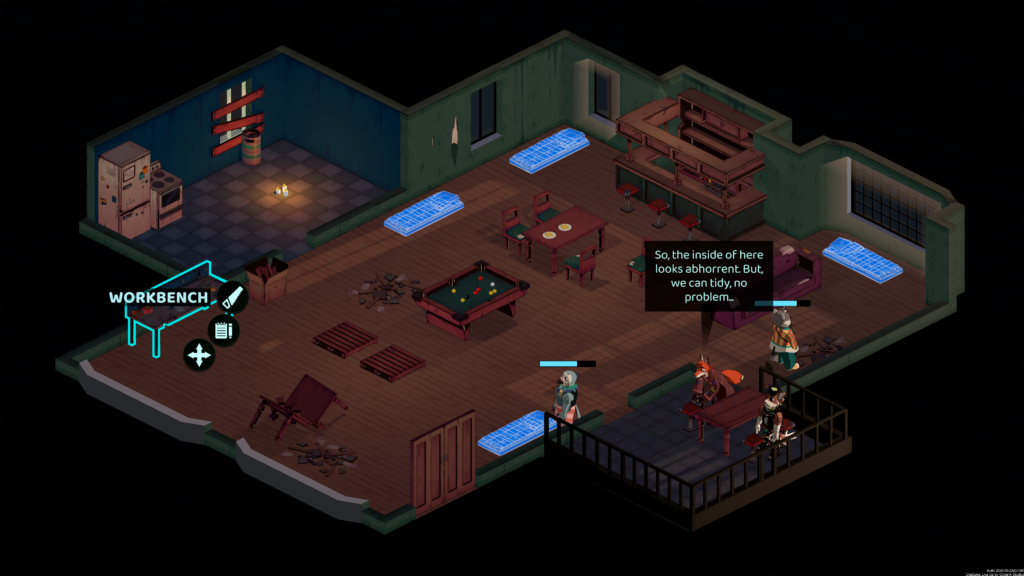
Sure, so it’s all still a work in a progress and some details are likely to change, but the core concept revolves around a crew of four characters cracking and squatting in various commercial buildings around Bristol. As the player progresses throughout the game, they uncover a shady landlord plot to privatise the city, and our crew has to balance decisions between fighting back against this megacorporation and protecting themselves and their community from wider harm and burnout.
Can you tell us about the game mechanics? How does the game model relationships and decision making? Are there resources to source and manage? Is there a “win” to be pursued or is the focus on narrative?
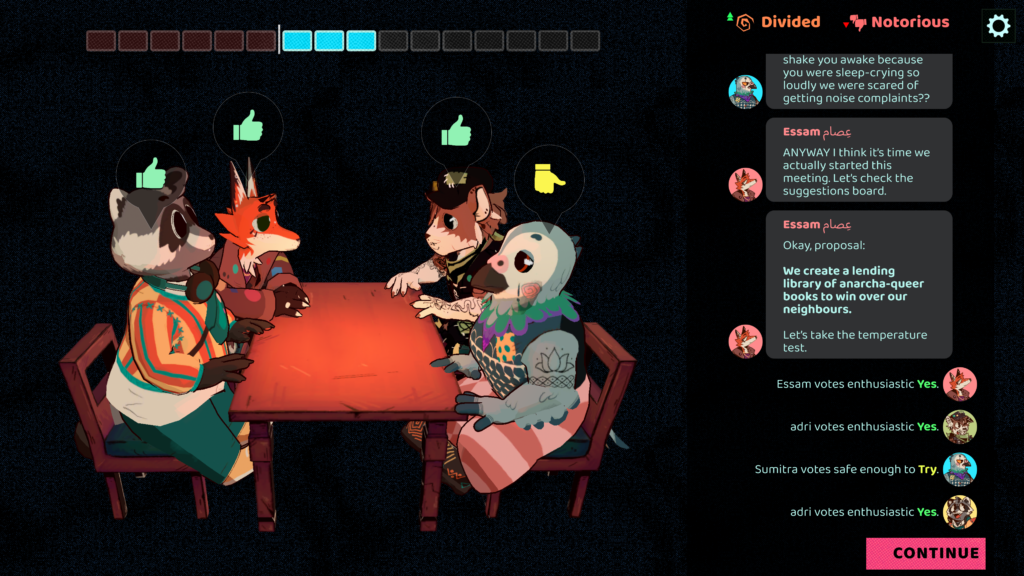
It’s a mixture of narrative decision making and simulation gameplay that’s pretty similar to The Sims. The player completes objectives to improve their squat, put on DIY fundraisers, and fulfil requests from the community all whilst balancing the needs of their crew. How well individual characters’ needs are met (hunger, energy, fulfilment) impacts on their capacity and solidarity as a crew. If you enter a meeting with a character that’s feeling hangry, they’re likely to make poor decisions. The simulation (ie. needs management) is designed to feed in to the story’s choices, and visa versa. Decision making is based on a Sociacratic consent based approach – if your crew has enough capacity, they can decide on whether taking on extra responsibilities is “safe enough to try”. In terms of “winning” the game… well, I guess we’ll just have to see how that pans out ;).
For many anarchists conjures up romantic visions of rebel vagabonds and less than romantic working class survival on the edges of society, How does Creatures Like Us! go about telling it’s story?
Tonally the game is pretty light-hearted for the most part, but obviously it hits on serious themes as well. We really want the characters to feel alive, so they spend more time squabbling and taking the piss out of each other than they do sitting around tables discussing anarchist praxis. We are trying to take a more “show don’t tell” approach to anarchism. Much like real world squatters, our characters come from a wide mixture of backgrounds and socio-economic statuses, and their reasons for squatting are also varied.
Speaking of tone, what visual language did you want the game to have? How do you balance a fun game experience with what is often a precarious and messy situation?
Aesthetically, the game art mixes a feeling of cosiness in the painterly furniture and cute characters against a backdrop of semi-derelict and grimy environments. In a way, the game does have a “Cozy Game” vibe to it, which hopefully makes the contrast of precarious living feel all the more impactful. The reality is that squats can be beautiful, lovingly cared for spaces and also that the homes that are created can be ripped away without notice. The tricky part is balancing that experience in a game that feels both true to the reality of squatting and not causing players to feel frustrated that they’re losing the worlds they have spent time creating. I guess time will tell if we’ve got that balance right!
With the art style and narrative, were you aiming for a particular vibe, did you want the game to feel like an idealised version of squatting, a documentary representation, or something more surreal and interpretive?
Apart from the 5-years-from-now dystopian satire of the housing issues the UK faces, we wanted the game to feel very realistic based on lived experiences of modern squatting. So much of this culture relies intrinsically on communal living and mutual aid, which sounds like an idealised utopia, but in action is fraught with issues, from manarchism to bickering over chores. Where most people playing this game may not have squatted, they will have probably been in a houseshare or affinity group with very similar experiences! None of these structures are perfect, and we don’t want to gloss over that. Mutual aid is a living organism, with muscles and ulcers and aches and pains. We want to show all of this, not just a romantised version.
Do you reckon there a tension between making a fun game and depicting something that is often a matter of survival?
It’s hard to reduce a lived experience to something either “fun” or “serious” – most of the time, it’s a chaotic platter of all ends of the spectrum. You can’t have one without the other when a story needs realistic dimension. It hits harder when one minute you are joking around a table and the next fighting a police raid – many people who battle state persecution can likely relate to this. It would be reductive to craft a story based on a very real, hard mode of living as a Dickensian tale of doom and gloom. That’s not to say there aren’t serious elements in the game – but survival takes many forms, from fighting to laughing to panic attacks.
As the players progress and customise their squat, is there a limited pool of assets and resources for them to draw from, or does it open up into more of a The Sims-esque sandbox and where we’ll be able to stick our favourite posters up on the wall?
Sandbox is a strong term, but we are definitely aiming for more customisation of your crew’s buildings. “Stuff on walls” has been on our task list for quite some time! Your crew gains access to food and other resources via skipping (or “dumpster diving” as Americans call it) and can build new pieces of furniture by salvaging pallets and old tyres etc. that they find lying around.
Next four will pivot into the politics, probably starting with your mention of Socratic consent based approach and ending on a “do you want gamers to start eyeing up empty properties” ;p
You mentioned that decision making is based on a Sociacratic consent basis, how is this implemented in the game?Currently, your crew tackles core objectives to improve their living conditions, fight back against landowner corporations, and connect their community. But depending on choices the player makes, other side quests or “requests” become available. How well the player has managed the needs of their crew whilst completing core objectives impacts their capacity to take on these additional requests. If the player has neglected the needs of a character, they are not going to feel able to take on extra tasks. A meeting takes place where the crew vote on whether taking on extra requests is either okay, not okay, or safe enough to try. There is an opportunity for the player to sway the vote in their favour, but at the risk of pushing characters into burnout.
Housing is often discussed through statistics, policy, and economics. What are you aiming for as you make such insecurity something the player experiences through a game?
It feels very detached when housing issues are discussed wholly through the lens of numbers and graphs. Having the player experience this insecurity through the eyes of the characters in-game gives it a dimension of realism that is far more personal.
Do you think political games need to offer answers, or is it enough for them to make a contradiction impossible to ignore?
When it comes to political debate, a common blunder is to expect an instant solution to be offered – like it isn’t enough to point out the issue itself. We want to spark frustration, passion and conversation between players about housing, property and displacement, not just in England, but worldwide. We can’t present a perfect solution, but it won’t stop us from shining a light on a problem!
What kinds of conversations do you hope happen between players after they finish the game?
It would be amazing if players felt a pull to start connecting with their local communities and start discussing alternatives to living under capitalism. What it means to be housed, and what housing and property mean in general. We live in an environment where most players, even if they haven’t experienced homelessness first-hand, will have experienced the low, stressful hum of housing insecurity in general. From dodgy bedsits to overcrowded houseshares, and the constant knowledge that most of us are a few pay checks away from the street, this is an almost universal weight. We also want to spark up conversations about the value of direct action, and how our liberties are slowly being eroded around us, in a world that does not forgive.
Be honest, do you want gamers to start eyeing up empty properties?
For legal reasons, the answer here is definitely “no” ;).
Our thanks to the Circle-A studies crew for taking the time out to answer our many questions!
You can find Circle-A Studios here: circlea.co.uk.
Creatures Like Us has a Kickstarter coming in October: tinyurl.com/CLU-KS.
You can connect with the Creatures Like Us community here: tinyurl.com/CLU-Discord