“We call on government officials to take responsibility for what is happening in the mentioned neighbourhoods and to find realistic and lasting solutions to the problems through dialogue, avoiding war and violence. The Syrian people have suffered enough from wars. We call on all Syrians, especially Syrian youths, to reject violence, stand for justice, and renounce war.”
– Ilham Ehmed Co-Chair of Foreign Relations for the Autonomous Administration of North and East Syria1.
Author’s Note: The situation in DAANES also called AANES or Rojava is in a deep state of flux with a lot of often contradictory informations being shared. Even during the research and writing time the situation has escalated and evolved. This was written between the 20th and 22nd of January and reflects to the best of my ability the events that happened up to that point. I have done my best to include only information that can be verified and use through out DAANES instead of the more common Rojava (which means Western Kurdistan) as its clear that these events have expanded beyond that region.
Part I
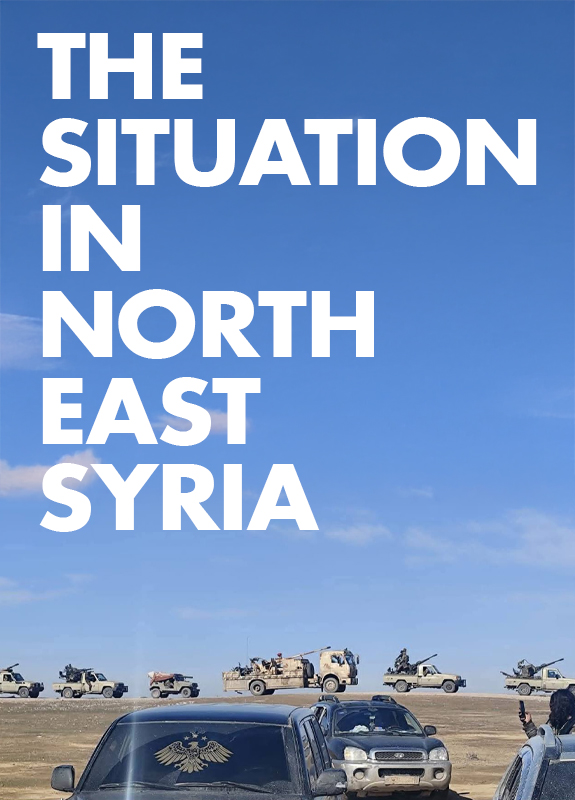
On the 6th of January blood was spilt on the streets of Aleppo. Over the past weeks conflict is escalating again in Syria, the new government led by the Hay’at Tahrir al-Sham (HTS) and its allied militias is launching another campaign of state consolidation, this time targetting the predominantly Kurdish* Democratic Autonomous Administration of North and East Syria (DAANES) commonly known internationally as Rojava. What started with clashes for control of two districts in the city of Aleppo is developing very quickly. When I started gathering notes most news sources with a presence on the ground were reporting violations of ceasefire and evacuation of Deir Ez-Zor by the Syrian Democratic Forces (SDF) the main military organisation operating within DAANES, an hour later most of those news sources are openly declaring a full scale conflict between Damascus and DAANES.
As I write people are dying, casualty estimates are trending upwards and the lists of names of those confirmed as killed are growing. There are calls for international support and general mobilisations in northern Syria and Iraq. Complicating matters is that as with every conflict in the modern day there is a powerful and concerted effort to spread misinformation about the conflict to international audiences. This involves both established and powerful media networks and scores of Open Source Intelligence (OSINT) accounts that have become a feature of modern conflict. So, in the interest of clarity I will provide a short and generalised timeline of this conflict using sources that I trust are reliable.
Though as this will involve many organisation names, acronyms and abbreviations it’s useful to have a list for reference. The group Anarchists in North East Syria (who are active on the Mastodon social network @a_in_nes@kolektiva.social) have provided a comprehensive one which I’ve edited to remove some names that are active in Syria but so far don’t appear to be involved in this conflict.
- HTS: Hay’at Tahrir al-Sham, that now hold the Interim Government
- SDF: Syrian Democratic Forces, military coalition of defense forces in NES
- SNA: Syrian National Army, Islamist Turkish proxy forces
- SSG: Syrian Salvation Government, political front of HTS
- SIG: Syrian Interim Government: political front of SNA and Turkey. Also known as STG, Syrian Transitional Government
- DAANES: Democratic Autonomous Administration of North and East Syria, political body in cooperation with SDF
- KRG: Kurdish Regional government of north Iraq
- KDP/PDK: Kurdish Democratic Party, governing party in KRG, linked to Barzani clan.
- FSA: Free Syrian Army, old name that was used as an umbrella for opposition groups against Assad
- YNK/PUK: Patriotic Union of Kurdistan, opposition party in KRG, linked to Talabani clan
- PYD: Partiya Yekitiya Democratic – Democratic Union Party, leading political party of DAANES
- ENKS: Kurdish national union party, a party in Rojava that is closely connected to KRG and Turkey
- KNK: Kurdistan National Congress, a political coalition and organization of parties and civil society from Kurdistan and Kurdish diaspora
Background
Before the open use of military force the HTS government in Damascus and DAANES were negotiating. The Syrian government (STG) has made its position clear that it is the government of the Syrian nation and that nations borders are unchanged from the start of the civil war. That includes the territory administered by the DAANES and its pushing for the latter to disarm its military and “reintegrate” into the national system. DAANES on the other hand wants to keep its autonomy. Talks had be on and off since March 2025 despite an initial agreement being reached on the 10th of March (see appendix 2), both sides blame each other for the failure to implement the agreement.
A six day counter insurgency operation was launched in March 2025 in the coastal areas around the city of Latakia, the stated targets where Assad loyalists. It wasn’t long before accounts and footage of STG forces and allied militias murdering civilians surfaced. The Syrian Observatory of Human Rights estimated over 1700 civilian deaths, mostly at the hands of the hands of the government. The region is majority Alawite while the ranks of the HTS and many of its allies are Islamist Sunni’s.
July 2025, disputes with the Druze minority in Suwayada again saw the deployment of the army and its allied militias, and once again reports quickly surfaced of atrocities and sectarian killings and the mutilation of bodies.
The offensive against DAANES
We come to January 2026, the citizens of the Aleppo neighbourhoods of Sheikh Maqsoud and Ashrafiyah both of which had been under intermittent states of siege and intimidation now found themselves inside “Legitimate military target” as declared by the STGs Ministry of Defence. Attacks with drones and artillery bombardments and abductions quickly followed.
“Syrian government forces shelled Kurdish neighborhoods in Aleppo on January 7, 2026, killing at least seven and displacing over 3,000 civilians to flee through evacuation corridors. The Syrian army declared the Sheikh Maqsoud and Ashrafiyeh districts—home to tens of thousands—”legitimate military targets.” 2
On the 10th a ceasefire was agreed between the two sides and with fighters affiliated with the SDF withdrawing from the city. This did not last long, the STG then designated the territories around Aleppo including Deir Hafer.
“The Syrian Transitional Government (STG) declared the areas of Maskana and Deir Hafer territory of military operations, both areas under control of SDF. They announced a plan to open a “humanitarian corridor” from those localities to Aleppo, and are already claiming that SDF is blocking civilians from exiting the area. A turkish drone bombed the sugar factory that was used as HQ of SDF, and heavy weapons hit residential areas of Deir Hafer. A turkish drone also hit Tabqa, tergeting an SDF vehicle that was there to provide medical treatment to injured. STG is sending military reinforcements from Latakia for those military operations. SDF is also sending reinforcements to respond to the military build up.”3
Another ceasefire agreement with the support of the United States was agreed on the 17th with the SDF agreeing further withdrawals to the East of the Euphrates river. This ceasefire was broken immediately with military operations launched by the STG and its allies in the SNA almost immediately. On the 20th (when I started writing this) DAANES had given up much of its territory while rallying its forces and supporters. Talk of open warfare between the two sides was common and several prison’s operated by the SDF housing thousands of Islamic State fighters were attacked and taken over by the forces of the STG, leading to many escapes4.
Then, on the evening of the 20th while looking on the BBC news site I see they have an article announcing yet another ceasefire agreement between the two sides.
“A statement said the SDF would be given four days to carry out consultations on a detailed plan for the peaceful integration of areas under its control into the state.
The presidency also promised that government forces would not enter the cities of Hassakeh and Qamishli, or any Kurdish villages.
At the same time, the SDF declared its “full commitment to the ceasefire” and said its forces would not initiate any military action unless they were attacked.
The SDF also said it was ready to “move forward with implementing” the deal reached with the government on Sunday that was supposed to end almost two weeks of fighting.” 5
Will this one last? According to my newsfeed and updates from the Liveuamap6 violations are continuing with a concentration of clashes closing in on the city of Kobane, so it looks as though clashes will continue, and a possible re-run of the violent siege of 2014.
Part II
There’s a pattern here, the HTS led Syrian state like every other state is driven to consolidate itself at the expense of its citizens. If the Syria the STG wishes to build is to survive as a functionally “normal” capitalist economy and come back into the fold of the international community it will need firm control over the territory, resources and working populations. DAANES and most regional, religious and ethnic minorities are potential obstacles to that goal. So, if they do not submit they must be made to submit or made non-existent. The state Syrian or otherwise will only tolerate opposition as long as it has to.
But there are conditions that make DAANES more of a serious threat then the others. This is for several reasons, territory is one, before the offensive DAANES was in nominal control of roughly a third of the land mass of Syria. That alone undermines the drive of the centralising STG. Another is economic, that territory contains Syria’s largest oilfields and many natural resources, I’ve the seen estimates as high as 70%. Another is ideological, the STG are Islamists while DAANES and its forces are motivated by an ideology called Democratic Confederalism, this goes deeper then team A and Team B, the two world views differ heavily on many matters, the role of religion in society, attitudes towards women and civil rights etc. Another point of contention is capitalist in nature, don’t misunderstand, both sides are economically capitalist, DAANES sells oil, uses the Syrian Pound as currency, has employers and wage labour, produces commodities and so on. However the aims of Democratic Confederalism are to transition to communal economy were production and consumption are collectivised via communes and co-operatives. This is also a barrier to the ability to centralise Syria’s economy. In summary the STG are in many ways the polar opposite to the decentralising and autonomous DAANES.
The Syrian state controlled by the STG is despite its military successes against its rivals extremely fragile. It does not have decades of institutional authority to rely on, nor does it have a clear mandate to rule. Throughout Syria there were massive celebrations at the downfall of Assad, but aside from being against the remnants of the Assad regime there is not much uniting the Syrian population. Another obstacle is the STG’s Sunni Islamist ideology and history, which alienates all of Syria’s minorities including many secular Muslims.
The STG has launched a concerted charm offensive, downplaying its Islamist character via gestures and reassurance via decree, and working hard to win over virtually every powerful nation it can. Even the Russian Federation who for years had subjected Syria to brutal and devastating sieges and bombing campaigns has found Syria’s new President open to dialogue and negotiation. Internally things look less rosy, aside from the massacres already mentioned tensions and small scale clashes have been common throughout the country. The nation has had little in the way of reform, its run via decrees from its President who ran a rather curious “election” Syrians went to the polls to select an electoral college who selected MPs, and in addition a third of the MPs are to be selected by the President himself.
Its a stretch to call this system democratic even by liberal western standards, and it looks even worse compared to the system of government within DAANES with its participatory mechanisms, open councils and regional congresses etc.
The operations against Aleppo lead very quickly to mobilised assault with armour and heavy weapons on the heart of DAANES in the space of two weeks, that shows that these operations were planned well in advance. Though the quick land grab is partially explained by local Arab tribes, some of them former allies of DAANES switching sides.
“The Syrian army reportedly deployed to positions that Shammari tribal fighters seized in northeastern Hasakah Province on January 20, such as the Yaroubiyah border crossing with Iraq and Tel Hamis. Iraqi and Syrian media reported that the fighters are members of the Sanadid Forces, which is an SDF-affiliated unit that consists of about 4,500 fighters from the Shammar tribe.”7
We are also provided with another example of the futility of faith in the international system. Not that we needed another. Turkey backs both the SNA and the HTS government extensively and is eager to destroy anything remotely similar to an independent Kurdish territory, for fear it would encourage its own Kurdish population to further opposition. Several journalists and commentators have noticed that actions against DAANES come soon after close negotiations with the Turkish government.
“A December 22 high-level Turkish delegation visited Damascus—Foreign Minister Fidan, Defense Minister Güler, and intelligence chief Kalın met Sharaa at the People’s Palace. Clashes intensified in Aleppo the same day, where Turkey-backed groups pressed Kurdish positions. The January 2026 Paris talks produced de-escalation agreements with Israel—and sideline coordination with Ankara. Aleppo’s Kurdish districts were then declared military zones.
The pattern: diplomatic progress abroad, military operations at home.”8
“Discussions about integrating the SDF as a unified bloc based on March-10 agreement, including a women’s division, as well as demands for decentralization and a democratic transition in Syria, experienced a serious setback in late 2025. During the last round of negotiations in Damascus, Foreign Affairs Minister Asaad Al-Shaibani reportedly interrupted the proceedings just before an agreement was to be signed. This move is believed to be the result of Turkey’s longstanding efforts to prevent Kurdish autonomy along its border.”9
As for the rest of the international community, the escalation of the conflict and even the prospect of renewed civil war in Syria has met with indifference. The United States has mediated ceasefires but done nothing as those agreements breakdown immediately.
Meanwhile the US, UK, EU etc. have continued to lift sanctions placed on Syria despite many of its new security forces and its President being former members of Al-Qaeda and other Islamist factions designated as terrorists. Some of the commanders deployed in these operations are still on the sanctions list for terrorism.
“Division 76, formed by the Turkey-backed Hamzat Division, led by Saif al-Din Bulad (Abu Bakr), who is listed under U.S. sanctions. By the end of 2025, the United Kingdom also imposed sanctions on this faction and its leader.”10
This shouldn’t surprise anyone familiar with how little the international community did in response to both the Alawite and Druze massacres.
We can thank Germany’s Chancellor Merz for a rare moment of honesty from a senior politician. Despite the pattern of massacres and the ongoing conflict happening right now, the German government planned not only to go ahead with a state visit from the head of the STG Ahmed Al-Sharaa (also known as Jolani which he used as his war name) but has been very keen to work out a deal to send encourage Syrian Germans to emigrate back to Syria.
“A German government spokesman said Berlin had an “interest in deepening and finding a new start with the new Syrian government”.
Among topics on the agenda will be “the return of Syrians to their home country,” he confirmed.
Merz, who fears being outflanked by the far-right AfD party on immigration, has previously insisted that there is “no longer any reason” for Syrians who fled the war to seek asylum in Germany.”11
Emphasis is mine.
Israel being the sole exception who launched airstrikes in the name of protecting the Druze community but also took advantage to expand its military presence on Syrian territory. There was once a time when Rojava could call on more international support, back in the 2010s when the SDF and its allies were useful in combating and containing Islamic State. Afterwards though they have been increasingly sidelined and ignored. One of the reasons Rojava contained so many Islamic State prisoners is because the international community had little interest in dealing with them nor repatriating the foreign fighters that were their own citizens. Indifference many may live to regret as many of those militants seem to now be free.
“SDF spokesman Farhad Shami said around 1,500 IS members had escaped during the clashes, according to Reuters news agency. The SDF also accused government forces of attacking al-Aqtan prison, north of the city of Raqqa, which is holding IS members and leaders.”12
US forces present in North Eastern Syria have announced an operation to remove Islamic State prisoners from Syria to Iraq.
The US military has launched a mission to transfer up to 7,000 Islamic State (IS) group fighters from prisons in north-eastern Syria to Iraq, as Syrian government forces take control of areas long controlled by Kurdish-led forces.
US Central Command said it had already moved 150 IS fighters from Hassakeh province to a secure location in Iraq.
The move aimed to prevent a breakout that “would pose a direct threat to the United States and regional security”, it added”13.
Jin! Jiyan! Azadi! (Woman! Life! Freedom!)
One element that deserve attention is the resolve of the women of DAANES. Throughout it’s existence DAANES has actively promoted a grass roots feminist movement and a commitment to equal rights that is remarkable compared to any government in the world and most avowedly progressive social movements. Much of the international attention focused of female combatants organised under the Women’s Protection Units (YPJ) but it goes much deeper than that. All official bodies operating in DAANES have to share power between men and women. This goes from small village communal groups to the top with its co-Chairs of the Executive Council, DAANES’s equivalent of a ruling body.
It is not clear what the future holds for the women of North Eastern Syria. Messages I’ve seen from them state their commitments to defend what they have won through hard and often deadly struggle. Many are veterans of the war against Islamic State. At present the SDF are negotiating and attempting to extract a commitment from the government in Damascus to protect the rights of the people of the region including the female population, but its hard to be optimistic. Regardless, the women of Rojava and the rest of Syria are conscious and active in the struggle for their emancipation. This struggle will go on in one form or another.
“The intellectual confidence among the women I met struck me hard – and I don’t mean just the writers or teachers. I mean all the women: from soldiers to judges, from women working in a textile factory to those on an agricultural committee. They were rereading feminist writers from Nawal El Saadawi to Virginia Woolf, Sakine Cansiz to Rosa Luxemburg, taking their ideas apart to see what they could use in practice, examining the limits of western liberalism when it came to women’s rights, and how feminism and socialism could work together.
This energetic reforging of the theory and practice of feminism couldn’t be more alien to the forces that are now confronting Rojava. All the powers that are rising around the globe right now, from Donald Trump’s US to al-Sharaa’s Syria, from Recep Tayyip Erdoğan’s Turkey to Vladimir Putin’s Russia, are ready to trample women’s rights underfoot alongside their disregard for democracy.”14
Misinformation
I’ve touched briefly on this earlier but I think it deserves further commentary. Misinformation and deliberate perpetuation of falsehoods are not new in politics and warfare. This is no exception, the STG is making full use of its control over the Syrian state media in particular the national news agency SANA to frame its actions in the best possible light and this work is aided by many of the established media networks, I’ve seen multiple calls to boycott the Qatari Al Jazeera over it and the Qatari states support for the STG as an example.
We also have to contend with the rise of social media. A positive in the proliferation of Twitter journalists, Signal and Telegram news channels etc. Is the explosion in coverage and reports from the ground. It is difficult -but not impossible as the reactionary regime in Iran15 have demonstrated- to blackout an area and cover-up completely what is going on. The rise of OSINT has uncovered many atrocities and exposed many of their perpetrators, but it should always be remembered that this too is a sword that cuts both ways. Government’s and other interested parties are increasingly courting these accounts, setting up there own and often setting up bot farms, the Russian state to pick just one example grants Telegram users who cover the war in Ukraine access to the Russian government and Ministry of Defence if it approves of their content. And to make things worse there are also many fakers chasing fame and payouts.
To help you navigate this sea of obfuscation here are some tips. 1. Look to see if other sources are reporting the same event, preferably from a different angle. 2. Be wary of social media accounts that make extreme claims without providing sources. In the past few days I have seen multiple accounts accuse the SDF of working with Assadists, PKK16 and using Iranian weapons. But none of the accounts I’ve come across share any footage or evidence unless you count a short quote from an STG commander. These claims spiked when the ceasefires broke down and the STG/SNA renewed their offensives. 3. When sources are provided check them. Misrepresentation of sources is common, if a claim seems suspect or extreme then go to the source yourself. 4. If images and footage is presented check if its confirmed. This problem or misleading imagery and video predates the adoption of Generative AI but that development has made it much worse. Regardless its important to verify their content. Is their a geolocation provided? Have other journalists/researchers come forward with additional material that supports or debunks it?
Growing Ethnic tensions
Throughout this text I’ve scrupulously made sure to use DAANES instead of the more common Rojava. The reason for that is that Rojava is often regarded as an exclusively Kurdish project. This is not the case, there are Kurd’s who are not supportive of the system in DAANES and there are non-Kurds who are active participants. The territory of DAANES included many populations who are not Kurdish. Though I was surprised to see so many mainstream media outlet’s who pride themselves on neutral language ditch that practice and frame this conflict as one between Syrians and Kurds.
Unfortunately one casualty of this conflict is cross community cohesion and unity. The offensive by the STG and its naked sectarian character has hardened animosity’s across communities. As also happened in their previous campaigns in Latakia and Suwayada.
“In face of such grave attacks, different Kurdish organisations and politically differently affiliated populations can be seen moving closer together, recognising the threat to all of them. Talabani, president of PUK in Kurdistan-Iraq condemned the attacks, expressing to side with NES. At the same time, the current situation sadly also fuels anti-Arab racism in NES, with Arabs sometimes being seen as one with what STG are representing. These ethnic divisions are precisely what Turkey and HTS are striving for and thriving on. In such times we need to remind ourselves and each other more than ever, that what is being defended in NES is a political liberatory effort that bridges among ethnic and national differences.”17
Theses sentiments are being shared by many accounts by people I know who have friends and family in Rojava and Aleppo. Though these sentiments are not uniform and an Arab vs Kurdish war remains the unfulfilled wish of agitators.
Part III What is to be done?
Its frustrating witnessing atrocities from far away, especially when you have connections to those involved. But there are actions we can take in Britain and other nations.
- Talk about what is happening! We are in a very bloody and confusing time, from Minnesota to Myanmar, there are atrocities and state violence, what’s happening in Syria is competing for space with Sudan, Iran, Ukraine, Thailand and Cambodia and so on. This conflict is ignored outside of the Syrian and Kurdish community and the smaller number of international minded socialists. This makes the misinformation campaigns more viable as they can more easily drown out what little coverage it is getting.
- Reach out to the Syrian, Kurdish and Turkish communities, find groups that are opposing this conflict and how to support those efforts. Demonstrations and protests are being organised globally.
- Apply pressure, the STG is vulnerable, it has made clear that it is desperate for legitimacy and financial survival. Despite Britain’s turn to working with the STG it is still heavily sanctioned, and its army is rife with Islamist extremists, many of which are still listed by the international community as terrorists. And documented proof of the STG’s atrocities are common. We have much to learn from the Palestinian solidarity networks.
- Learn. Regardless of what happens it is important that we take DAANES and its people seriously as a political and social reality. We should learn from it, what challenges it faces, what worked well practically and what did not, and access its flaws honestly.
No matter what happens, the struggle for a better world free of exploitation and oppression will only fail if we give up. Solidarity is a powerful sword and shield. This is not the end.
J.Palance
J. Palance is a disorganised Anarchist who lives in Northern Europe and tries to lend a hand where possible.
* Editorial note, The population of the DAANES is diverse and as a who skews Arabic with populations centered in the Southern regions of Raqqa and Deir Ez Zor, which are generally considered a heartland of the Arabic tribal communities. Across the majority of the Northern regions, the areas currently under assault, in urban centres and villages to demography is diverse and mostly predominately ethnically Kurdish with an array of Assyrians/Syriacs, Armenians, Turkmen, Circassians, Yazidis and others. These demographics are in flux due to the conflict with contrasting studies in 2004 and 2011. Any reduction of this conflict to a single Arab block fighting against Kurdish authority is entirely disinformative.
Appendix 1: List of confirmed dead or wounded during the military operations in Aleppo18
Events and clashes are confusing and its easy to fall back into abstractions. So, as a reminder that human lives suffer when bombs fall I’m including this list of the fallen. It is important to keep in mind that this list is documenting just one scene of conflict and that it was published on the 6th of January while the assault was ongoing and it is highly likely to be higher in the Aleppo alone.
Documentation of the Names of the Martyrs:
1. Fatima Hammada – 41 years old
2. Masoud Faeq Abdo – 30 years old
3. Child Knorshid Omar
4. Woman (identity unknown)
Names of the Injured:
1. lvan Abdo — 2 years old
2. Sham Dilo — 3 years old
3. Sherif Sido — 52 years old
4. Mohammad Habib – 82 years old
5. Aslan Bakr — 18 years old
6. Ali Aslan Muslim Bilal – 17 years old
7. Sharfan Abdo Mamo – 17 years old
8. Hassan Mohammad Eid Qertan – 30 years old
9. Mohammad Sheikh Kilo — 70 years old
10. Ramzi Kilo – 18 years old
11. Mohammad Hussein Bakr — 23 years old
12. Khadija Alloush — 47 years old
13. Shiro Mohammad Hussein — 44 years old
14. Mohammad Nour Shobak — 26 years old
15. Mohammad Ibesh – 21 years old
16. Hamid Habash – 74 years old
17. lbrahim Mohammad Rashid — 34 years old
18. Hevin Omar — 29 years old
19. Dima Al-Hussein — 85 years old
20. Mustafa Abdulhamid Hassan — 38 years old
21. Arslan Allo — 75 years old
22. Rifaat Mohammad Allo — 64 years old
23. Masoud Ali Karkour — 18 years old
24. Abdulaziz Dawoud — 24 years old
25. Rajab AbdulFattah — 16 years old
26. Nouri Khalil — 29 years old
27. George Khawam -— 42 years old (Christian)
28. Nouri Jamal Hussein — 34 years old
29. Jihad Saleh Nasser — 15 years old
30. Dilberin Hamdoush -— 45 years old
31. Mohammad Zakaria Mardalli
32. Orhan Samo
33. Mohammad Saleh Al-Malih — 75 years old
34. Abdullah Mohammad Saleh Al-Malih — 26 years old
35. Ahmad Badr Al-Din Zaidan — 15 years old
36. Rishal Roto — 38 years old
37. Daughter of Anmad Badr Al-Din Zaidan — 6 years old
38. Son of Ahmad Badr Al-Din Zaidan – 7 years old
Appendix 2: The Principles of Democratic Confederalism19
Given the subject at hand and the level of confusion surrounding it, I feel a short reproduction of the aims of the ideology that guides DAANES. Keep in mind that these principles are how DAANES is supposed to work, not necessarily how it does work on the ground.
Also it is important to remember that while many of these principles are positives for Anarchists, and an improvement on how the principles of most national governments, it is not a blueprint for Anarchism. There are many critiques of Democratic Confederalism from an Anarchist perspective, but that’s beyond the scope of this work.
And third and finally the text is just one section of a longer work Democratic Confederalism by Obdullah Ocalan. I recommend reading the full text and other articles and essays on democratic confederalism especially those through an Anarchist lens. It’s important to take these ideas seriously and equally important not to romanticise them.
1. The right of self-determination of the peoples includes the right to a state of their own. However, the foundation of a state does not increase the freedom of a people. The system of the United Nations that is based on nation-states has remained inefficient. Meanwhile, nation-states have become serious obstacles for any social development. Democratic confederalism is the contrasting paradigm of the oppressed people.
2. Democratic confederalism is a non-state social paradigm. It is not controlled by a state. At the same time, democratic confederalism is the cultural organizational blueprint of a democratic nation.
3. Democratic confederalism is based on grass-roots participation. Its decision-making processes lie with the communities. Higher levels only serve the coordination and implementation of the will of the communities that send their delegates to the general assemblies. For limited space of time they are both mouthpiece and executive institutions. However, the basic power of decision rests with the local grass-roots instituions.
4. In the Middle East, democracy cannot be imposed by the capitalist system and its imperial powers which only damage democracy. The propagation of grass-roots democracy is elementary.
It is the only approach that can cope with diverse ethnical groups, religions, and class differences. It also goes together well with the traditional confederate structure of the society.
5 Democratic confederalism in Kurdistan is an anti-nationalist movement as well. It aims at realizing the right of self-defence of the peoples by the advancement of democracy in all parts of Kurdistan without questioning the existing political borders. Its goal is not the foundation of a Kurdish nation-
state. The movement intends to establish federal structures in
Iran, Turkey, Syria, and Iraq that are open for all Kurds and at the same time form an umbrella confederation for all four parts of Kurdistan.
Appendix 3: Text of the March 10th Agreement20
1. Ensuring the rights of all Syrians to representation and participation in the political process and all state institutions based on competence, regardless of their religious or ethnic backgrounds.
2. Recognizing the Kurdish component as an integral part of the Syrian state and guaranteeing its citizenship rights and all constitutional entitlements.
3. Ceasefire implementation across all Syrian territories.
4. Integration of all civil and military institutions of NE Syria into the administration of the Syrian state, including border crossings, airports, and oil and gas fields.
5. Guaranteeing the return of all displaced Syrians to their towns and villages while ensuring their protection by the Syrian state.
6. Supporting the Syrian state’s efforts in combating remnants of terrorism and all threats to its security and territorial integrity.
7. Rejecting calls for division and all forms of hate speech or incitement aimed at sowing discord among the components of Syrian society.
8. Establishing executive committees to work toward implementing the agreement before the end of the current year (2025)
Appendix 4: Rojava is not Alone! Statement of the Anarchist Front21
What is happening today in “Rojava” (North and East Syria) is not merely a military conflict between several states and armed forces; it is an organized attempt to destroy one of the rarest emancipatory experiences of our time. An experience in which people, beyond nationalist borders and state-centered structures, have sought to build their lives on the basis of self-governance (horizontal self-management and self-organization), mutual aid, gender equality, and the free coexistence of different ethnic groups and beliefs. Kurds, Arabs, Assyrians, Armenians, Yazidis, and other inhabitants of this land have shown that it is possible to organize economic, social, political, and cultural life without a centralized state, without repressive armies, and without hierarchical systems
From our perspective, states – whether the Syrian central government, regional powers, or global powers _ share one thing in common: the preservation of domination, control, and the reproduction of violence. The tactical withdrawals of great powers and their open and hidden ‘green lights’ are merely another chapter in the same old game in which the lives and futures of ordinary people are sacrificed to geopolitical interests. The attack on Rojiava is an attack on the very possibility of horizontal self-organization, on councils and communes, and on the collective will to live without masters
The right to self-determination does not mean replacing one state with another; it means the right of people to directly decide about their way of life, their economy, culture, and security = without imposed borders, without occupying armies, and without authoritarian elites. Defending Rojava means defending the principle that freedom is born from solidarity and collective resistance, not from the barrels of state guns. Rojava is not alone, because wherever people rise against domination, wherever communes stand against palaces, and
wherever solidarity takes the place of obedience, there is a living soul. Our solidarity with the people of this land is solidarity with a world in which no people rule over other people, and no government over a free society. The hands of the governments are short of the words of the Rojava people! Woman-life-freedom!
– Anarchist Front
More sources
Blade Runner’s series of articles in Freedom:
https://freedomnews.org.uk/2026/01/20/state-integration-forced-on-rojava/
Anarchists in NES:
https://anarchism.space/deck/@a_in_nes@kolektiva.social
also available here on Organise (https://organisemagazine.org.uk/category/int/)
Citations
1 https://english.anf-news.com/rojava-syria/ilham-ehmed-transitional-government-has-declared-war-on-kurds-82999
2 Syria’s New Order: Concessions Abroad, Crackdowns At Home By Güney Yıldız, https://www.forbes.com/sites/guneyyildiz/2026/01/07/syria-shells-kurdish-neighborhoods-in-aleppo-as-sharaa-signs-israel-intelligence-deal/
3 Anarchists in North Eastern Syria January 16th 2026 https://anarchism.space/deck/@a_in_nes@kolektiva.social/115903200497713585
4 I have seen footage of what appears to be Syrian Army personnel and former prisoners carrying out executions.
5 New ceasefire in Syria after Kurdish-led forces pull out of camp for IS families, https://www.bbc.co.uk/news/articles/c4g39w8k8zwo
6 An open source conflict tracker that matches news to their geographical locations https://syria.liveuamap.com/
7 Institute for the study of war https://understandingwar.org/research/middle-east/iran-update-january-20-2026/
8 Syria’s New Order: Concessions Abroad, Crackdowns At Home By Güney Yıldız,
9 Kurds Seek Power-Sharing Arrangement in Damascus Following U.S. Abandonment, https://www.theamargi.com/posts/kurds-seek-power-sharing-arrangement-in-damascus-following-u-s-abandonment
10 Attacks targeting Al-Ashrafieh and Sheikh Maqsoud Neighborhoods 08.01.2026 https://archive.org/details/attacks-targeting-al-ashrafieh-and-sheikh-maqsoud-neighborhoods-08.10.2026
11 Syria’s leader set to visit Berlin with deportations in focus https://www.msn.com/en-us/news/world/syrias-leader-set-to-visit-berlin-with-deportations-in-focus/ar-AA1UlkKs
12 US to transfer Islamic State prisoners from Syria to Iraq https://www.bbc.co.uk/news/articles/cx20pwqkgp9o
13 Idib.
14 The revolutionary women of Rojava are in grave danger. That has consequences for us all. Natasha Walter, https://www.theguardian.com/commentisfree/2026/jan/22/revolutionary-women-rojava-grave-danger-syria?CMP=bsky_gu#Echobox=1769097780
15 As I write this Iran enters its third week of 99% internet connectivity disabled.
16 Kurdistan Worker’s Party, a Stalinist party that waged a national liberation war mainly inside Turkey since 1984. Has become a bogey man for the Turkish government and many others who oppose Kurdish independence and autonomy.
17 Anarchists in North Eastern Syria highlights 18/01/26 – 20/01/26 https://anarchism.space/deck/@a_in_nes@kolektiva.social/115932556347667170
18 Situation Report about the Kurdish Neighborhoods in Aleppo January 6, 2026 https://archive.org/details/signal-2026-01-07-083307/page/n1/mode/1up
19 https://ocalanbooks.com/downloads/democratic-confederalism.pdf
20 https://hawarnews.com/en/sdfdamascus-govt-sign-eight-point-agreement
21 Machine translation https://anarchistfront.noblogs.org/post/2026/01/22/56799/%d8%a8%db%8c%d8%a7%d9%86%db%8c%d9%87-%d8%b1%d9%88%da%98%d8%a6%d8%a7%d9%88%d8%a7-%d8%aa%d9%86%d9%87%d8%a7-%d9%86%db%8c%d8%b3%d8%aa/