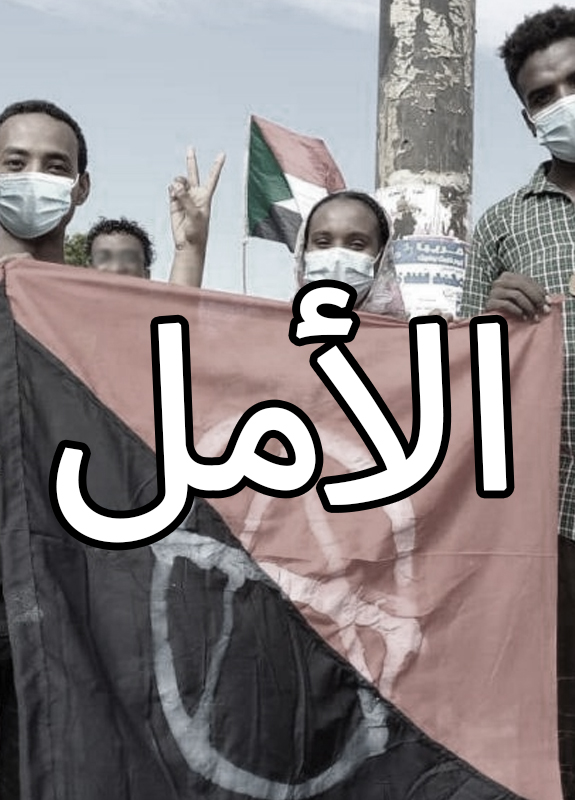
The Anarchist Group in Sudan working with CNT-AIT, have a newsletter publication, called Al Amal. It’s name in English is HOPE. This is the spread of it’s 6th issue and we will be sharing it in full from here on. .PDF files available at the bottom. Further issues can be found on the CNT-AIT website here.
The war in Sudan has now entered its third year …
The war in Sudan has now entered its third year, with no end in sight. This war was planned as early as 2019, as the generals of blood themselves admitted, stating that its timing had been set back then, but was delayed due to incomplete preparations. What a horrifying reality.
This state has always been one that plans and orchestrates internal wars, suppresses freedoms by every possible means, and perpetuates continuous brutal violence. This regime, which carries out systematic arrests, organized torture in so-called “ghost houses,” and extrajudicial killings, now stands fully exposed before the revolutionary masses.
The Rapid Support Forces are not separate from this regime; they are its product—an extension of its brutality and savagery. All the crimes committed, including ethnic cleansing and genocide, are a direct result of policies carried out under the protection of this regime.
Today, after the destruction of Khartoum, Wad Madani, El Fasher, El Geneina, Zalingei, El Nahud, El Dinder, and Omdurman—and with ongoing sieges on Dilling, El Obeid, Kadugli, and other areas—millions of Sudanese have been displaced, and healthcare and education systems have completely collapsed.
Three years have been enough to tear apart the already fragile social fabric, fueling racism and intensifying tribal divisions to a dangerous degree. Three years in which the people have been shocked by the brutality of this regime and the consequences of its policies, to the point that no conscious person can fail to recognize that this is among the worst regimes in the world.
And now, eight years after the revolution that demanded the fulfilment of the people’s aspirations, revolutionaries and comrades remain committed to their revolutionary project— to uproot authoritarian systems from their very foundations.
We, having lost comrades, revolutionaries, friends, brothers, and sons along this difficult and complex path, affirm that we will continue forward until we achieve our goals and realize our aspirations for freedom.
Long live the revolution !
Down with the regime !
The Anarchist Group in Sudan
Disclaimer: currently the Sudan anarchist gathering do not have any facebook page. We are not liable for the information published on Facebook on our behalf.
The war in Sudan is still ongoing, and it is also increasingly clear that it is an imperialist war supported internationally. Chad and Libya have become major hubs for mobilizing and recruiting Janjaweed forces, while Ethiopia has entered the conflict by attacking the Blue Nile region—areas that are new to this war.
This war has affected all parts of Sudan. Every day, thousands of vulnerable Sudanese people are displaced, left facing death without services, food, healthcare, or mercy. We continue to witness daily, severe violations in Darfur and Kordofan, and now in the Blue Nile as well, which signals that the conflict is unlikely to end anytime soon.
This meaningless war is one aimed at destroying the people—killing them, brutalizing them, and demolishing their resources. The war today is not merely a political or military conflict; it is a devastating economic war. Securing even the most basic necessities has become a real struggle, even for those living far from the frontlines. The targeting of power stations has led to consecutive agricultural failures, destroying farmers’ reserves of grain and strategic crops, and devastating small farmers’ livelihoods and projects.
In wars waged by the state itself, the ultimate losers are always the people. But the Janjaweed war on Sudan today, as is evident, is a war aimed at dismantling indigenous communities and completely displacing them.
With the spread of dengue fever and deadly diseases in Sudan, Anarchist Group in Soudan launch a call to solidarity
With the spread of dengue fever and deadly diseases in Sudan, obtaining medicine has become extremely difficult due to the collapse of the healthcare system. The shortage of medical staff and the destruction of 70 percent of hospitals have exposed millions of children, women, and vulnerable people to death in numbers greater than those caused directly by this catastrophic war.
The anarchist group in Sudan calls on you to support a fundraising campaign to provide life-saving medicines such as paracetamol, antibiotics, Flagyl, and IV fluids.
As we struggle to end this war, we also struggle to lessen its impact on us and on our people.
Support your comrades in Sudan.
The Anarchist Group in Sudan
To cooperate to the solidarity fund you can use our paypal platform https://www.paypal.com/paypalme/cntait1
To contact us : contact@cnt-ait.info
Blue Nile Events and the Rise of the Partition Plan Through Proxy War
If the plan from the very beginning was to end with the second partition of Sudan, then why is the same scenario being repeated, killing thousands of Sudanese people every day in a random yet systematic way? Those who do not die from war may die from hunger or disease.
Sudan, a country that occupies a strategic position in the routes of human trafficking, drugs, and weapons, seems as though it has been condemned to hell forever. The current war has become a human grinder that has drawn mercenaries from all neighbouring countries.
It is noticeable that the movement of irregular migrants has declined significantly in the western desert, and perhaps this phenomenon is connected to the ongoing war. Under capitalism, even the most unethical possibilities seem entirely possible.
Opening a new front in Ethiopia to pull in Ethiopians, in Dilling to pull in Southerners, and in western Sudan to recruit mercenaries from the Central African Republic, Niger, Chad, and Libya, is nothing more than an accelerated process of human depletion. In Africa, people have become cheaper to the state than livestock, and that is why this project continues in the region.
Sudan’s vast territory and diverse geography make it an ideal battlefield for wars fueled by leftover weapons. DshK machine guns, medium weapons, and crude artillery no longer have much of a market in modern warfare, despite the existence of huge quantities manufactured around the world that need an environment in which they can be used, in exchange for gold, raw materials, ports, strategic bases, and plans for domination over peoples.
The irony is that Sudanese people are among the largest gold producers in Africa, among the largest importers of weapons, and among the largest exporters of livestock. Yet a kilogram of meat costs the equivalent of 13 dollars, while a worker earns no more than 9 dollars for 12 hours of labor. This reality leaves the majority impoverished and pushes many toward war and military camps in exchange for salaries that barely cover their most basic needs.
What comes together in Sudan’s crisis is ignorance, devotion to authority, and hatred of it at the same time, which points to a very deep propaganda machine that will require many years of work to uproot from people’s minds.
Permanent work, organized struggle, and continuous political education are the real keys to solving these crises. What cannot be achieved through knowledge cannot be achieved through force.
Companions of AGS
May Day
May 1st is not a commemoration of a victory, but rather a symbol of old wounds that have not yet healed.
We cannot consider it a holiday for the working class as it has become today: fearful, hesitant, or even traitorous.
True rebellion is not confined to a particular class or location. It infiltrates, erupts, and appears from where we least expect: a simple worker, a homeless person without papers, a mother challenging poverty, a young man burning with longing for a justice he does not know its form.
Today, many workers defend their masters, and many choose obedience over revolt. This is not the end of the road, but rather a sign that the spark is no longer limited to a single place or name.
May 1st, then, is not a sanctification of a class, but a reminder that the desire for liberation is still breathing beneath the ashes, awaiting new bodies, new voices, and uncontainable anger.
Rebellion does not die; it only changes its features.
Thank you for following and caring
El Tunes